
How to Hire an AI Developer: A Complete Hiring Guide
Every organization exploring AI right now is running into the same wall: the internal team that could evaluate, hire, and manage an AI developer doesn’t exist yet, because AI expertise is exactly the gap the organization is trying to fill. Learning how to hire AI developers while you are simultaneously trying to figure out what “good” AI talent even looks like is a genuinely difficult position to be in – and it’s why so many AI hiring decisions get made on resume keywords and certificate badges rather than evidence of real, shipped work.
This guide covers how to hire AI developers with actual production experience, the different categories of AI talent you might need – generative AI developers, gen AI developers, remote AI developers, or AI/ML engineers – and the practical vetting process that separates candidates who can build a real system from those who can only describe one.
According to SPV Consulting’s approach to AI talent, drawn from placing AI and ML professionals alongside SNP-certified SAP consultants for manufacturing, pharmaceutical, and food and beverage clients, the organizations that hire well are the ones that define the problem before they define the job title.
Why Hiring AI Developers Is Different From Hiring General Software Engineers
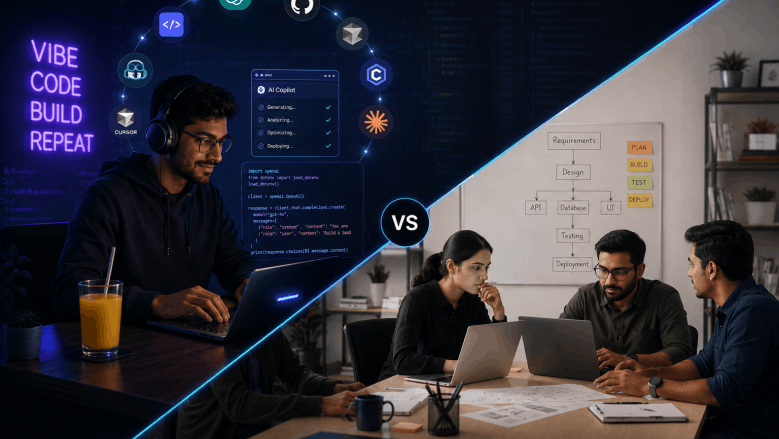
Before covering how to hire AI developers specifically, it’s worth understanding why this hiring process differs meaningfully from filling a standard software engineering role – a distinction that shapes every decision covered in this how to hire AI developers guide.
The skill category is broader than the job title suggest
“AI developer” can mean someone who fine-tunes large language models, someone who builds classical machine learning pipelines, someone who wires together generative AI APIs into an application, or someone who designs autonomous agentic systems – four genuinely different skill sets that a single job posting often blurs together.
Production experience is rarer than certification
A large number of candidates have completed online AI courses or built portfolio projects using publicly available datasets. Far fewer have taken a model or an AI system through the full production lifecycle – handling real data quality problems, integration constraints with existing business systems, and the governance requirements that come with deploying AI in a regulated or enterprise environment.
The field moves fast enough that resume keywords go stale quickly
Generative AI and agentic AI tooling has changed substantially even within the past two years. A candidate’s resume listing “AI experience” from three years ago may reflect an entirely different technical landscape than what your project actually requires today.
What Are the Different Types of AI Developers You Can Hire?
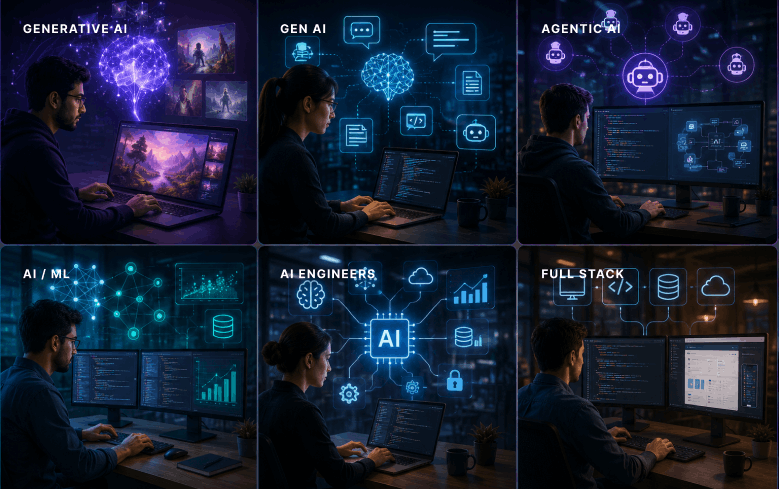
Understanding what you’re actually looking for is the first step in learning how to hire AI developers effectively, since “AI developer” covers several distinct specializations.
SPV Consulting’s IT recruitment services team screens candidates against each of these categories separately, rather than treating “AI developer” as a single undifferentiated skill set.
1.
Generative AI developers
They build systems using large language models and generative models – chatbots, content generation tools, code generation assistants, and applications that produce novel text, images, or other content based on learned patterns. If your project involves an LLM-powered feature, you are looking to hire generative AI developers specifically, not a general AI/ML engineer. Organizations that hire generative AI developers should expect to screen for prompt engineering skill, retrieval-augmented generation experience, and hands-on work with major LLM providers.
2.
Gen AI developers
They are largely used interchangeably with generative AI developers in job postings and hiring searches – the same skill set, shorter phrasing. Organizations searching to hire gen AI developers are typically looking for the same production LLM integration and prompt engineering experience as those searching for generative AI talent. Whether a job posting says hire gen AI developers or hire generative AI developers, the underlying technical bar should be identical.
3.
Agentic AI developers
They specialize in building autonomous or semi-autonomous AI agents – systems that can plan, take multi-step actions, call tools and APIs, and operate with some degree of independence toward a defined goal, rather than responding to a single prompt and stopping. This is one of the fastest-growing and most specialized categories of AI talent, and genuine agentic AI development experience is still relatively scarce.
4.
AI/ML developers
They (also searched as AI ML developers, or AI and machine learning developers) cover the broader discipline of building, training, and deploying machine learning models – predictive models, classification systems, recommendation engines, and computer vision – as distinct from the LLM-specific work generative AI developers do.
5.
AI engineers
They typically sit closer to production infrastructure – MLOps, model deployment pipelines, monitoring, and the engineering discipline required to keep AI systems reliably running in production rather than the initial model development itself. Organizations that hire AI engineers specifically are usually further along in their AI maturity, already past initial model development and focused on scaling and operationalizing what they’ve built.
How to Hire AI Developers: A Step-by-Step Process
Step 1: Define the Problem Before Writing the Job Description
The most common mistake in AI hiring is writing a job posting for “an AI developer” before defining what the AI needs to actually do. A generative AI chatbot project, a predictive maintenance model, and an agentic workflow automation system each require meaningfully different technical backgrounds.
Before you can figure out how to hire AI developers for your specific need, define the business problem, the type of AI system required to solve it, and the systems it needs to integrate with – this single step determines how to hire AI developers correctly for everything that follows.
Step 2: Decide Whether You Need In-House, Remote, or Offshore Talent
Organizations looking to hire remote AI developers gain access to a significantly larger talent pool than a local-only search allows, and remote-first hiring has become the default for most AI roles given how concentrated AI talent is in specific geographic hubs.
For many organizations, deciding to hire remote AI developers is less a compromise than a deliberate strategy to access the strongest available candidates regardless of location. Some organizations specifically choose to hire offshore AI developers to manage cost while accessing strong technical talent pools in markets with deep AI education and delivery infrastructure.
The right choice depends on your budget, your need for real-time collaboration, and whether the work involves sensitive data requiring stricter access controls.
Step 3: Choose Your Engagement Model
Whether you are looking to hire ai developers for project-based work with a defined scope and end date, or building a dedicated AI capability that needs to persist and evolve over time, the engagement model shapes everything from contract structure to how you evaluate candidates.
SPV Consulting’s IT outsourcing services and staffing models support both approaches. Project-based hiring suits a defined deliverable – a specific model, a specific integration. Dedicated hiring suits organizations building an ongoing AI capability that needs institutional knowledge to accumulate over time rather than resetting with every new engagement.
Step 4: Screen for Production Experience, Not Just Technical Knowledge
Technical interviews for AI roles should probe for evidence of real production work: What happened when the model’s performance degraded after deployment? How did they handle a data quality issue that surfaced only after the system went live? What tradeoffs did they make between model accuracy and inference speed for a real business constraint?
Candidates with genuine production experience answer these questions with specific, concrete detail. Candidates without it tend to answer in generalities.
Step 5: Validate With a Practical Assessment
A take-home or paired technical exercise reflecting a scaled-down version of your actual problem reveals far more than a resume or a certification list. This is where the difference between candidates who have built production AI systems and those who have only completed structured courses becomes clear – and where the evaluation criteria differ meaningfully for generative AI, agentic AI, and classical AI/ML roles.
Step 6: Confirm Integration and Governance Fit
For organizations running existing enterprise systems – SAP, CRM platforms, data warehouses – the strongest AI developers understand not just how to build a model, but how to connect it to the operational systems where decisions actually get made and executed.
This is a step many generic guides on how to hire AI developers skip entirely, even though it’s often where AI investments succeed or stall.
SPV Consulting’s SAP staffing services team and our guide on best practices for AI-driven product development cover this integration challenge in more depth. This step is where many technically strong AI candidates are eliminated: they can build a model, but they have never had to make it operate reliably inside a live enterprise environment with existing governance and compliance requirements.

Where to Find AI Developers for Hire
Organizations searching for where to find AI developers for hire – and figuring out how to hire AI developers without an existing internal AI team to lean on – generally have four realistic paths, each with a different tradeoff between cost, vetting depth, and speed.
Dedicated AI staffing and recruiting partners
They provide pre-vetted candidates matched to your specific technical requirements, typically with faster time-to-hire than an internal search and significantly deeper technical screening than an open marketplace, at a cost premium reflecting that vetting work. SPV Consulting’s IT staffing services operate on exactly this model for AI and broader technology roles.
Freelance marketplaces
They (Upwork, Toptal-style platforms) offer the fastest access to a wide pool of AI developers for hire, at the cost of highly variable vetting rigor – some platforms screen extensively, others allow essentially open registration.
Direct hire through internal recruiting
They give full organizational control over the hiring process but requires internal technical expertise to evaluate AI-specific skills accurately – a genuine catch-22 for organizations hiring their first AI developer without existing AI leadership in place to assess candidates.
Platform-specific developer communities
They have emerged around specific AI-assisted development tools. Organizations searching for where to hire Bolt AI developers or where to hire Replit AI developers are typically looking for developers experienced with these specific AI-powered coding platforms – Bolt.new and Replit’s AI agent – for rapid prototyping and AI-assisted application development.
These are typically found through the platforms’ own community hubs, general freelance marketplaces filtered by tool experience, or staffing partners with developers cross-trained on modern AI-assisted development tooling.
How to Hire Python Developers for AI Work Specifically
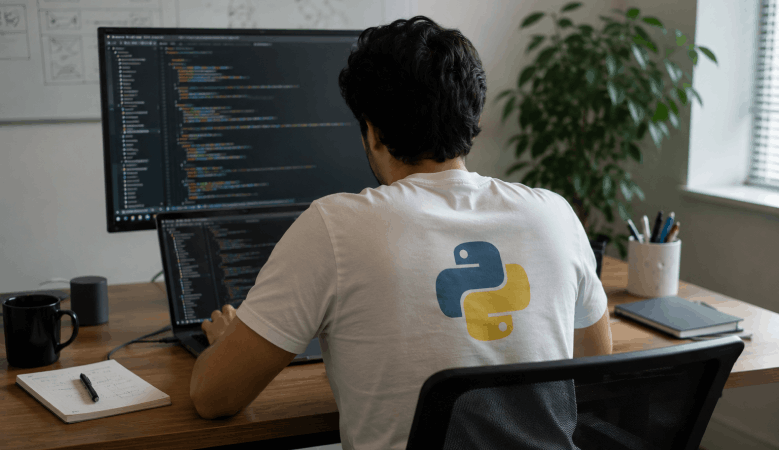
Python remains the dominant language for AI and machine learning development, and organizations researching how to hire Python developers for AI projects should screen for a specific combination of skills beyond general Python proficiency: experience with ML and AI frameworks (PyTorch, TensorFlow, scikit-learn, or LLM orchestration frameworks like LangChain), data manipulation libraries (pandas, NumPy), and familiarity with the deployment and MLOps tooling that takes a Python-based model from a notebook into production.
General Python engineering skill alone does not guarantee AI development competency – the ability to write clean, efficient Python code is necessary but not sufficient for AI-specific work, which also requires understanding of model behavior, data pipeline design, and the specific failure modes that appear in AI systems but not in traditional software applications.
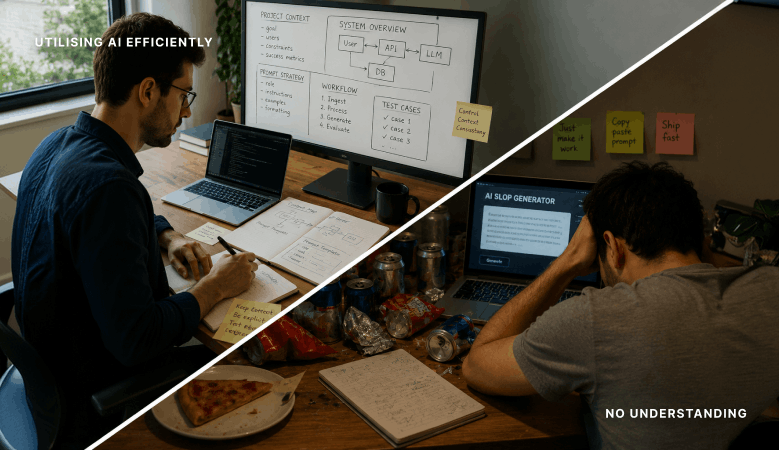
Vetting AI Developers: What Actually Separates Strong Candidates From Weak Ones
Strong signal: they can explain a production failure and how they fixed it
Every experienced AI developer has a story about a model or system that broke in an unexpected way after deployment. Candidates who can describe this in specific detail – what broke, how they diagnosed it, what they changed – demonstrate real production experience.
Weak signal: portfolio projects built entirely on clean, public datasets
Real business data is messy. A portfolio built exclusively on well-known, pre-cleaned public datasets (MNIST, well-known Kaggle competitions) does not demonstrate the data-wrangling and edge-case-handling skill that production AI work actually requires.
Strong signal: they ask about your data and integration constraints before proposing a solution
Candidates who immediately propose a specific model architecture without first asking what data you have, how clean it is, and what systems the output needs to connect to are demonstrating theoretical knowledge over practical judgment.
Weak signal: certification-heavy resumes with limited shipped work
Certifications demonstrate structured learning, which has value, but a resume dominated by certification badges with limited evidence of deployed, working systems should prompt deeper questioning about actual hands-on experience.
Strong signal: they can discuss model monitoring and drift
AI systems degrade over time as real-world data shifts away from training data patterns. Candidates who proactively discuss how they monitor deployed models for this drift demonstrate an understanding that goes beyond initial model-building into genuine operational AI competency.

Common Mistakes When Hiring AI Developers
Writing one generic "AI developer" job posting for a role that actually requires a specific specialization
A generative AI chatbot project and a predictive maintenance model require different skill sets. Posting a generic role attracts a mismatched candidate pool and produces poor-fit hires.
Over-indexing on academic credentials over production experience
A strong academic AI background is valuable but does not substitute for evidence of building and operating real production systems, particularly for roles focused on deployment and integration rather than research.
Skipping a practical technical assessment
Resume and interview conversation alone frequently fail to reveal genuine technical depth in AI-specific work. A scaled-down practical exercise reflecting your actual problem reveals far more than conversation alone.
Ignoring integration and governance fit
Especially for enterprise environments, an AI developer who can build a strong model but cannot work within existing data governance, security, and system integration requirements creates a capability gap that surfaces only after hiring.
Underestimating the value of a specialized staffing partner for a first AI hire
Organizations without existing AI leadership often struggle to evaluate AI-specific technical depth accurately during their first AI hire, leading to costly mis-hires that a properly vetted staffing partner could have prevented.
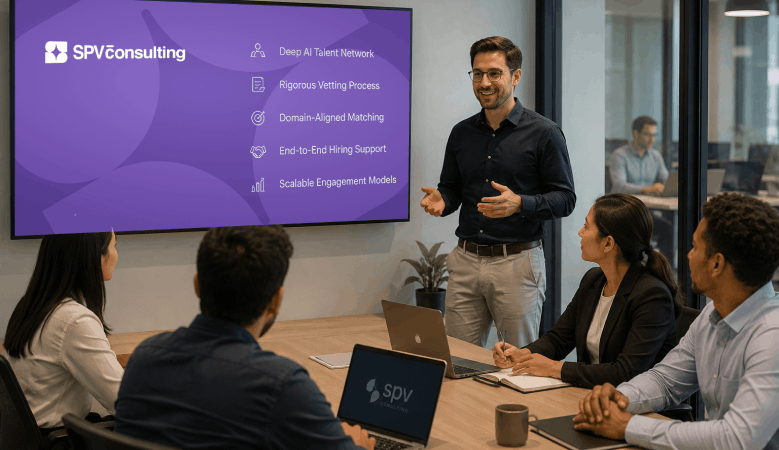
How SPV Consulting Helps Organizations Hire AI Developers
If you’re still working out how to hire AI developers for your specific environment, SPV Consulting places AI and ML professionals – generative AI developers, agentic AI specialists, AI/ML engineers, and MLOps engineers – with a technical screening process that goes beyond certifications and portfolio review, evaluating for genuine production experience and the specific ability to connect AI systems to the operational environments where they need to run. Organizations that hire AI engineers or hire remote AI developers through SPV Consulting get access to the same rigorous vetting standard regardless of role specialization.
Screening built around production evidence, not resume keywords
SPV Consulting’s technical vetting process for AI developers probes specifically for the production experience signals covered in this guide – real deployment stories, data quality problem-solving, and monitoring discipline – not just credential verification.
SAP and enterprise integration depth
For organizations running SAP, SPV Consulting’s combination of AI talent and SNP-certified SAP expertise means placed AI developers understand how to connect AI systems to SAP data structures, workflows, and governance requirements – a combination most generalist AI staffing firms and freelance marketplaces cannot offer.
Flexible engagement models
Whether an organization needs to hire dedicated AI developers for an ongoing capability, hire AI developers for project work with a defined scope, or add remote AI developers to an existing internal team, SPV Consulting matches the engagement structure to the actual need rather than defaulting to a single model.
Industry-specific AI talent
For SPV Consulting’s AI placements bring industry context alongside technical AI skill – understanding production environments, regulatory constraints, and the operational realities that shape how AI actually gets deployed in these sectors.
Ready to hire AI developers for your team?
Contact SPV Consulting to discuss your specific AI hiring needs, whether that’s a single generative AI developer for a defined project or a dedicated AI/ML team built for the long term.
min read
TOPICS
- Why Hiring AI Developers Is Different From Hiring General Software Engineers
- What Are the Different Types of AI Developers You Can Hire?
- How to Hire AI Developers: A Step-by-Step Process
- Where to Find AI Developers for Hire
- How to Hire Python Developers for AI Work Specifically
- Vetting AI Developers: What Actually Separates Strong Candidates From Weak Ones
- Common Mistakes When Hiring AI Developers
- How SPV Consulting Helps Organizations Hire AI Developers
Frequently Asked Questions
How do I hire AI developers?
Learning how to hire AI developers effectively starts with defining the specific business problem and AI system type required (generative AI, agentic AI, or classical AI/ML), deciding on engagement model and location (in-house, remote, or offshore), screening candidates specifically for production experience rather than certifications alone, validating with a practical technical assessment reflecting your actual problem, and confirming the candidate’s ability to integrate AI output with your existing systems and governance requirements.
What is the difference between hiring generative AI developers and AI/ML developers?
Generative AI developers specialize in building systems using large language models and generative models – chatbots, content generation, and LLM-powered applications. AI/ML developers cover the broader discipline of building and deploying machine learning models, including predictive models, classification systems, and computer vision, which is distinct from LLM-specific generative AI work.
Where can I find AI developers for hire?
AI developers for hire can be found through freelance marketplaces offering fast access but variable vetting quality, dedicated AI staffing and recruiting partners offering pre-vetted candidates with deeper technical screening, direct internal recruiting requiring in-house AI expertise to evaluate candidates, and platform-specific communities for specialized tools.
How much does it cost to hire AI developers?
Cost varies significantly based on specialization, seniority, engagement model, and location. Generative AI and agentic AI specialists, given current scarcity in these emerging fields, typically command a premium over general AI/ML roles. Offshore and remote AI developers generally offer lower rates than onshore hires, though the gap has narrowed as AI talent demand has grown globally.
How do I hire Python developers for AI projects specifically?
When hiring Python developers for AI work, screen beyond general Python proficiency for specific experience with AI and ML frameworks (PyTorch, TensorFlow, scikit-learn, or LLM orchestration tools), data manipulation libraries, and MLOps or deployment tooling. General Python skill is necessary but not sufficient – AI-specific work also requires understanding of model behavior and data pipeline design.
Should I hire dedicated AI developers or work with AI developers for hire on a project basis?
The right choice depends on whether your AI need is a defined, bounded deliverable or an ongoing capability. Project-based engagement suits a specific model or integration with a clear end date. Hiring dedicated AI developers suits organizations building AI as a persistent, evolving capability where institutional knowledge and continuity matter over time.
What questions should I ask when interviewing AI developer candidates?
Ask candidates to describe a specific production failure they encountered and how they diagnosed and resolved it, what data quality challenges they have handled in real projects, how they monitor deployed models for performance degradation over time, and what tradeoffs they have made between model accuracy and other constraints like inference speed or cost in a real business context.
Is it better to hire remote AI developers or local AI developers?
Hiring remote AI developers significantly expands the available talent pool given how concentrated AI expertise is in specific markets, and has become standard practice for most AI hiring. Local hiring may be preferable when the work requires frequent in-person collaboration, handling of highly sensitive on-premise data, or close, continuous integration with a physically co-located team.