
Comparing SAP BTP and SAP CPI: A Complete Guide
Ask an SAP architect to explain the difference between SAP BTP vs SAP CPI, and you will often get an answer that raises more questions than it resolves. That confusion is not a knowledge gap on the reader’s part – it reflects genuinely inconsistent terminology across SAP’s own documentation, consulting content, and job postings, where BTP vs CPI is sometimes presented as a comparison between two competing technologies and sometimes as if SAP BTP and CPI are the same thing.
They are neither. To understand SAP CPI vs BTP, you first need to recognize that SAP BTP is a broader cloud platform, while SAP CPI is now commonly referred to as SAP Cloud Integration is an integration capability within SAP’s Integration Suite.
Getting this distinction wrong leads to real consequences: mis-scoped integration projects, job descriptions asking for skills that don’t map to any actual SAP role, and architecture decisions built on a false premise. Rather than asking whether to choose BTP or CPI, organizations should understand how SAP BTP and CPI work together, where Cloud Integration fits within the BTP ecosystem, and which integration capabilities are actually required for a given project.
This guide covers exactly how SAP BTP and SAP CPI relate, the SAP BTP Integration Suite architecture that CPI sits inside, the SAP BTP CPI cockpit interface professionals work in daily, and the practical decision points that matter when scoping an SAP integration project. According to SPV Consulting’s approach, drawn from SNP-certified engagements building SAP integration architecture for manufacturing, pharmaceutical, and food and beverage clients, most integration project delays trace back to this exact confusion happening at the requirements stage, before a single line of iFlow logic gets built.
SAP CPI Vs SAP BTP Explained
The difference between SAP CPI vs BTP becomes much clearer once you understand that they operate at different levels of the SAP technology stack.

What Is SAP BTP?
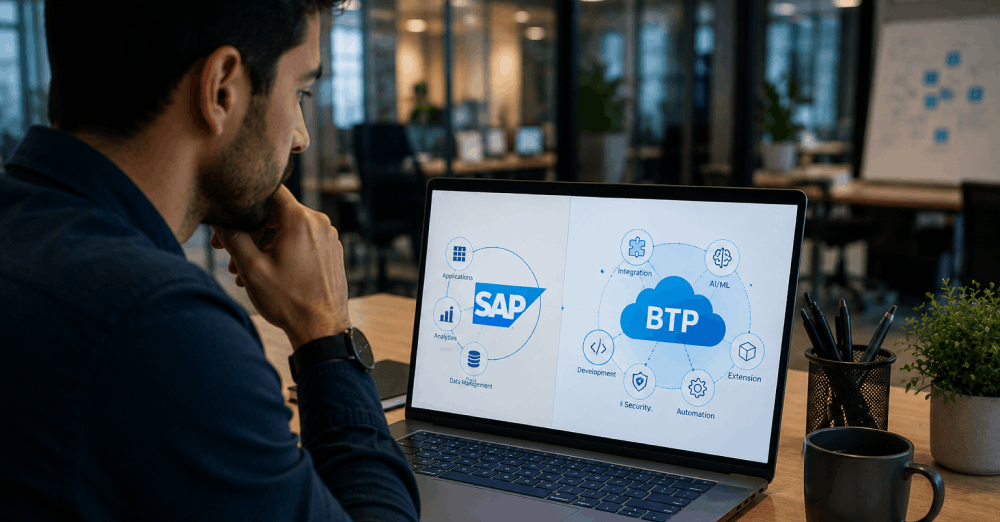
SAP BTP (Business Technology Platform) is SAP’s unified platform-as-a-service (PaaS) offering, combining database and data management, analytics, application development, automation, and integration capabilities into a single cloud environment. SAP BTP is the foundation layer – the platform SAP customers use to extend, integrate, and build on top of their core SAP systems (S/4HANA, SuccessFactors, Ariba, and others) without disrupting the stability of those core systems.
SAP BTP is organized into several capability areas: Database and Data Management (built on SAP HANA Cloud), Application Development (including SAP Build and the ABAP Cloud environment), Automation (SAP Build Process Automation), Analytics (SAP Analytics Cloud), AI capabilities (including SAP Joule), and Integration – delivered through SAP Integration Suite. Comparing SAP BTP vs SAP CPI without understanding this structure is where most of the confusion in the market actually originates.
What Is SAP CPI?
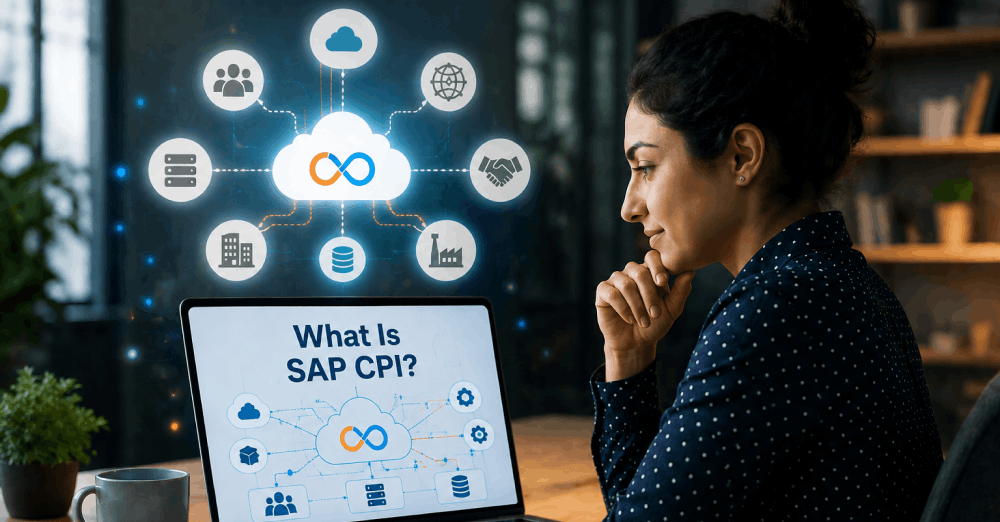
SAP CPI (Cloud Platform Integration, now more precisely referred to as SAP Cloud Integration) is the runtime engine and design environment for building integration flows (iFlows) that connect SAP and non-SAP systems – cloud-to-cloud, cloud-to-on-premise, and hybrid landscapes. SAP CPI handles message routing, data transformation, protocol conversion, and the orchestration logic that moves data reliably between systems.
SAP CPI supports a wide range of integration patterns: application-to-application (A2A), business-to-business (B2B), IoT integration, and data migration scenarios. It ships with pre-built integration content packages for common SAP-to-SAP and SAP-to-third-party scenarios, which significantly accelerates integration development compared to building every connection from scratch.
Is SAP CPI Part of SAP BTP? The Direct Answer
Yes. SAP CPI is part of SAP BTP – specifically, it is the core integration runtime within SAP BTP Integration Suite, which is itself one of the capability services available inside the broader BTP platform. SAP CPI is not a separate product you purchase or deploy independently of BTP; it runs on BTP infrastructure and is provisioned as a service within a BTP subaccount.
The confusion around whether SAP CPI is part of SAP BTP stems largely from naming history. SAP CPI began as SAP HANA Cloud Integration (HCI), was renamed SAP Cloud Platform Integration when SAP Cloud Platform launched, and was renamed again to SAP Cloud Integration when SAP Cloud Platform was rebranded as SAP Business Technology Platform in 2021. Job postings, older documentation, and training content often still use “CPI” as shorthand, even though the official product name has changed – which is exactly why so many professionals still search for “SAP BTP CPI” as if it were a single combined product name rather than a platform-and-capability relationship.
SAP BTP Integration Suite and SAP CPI: How They Actually Fit Together
SAP BTP Integration Suite is the umbrella integration service within BTP, and it bundles several distinct tools, of which CPI is the primary one:
SAP Cloud Integration (CPI)
The iFlow design and runtime engine for building and executing integration scenarios.
API Management
Governs API creation, publishing, security policies, rate limiting, and the developer portal experience for exposing APIs to internal and external consumers.
Integration Advisor
Uses machine learning to accelerate B2B mapping development between different message formats and standards.
Event Mesh
Enables event-driven architecture, allowing systems to publish and subscribe to business events in real time rather than relying purely on point-to-point integration calls.
Cloud Connector
A lightweight on-premise agent that enables secure connectivity between BTP cloud services and on-premise systems without opening inbound firewall ports.
Understanding SAP BTP Integration Suite and CPI as a bundled offering – not competing tools – is the foundation for scoping any SAP integration project correctly. When an organization licenses SAP BTP Integration Suite, they are licensing access to CPI plus this surrounding toolset, priced and provisioned together rather than as separate purchases.
SAP BTP vs SAP CPI: A Direct Comparison
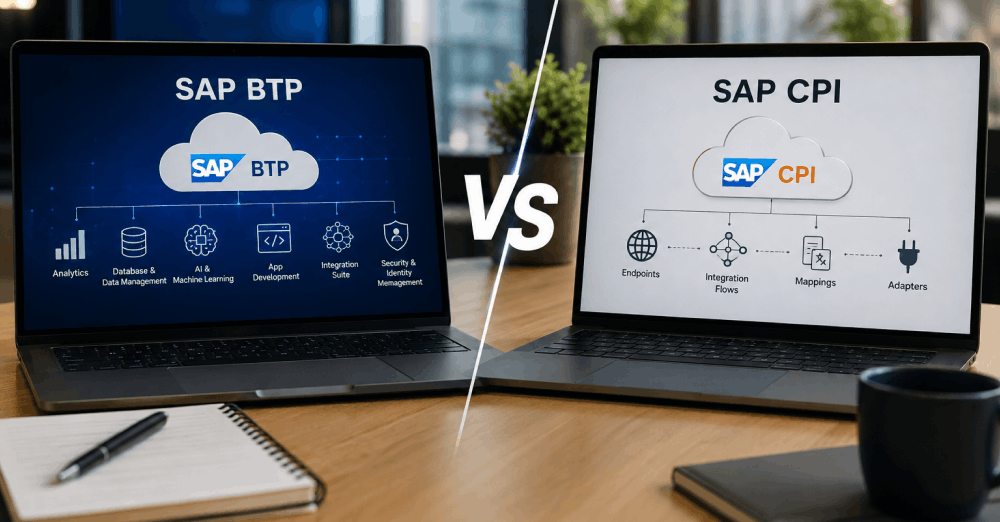
Since SAP CPI is a component within BTP rather than a competing alternative, a fair comparison of SAP BTP vs SAP CPI is really a comparison of platform versus capability – useful for understanding scope, not for choosing between them. The table below breaks down SAP BTP vs SAP CPI across the dimensions that matter most when comparing SAP BTP and SAP CPI for project scoping, hiring, or training purposes.
The table below highlights the practical differences between SAP CPI vs SAP BTP.
Aspect
SAP BTP
Best For
What it is
The full platform-as-a-service environment
The integration runtime within BTP Integration Suite
Scope
Database, application development, automation, analytics, AI, and integration
Integration flow design, execution, and monitoring specifically
Relationship
The platform CPI runs on
A service provisioned within a BTP subaccount
Who uses it
Architects, developers, and administrators across multiple disciplines
Integration developers and architects specifically
Licensing
Broader platform subscription covering multiple capability areas
Included within SAP BTP Integration Suite licensing
Skill focus
Platform administration, service provisioning, cross-capability architecture
iFlow development, message mapping, adapter configuration
SAP BTP vs CPI: What Is the Practical Difference?
The simplest way to understand BTP vs CPI is to think about the level at which each technology operates.
The practical takeaway: an organization does not choose between SAP BTP and SAP CPI. An organization licenses SAP BTP as the platform, then provisions Integration Suite (which includes CPI) as one of the capability services running on that platform, alongside whatever other BTP services – database, application development, automation – the organization also needs.
SAP BTP vs CPI: How the Same Question Gets Asked Differently
The underlying question behind SAP BTP vs CPI, SAP CPI vs BTP, SAP BTP CPI, and SAP CPI BTP is always the same one, just phrased differently depending on who is asking and why.
A hiring manager writing a job posting typically searches for SAP btp CPI as a combined skill phrase, treating it as shorthand for “integration developer experience on SAP’s cloud platform.”
A developer researching their next role often searches SAP CPI vs BTP specifically to understand whether a listed position wants deep CPI development skill or broader BTP platform administration experience.
A project sponsor scoping a new initiative might search SAP BTP vs CPI while trying to determine whether their organization needs a full BTP platform engagement or a narrower SAP BTP integration suite CPI implementation focused purely on connecting two existing systems.
None of these framings are wrong, and none of them describe two competing products. SAP CPI BTP, SAP BTP vs sap CPI, and SAP CPI vs BTP are all different ways of asking the same underlying question: how does the integration runtime relate to the platform it runs on. Whether someone types SAP BTP vs CPI into a search bar or asks a colleague to explain SAP CPI BTP during onboarding, the answer, regardless of phrasing, stays consistent – CPI is the integration capability; BTP is the platform hosting it.
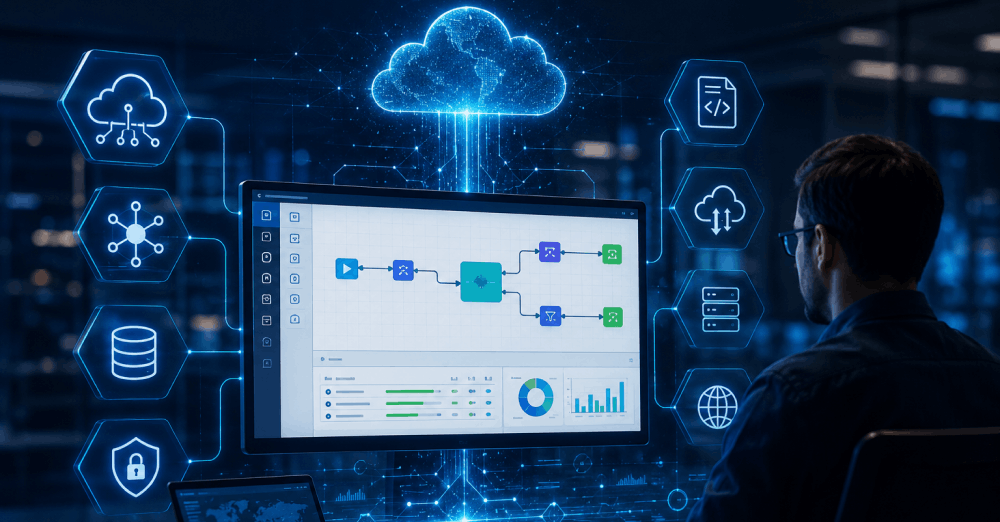
The SAP BTP CPI Cockpit: Where Integration Work Actually Happens
The SAP BTP CPI cockpit – sometimes referred to as the SAP CPI BTP cockpit – is the web-based administrative and monitoring interface where integration developers and administrators manage iFlows day to day – deploying integration packages, monitoring message processing, troubleshooting failed messages, and managing security material like credentials and certificates.
In practical terms, the cockpit is where teams move beyond the theory of SAP CPI vs BTP and actually work with the integration service. Developers can deploy integration packages, monitor message processing, troubleshoot failed messages, and manage security material such as credentials and certificates.
Within the SAP BTP CPI cockpit, integration teams typically work across several functional areas: the Design area for building and editing iFlows using the graphical modeling interface, the Monitor area for tracking message processing status, viewing error logs, and reprocessing failed messages, the Manage Security area for handling credentials, certificates, and OAuth configuration required for secure connectivity, and the Integration Content area for browsing and deploying pre-built content packages from SAP’s integration content catalog.
For organizations evaluating integration talent or training programs, familiarity with the SAP BTP CPI cockpit specifically – not just theoretical knowledge of integration concepts – is one of the clearest signals of genuine hands-on experience versus certification-only knowledge.

Why This Matters: The Real Business Problem Behind the Confusion
Organizations rarely search for “SAP BTP vs SAP CPI” out of academic curiosity. The confusion surfaces at specific, costly moments in a project lifecycle.Comparing SAP BTP and SAP CPI at these stages helps organizations distinguish between broader BTP platform requirements and the specific integration capabilities they actually need.
During integration project scoping
When a project team scopes “SAP BTP work” without specifying which BTP capability is actually needed, budget and timeline estimates become unreliable. An integration-only project needs Integration Suite provisioning and CPI development effort – not a full BTP platform buildout across every capability area.
During talent acquisition
Job postings that ask for “SAP BTP CPI experience” as if it were one skill set conflate two different things: BTP platform administration knowledge and CPI-specific integration development skill. A candidate strong in iFlow development may have limited exposure to broader BTP service provisioning, and vice versa – hiring managers who don’t understand the distinction end up screening candidates against the wrong criteria.
During vendor and consulting engagement scoping
Organizations that request “BTP consulting” when they actually need CPI integration development risk engaging a consulting partner scoped for the wrong depth of work – either over-scoped and over-priced, or under-scoped and unable to deliver the specific integration expertise required.Comparing SAP BTP and SAP CPI based on the actual project requirements can prevent both situations.
During training and certification planning
Professionals researching SAP BTP CPI training options need to know whether they are pursuing a broad BTP platform certification or an integration-specific CPI certification path, since these map to different SAP learning journeys with different prerequisite knowledge and different career outcomes.The distinction is particularly important for professionals deciding whether an SAP CPI vs SAP BTP learning path better matches their intended role.
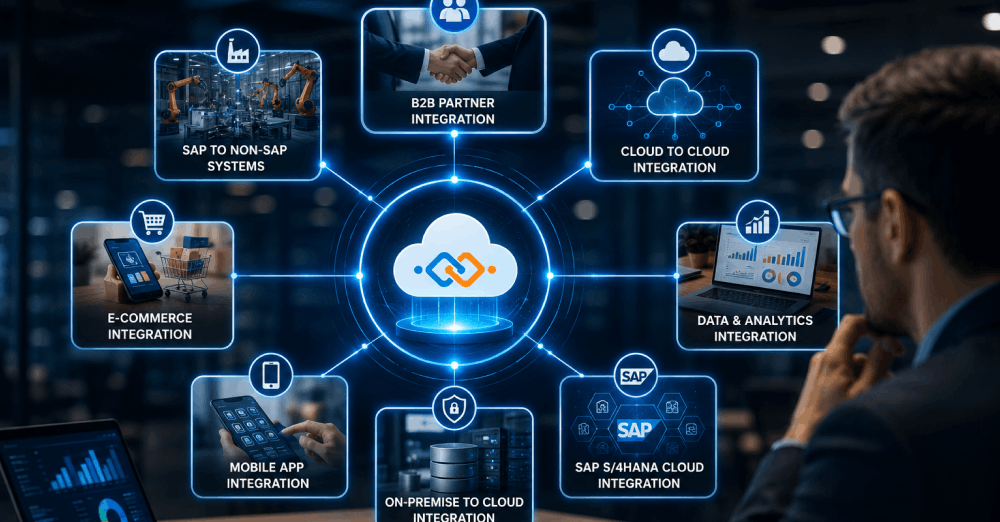
Common Integration Scenarios Where SAP CPI on BTP Delivers Value
SAP S/4HANA to third-party e-commerce integration
Order data flowing from an e-commerce platform into S/4HANA for fulfillment, with inventory and pricing data flowing back out, orchestrated through CPI iFlows running on BTP.
SuccessFactors to on-premise payroll integration
For organizations running SuccessFactors as their cloud HR system alongside an on-premise or third-party payroll system, CPI handles the secure, scheduled data synchronization between the two.
Ariba to S/4HANA procurement integration
Purchase orders, invoices, and supplier data moving between SAP Ariba and S/4HANA, using CPI’s pre-built Ariba integration content packages to accelerate deployment.
IoT sensor data integration for manufacturing
For manufacturing organizations connecting shop floor equipment and IoT sensors to SAP for production monitoring and predictive maintenance, CPI provides the integration layer between operational technology and SAP’s business systems.
B2B document exchange with trading partners
EDI, IDoc, and other B2B document formats exchanged with suppliers and customers, using CPI’s B2B integration capabilities alongside Integration Advisor for mapping development.

Three Real Scenarios Where This Distinction Matters
Scenario one: scoping a new integration project. A manufacturing client approaches SPV Consulting asking for help “with SAP BTP” to connect their S/4HANA environment to a third-party logistics provider. Comparing SAP BTP and SAP CPI at the requirements stage reveals the actual need is CPI development work within an existing Integration Suite subscription, not a broader BTP platform engagement – a distinction that changes the proposal, timeline, and team composition significantly.
Scenario two: evaluating a candidate for an integration role. A hiring manager’s job posting asks for “SAP BTP CPI experience,” and two candidates apply. One has spent three years building iFlows and can navigate the SAP CPI btp cockpit fluently but has never provisioned a BTP service from scratch. The other has broad BTP platform administration experience but limited hands-on CPI development. Here, SAP CPI vs SAP BTP becomes a genuinely practical interview question. The candidate’s ability to explain the relationship between the two technologies helps determine whether their experience actually matches the role.
Scenario three: planning a team’s skill development. An IT director budgeting for the next fiscal year needs to decide between broader SAP btp CPI training for the integration team versus a narrower SAP CPI course focused specifically on iFlow development. Understanding that these represent genuinely different learning journeys – platform administration versus integration development – prevents budget being spent on training that does not match what the team actually does day to day.

SAP BTP CPI Training and Certification Path
Professionals researching SAP BTP CPI training face the same terminology confusion that affects project scoping – training catalogs mix broad BTP platform courses with CPI-specific integration development courses, and picking the wrong starting point wastes time on prerequisite knowledge that is not actually required.
For integration developers specifically, the most direct path is SAP’s official SAP CPI course content delivered through SAP Learning Hub, covering iFlow design, adapter configuration, message mapping, and security material management within the SAP Cloud Integration environment. Whether you call it SAP BTP CPI training or simply a SAP CPI course, this path does not require completing broader SAP BTP platform administration training first – a learner can build genuine CPI competency starting from integration fundamentals directly.
For architects and administrators, SAP BTP CPI training should include broader platform content: subaccount and entitlement management, service provisioning across BTP capability areas, and how Integration Suite fits alongside BTP’s other services (application development, automation, analytics). This is a different, broader learning journey than the CPI-specific developer path.
Free and low-cost starting points include openSAP’s periodic courses on SAP Integration Suite and Cloud Integration fundamentals, and SAP’s free trial BTP account, which lets learners build and deploy actual iFlows in a live SAP BTP CPI cockpit environment rather than learning purely through video content. Hands-on practice in the cockpit – not just course completion – is what distinguishes job-ready CPI skill from certificate-only knowledge.
Certification is available through SAP’s official certification program for SAP Certified Development Associate – SAP Integration Suite, which validates CPI-specific development skill and is the credential most commonly requested in integration developer job postings, distinct from broader SAP BTP platform certifications.

Choosing Between SAP CPI and Legacy Integration Tools
Organizations still running SAP PI/PO or evaluating a move to cloud integration face a related but distinct decision from the BTP-versus-CPI question covered above: whether to migrate existing integration logic to CPI running on BTP, or continue maintaining on-premise integration tooling.
SAP has signaled continued strategic investment in SAP Cloud Integration as its primary integration runtime, while legacy on-premise tools like PI/PO receive comparatively limited ongoing enhancement. Organizations planning integration architecture for the next several years should treat CPI on BTP as the direction SAP’s own roadmap is heading, even where existing PI/PO investments continue running in parallel during a transition period.
The migration decision itself depends on factors like current integration complexity, the number of active interfaces requiring migration, in-house CPI skill availability, and whether the organization is already moving other systems (S/4HANA, SuccessFactors) to the cloud in a way that makes cloud-native integration a natural extension of that broader transformation.
How SPV Consulting Approaches SAP BTP and SAP CPI Integration Projects
SPV Consulting’s SNP-certified consultants scope SAP BTP and SAP CPI engagements based on the actual integration need, distinguishing platform provisioning work from CPI-specific integration development – a distinction that matters directly to project cost, timeline, and staffing accuracy.
Correct scoping from the start. SPV Consulting distinguishes between BTP platform provisioning needs and CPI-specific integration development work during initial requirements gathering, so clients are not paying for broader platform consulting when the actual need is integration flow development, or under-resourcing genuine platform architecture work when it is required.
Manufacturing and regulated industry integration depth. For manufacturing, pharmaceutical, and food and beverage clients, SPV Consulting’s CPI integration work frequently connects SAP S/4HANA with MES systems, IoT sensor data, and industry-specific compliance and traceability systems – integration scenarios that require both CPI technical skill and genuine understanding of the operational and regulatory context driving the integration requirement.
Talent that matches the actual role. When staffing SAP BTP and SAP CPI positions, SPV Consulting screens candidates against the specific skill set the role requires – iFlow development depth for CPI-focused roles, or broader platform architecture experience for BTP-focused roles – rather than treating “BTP CPI experience” as a single undifferentiated qualification.
min read
TOPICS
- SAP CPI Vs SAP BTP Explained
- Is SAP CPI Part of SAP BTP? The Direct Answer
- SAP BTP Integration Suite and SAP CPI: How They Actually Fit Together
- SAP BTP vs SAP CPI: A Direct Comparison
- SAP BTP vs CPI: What Is the Practical Difference?
- SAP BTP vs CPI: How the Same Question Gets Asked Differently
- The SAP BTP CPI Cockpit: Where Integration Work Actually Happens
- Why This Matters: The Real Business Problem Behind the Confusion
- Common Integration Scenarios Where SAP CPI on BTP Delivers Value
- Three Real Scenarios Where This Distinction Matters
- SAP BTP CPI Training and Certification Path
- Choosing Between SAP CPI and Legacy Integration Tools
- How SPV Consulting Approaches SAP BTP and SAP CPI Integration Projects
Frequently Asked Questions
What is the SAP BTP CPI full form?
The SAP BTP CPI full form breaks down as follows: SAP BTP stands for SAP Business Technology Platform, and SAP CPI originally stood for SAP Cloud Platform Integration, though the product is now officially referred to as SAP Cloud Integration following SAP’s 2021 rebrand of SAP Cloud Platform to SAP Business Technology Platform. “SAP BTP CPI” as a combined term reflects common industry usage rather than an official product name – it refers to SAP Cloud Integration running as a service within SAP BTP.
Is SAP CPI part of SAP BTP?
Yes, is SAP CPI part of BTP is one of the most searched questions in this space, and the direct answer is straightforward: SAP CPI is part of SAP BTP specifically as the core runtime engine within SAP BTP Integration Suite, one of the capability services available on the BTP platform. It is not a standalone product purchased or deployed separately from BTP.
What is the difference between SAP BTP Integration Suite and SAP CPI?
SAP BTP Integration Suite is the broader integration service bundle within BTP, comprising SAP Cloud Integration (CPI), API Management, Integration Advisor, Event Mesh, and Cloud Connector. SAP CPI is specifically the iFlow design and runtime engine within that bundle – the component most directly responsible for executing integration logic.
What are common SAP BTP CPI interview questions?
Common SAP BTP CPI interview questions cover iFlow design and the graphical modeling interface, message transformation techniques (including Groovy scripting and XSLT mapping), adapter configuration for different connection types (SuccessFactors, Ariba, OData, SFTP), error handling and exception subprocess design, security material management (OAuth, certificates), performance optimization for high-volume message processing, and monitoring and troubleshooting failed messages within the SAP BTP CPI cockpit. Interviewers frequently also ask candidates to explain the relationship between SAP BTP and SAP CPI directly, since this distinction reveals whether a candidate has genuine platform-level understanding or only tool-level familiarity.
Where can I find SAP BTP CPI training?
SAP offers official SAP BTP CPI training through SAP Learning Hub, including role-based learning journeys for integration developers and architects. Additional SAP CPI course options are available through SAP-authorized training partners and platforms like openSAP, which periodically offers free introductory courses on SAP Integration Suite and Cloud Integration fundamentals. For hands-on skill development, SAP provides a free trial BTP account that allows learners to build and test iFlows directly in the SAP BTP CPI cockpit rather than relying on video instruction alone.
Do I need to learn SAP BTP before learning SAP CPI, or can I start with CPI directly?
Most integration developers can start directly with SAP CPI fundamentals – iFlow design, adapters, and mapping – without first mastering the full breadth of SAP BTP’s other capability areas (application development, automation, analytics). A working understanding of BTP account and subaccount structure is useful context, but deep BTP platform administration knowledge is not a prerequisite for effective SAP CPI development work.
Is SAP CPI being replaced or renamed again?
SAP CPI (now officially SAP Cloud Integration) remains an actively developed, core component of SAP BTP Integration Suite, with SAP continuing to release regular feature updates. There is no current indication that SAP is retiring or replacing Cloud Integration – it remains SAP’s strategic cloud integration runtime, distinct from legacy tools like SAP PI/PO, which SAP has signaled will not receive the same level of continued investment.
What skills does someone need for SAP BTP CPI roles?
SAP BTP CPI roles typically require iFlow development skills within the CPI design environment, Groovy or JavaScript scripting for custom message transformation, XML and JSON data format knowledge, familiarity with common adapters (SuccessFactors, Ariba, OData, SFTP, IDoc), understanding of security protocols (OAuth 2.0, certificate-based authentication), and working knowledge of the SAP BTP CPI cockpit for deployment and monitoring. Broader SAP BTP platform knowledge – subaccount structure, entitlements, and service provisioning – rounds out a well-qualified integration professional’s skill set.