
Best Practices for AI-Driven Product Development
AI-driven product development is no longer a competitive differentiator reserved for technology giants. Following the best practices for AI-driven product development is what separates organizations that generate measurable ROI from those that accumulate expensive AI technical debt.
AI in product development is embedded across ideation, design, quality assurance, manufacturing, and post-launch iteration at companies of every size and sector. The challenge today is not access to AI tools. It is knowing how to apply them with discipline.
Most organizations that struggle with AI in product development share the same pattern: they invest in tools before defining the problem, move without assessing their data, skip governance until something goes wrong, and treat AI as a standalone capability rather than something that must connect to the operational systems where real decisions get made.
This guide covers the best practices for AI-driven product development that high-performing organizations follow and what the ones falling behind are consistently getting wrong. The practices here draw on SPV Consulting’s enterprise delivery experience working with manufacturing, pharmaceutical, and food and beverage clients, where AI in product development intersects with complex ERP environments, regulated data, and high-stakes quality control requirements.
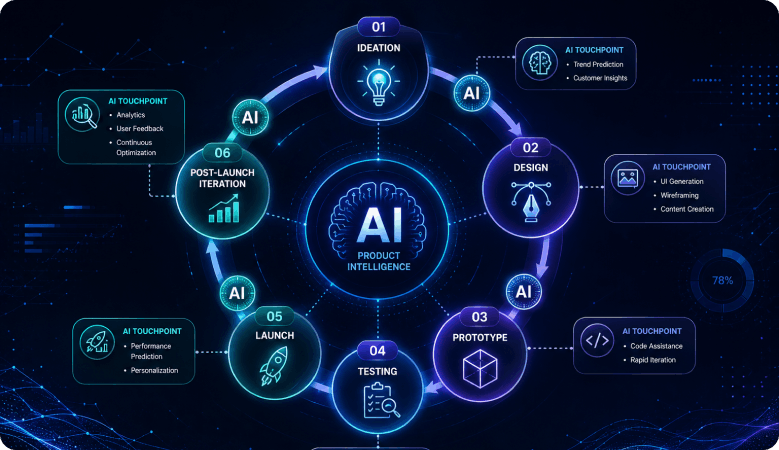
What is AI in Product Development?
AI in product development refers to the application of artificial intelligence technologies including machine learning, natural language processing, computer vision, generative AI, and AI agents to accelerate, automate and improve decision-making across the product development lifecycle.
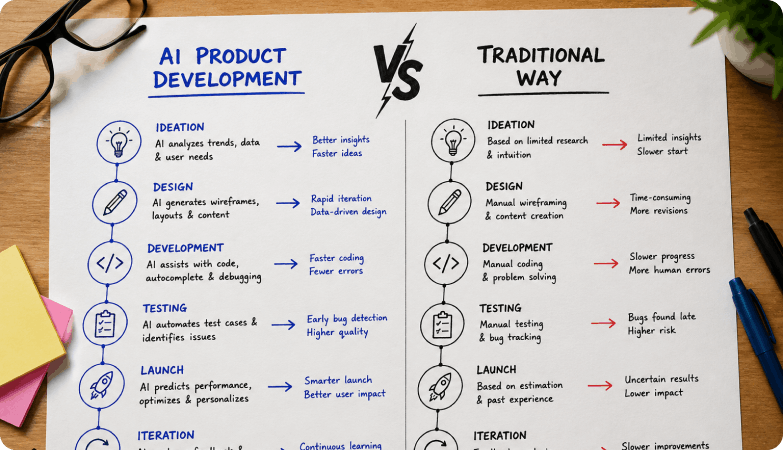
AI Product Development Vs Traditional Way
AI in product development is distinct from traditional product development in one specific way: instead of relying purely on human judgment and manual analysis at each stage, AI uses data and models to inform, augment, or automate decisions that were previously made more slowly and with less evidence. Generative AI in product development adds a further capability: the ability to create,design variants, requirement drafts, test scenarios and product formulations, not just analyze.
The stages where AI in product development creates the most measurable impact include ideation and market research, requirements gathering, design and prototyping, quality assurance, supply chain integration, product lifecycle management, customer feedback analysis, and post-launch performance monitoring.
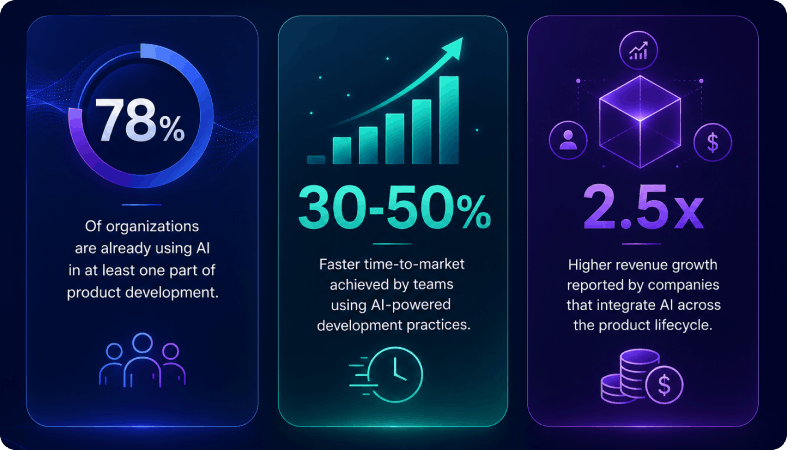
Why Following Best Practices for AI-Driven Product Development Matters Now
The business case for AI in product development is not speculative. According to McKinsey’s State of AI 2025 report, 80% of organizations set efficiency as an objective of their AI initiatives but the companies seeing the most value are those that also set growth and innovation as objectives alongside efficiency.
In product development specifically, that ambition translates into three measurable outcomes:
1.
Speed
AI in product development compresses design iteration cycles that previously took weeks into hours. Research from Scopic Software indicates that AI-driven approaches have achieved up to a 90% reduction in development time in defined use cases.
2.
Quality
According to a Deloitte survey of manufacturing companies cited by Vena Solutions, 83% of manufacturing respondents believe AI has already had, or will have, a practical and measurable impact on their operations – with quality testing cited as the leading production use case.
3.
Revenue growth
Companies that PwC identifies as Digital Champions – those advanced in using AI in product development report more than 30% of revenues coming from fully digital products or services.
These outcomes are not the result of deploying more AI tools. They are the result of following the best practices for AI-driven product development that the highest-performing organizations apply consistently.

How AI in Product Development Works
AI in product development works by connecting data sources, analytical models, and operational systems across the development lifecycle. The typical architecture involves:
Data inputs
Market research data, customer feedback, product performance metrics, financial data, regulatory compliance information, competitor intelligence, and operational data from manufacturing or supply chain systems.
AI and ML layer
Machine learning models, large language models, computer vision systems, predictive analytics engines, and generative AI tools that analyze inputs, identify patterns, generate options, and make recommendations.
Orchestration and integration
The layer that connects AI outputs to the operational systems where product development decisions are executed – ERP systems like SAP, PLM platforms, CRM systems, quality management systems, and supply chain tools.
Human review and governance
The structured processes that ensure AI recommendations are evaluated and approved by the right people before being acted upon, particularly for high-stakes or regulated decisions.
This architecture is where most AI in product development programs fall short: they build strong AI and ML capability but fail to close the loop to the operational systems where decisions get implemented. An AI model that recommends a material substitution but cannot connect to the SAP procurement and production planning systems where that substitution must be executed creates analysis without action.
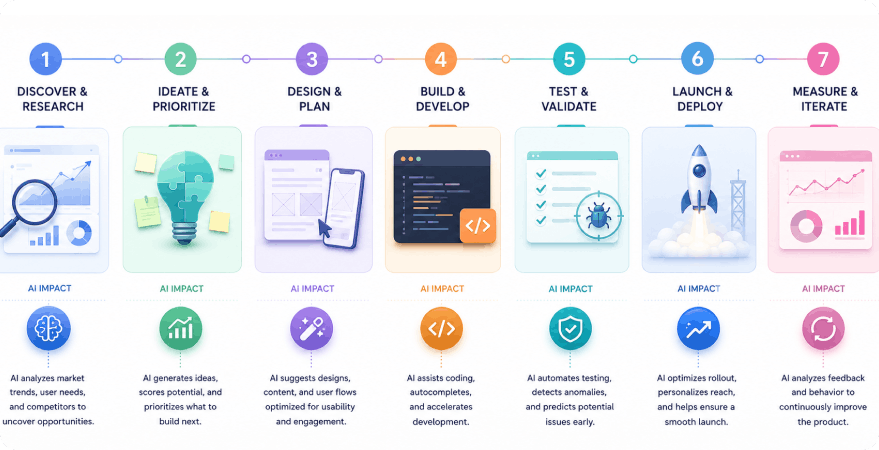
The Stages Where AI in Product Development Creates Value
1.
Ideation and Market Research
AI in product development at the ideation stage analyzes market trends, customer reviews, social media signals, and competitive data to surface unmet needs faster than any manual research process. Natural language processing extracts structured insight from unstructured data support transcripts, product reviews, survey responses and identifies patterns that human analysts miss at volume.
2.
Requirements Gathering
AI in product development assists in analyzing stakeholder inputs, historical product data, and regulatory requirements to generate draft functional and non-functional requirements. Generative AI in product development generates multiple requirement variants based on different design assumptions, allowing product teams to pressure-test scope earlier in the cycle.
3.
Design and Prototyping
Generative AI in product development enables exploration of design variants at a scale that was previously impossible. Machine learning algorithms analyze past design performance, user feedback, and manufacturing constraints to suggest optimized configurations. Generative AI tools can automate CAD modeling, generate 3D prototypes from text descriptions, and accelerate iteration from concept to testable prototype from weeks to days.
4.
Quality Assurance
Computer vision and machine learning models inspect products for defects with accuracy and throughput that manual QA cannot match. AI in product development generates test scenarios automatically, detects anomalies, flags compliance deviations, and identifies patterns of recurring defects that point to upstream process issues rather than individual failures.
5.
Manufacturing and Supply Chain
AI optimizes production scheduling, predicts equipment failures before they cause downtime, manages material requirements dynamically, and identifies bottlenecks in real time. In food and beverage and pharmaceutical environments, AI in product development assists with lot traceability, quality hold management, and regulatory batch documentation.
6.
Product Lifecycle Management
AI in product development enhances PLM by providing continuous visibility into product performance across the lifecycle – from launch through maturity to end-of-life planning. Machine learning models forecast demand, identify performance degradation early, surface opportunities for feature enhancement, and support decisions about when to invest in updates versus retire a product line.
7.
Post-Launch Monitoring and Iteration
AI in product development does not end at launch. Post-launch AI systems monitor user behavior, product performance data, support ticket patterns, and market signals to surface improvement opportunities continuously. Sentiment analysis tracks how customer perception evolves. Recommendation engines surface feature ideas based on what users are actually doing versus what the product was designed to support.
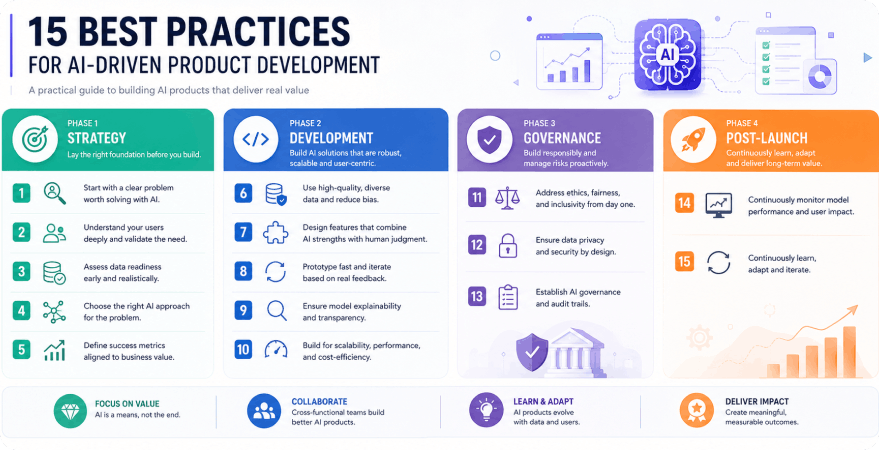
15 Best Practices for AI-Driven Product Development
Phase 1: Strategy and Foundation
The foundation of any effective best practices for AI-driven product development framework starts with strategy – before a single model is selected, a dataset is cleaned, or a vendor is briefed.
Best Practice 1: Define the Problem Before Selecting the AI Tool
The most consistent source of wasted investment in AI in product development is tool selection that precedes problem definition. Teams adopt a generative AI platform because it is impressive or visible, then search for problems to apply it to.
The best practices for AI-driven product development start with a clearly articulated problem statement: What decision do we need to make faster or more accurately? What task produces too much variability? What information do we lack at the moment we need it? The answers determine which AI capabilities are relevant – not the other way around.
In manufacturing, the problem might be: our design-to-prototype cycle takes eight weeks and a third of first prototypes require significant rework. In pharmaceutical product development, it might be: we are missing regulatory compliance requirements in early design reviews because teams do not have real-time access to up-to-date guidance. Each problem leads to a different AI capability, not the same solution.
Best Practice 2: Assess Your Data Readiness Before Committing to a Roadmap
AI in product development is only as good as the data it learns from and operates on. Most organizations underestimate the time, cost, and effort involved in getting data into a state where it can reliably power AI-driven outcomes.
Data readiness for AI in product development requires assessing four dimensions:
- Quality (is the data accurate and complete?)
- Relevance (does it represent the problem you are solving?)
- Structure (is it consistently formatted for AI ingestion?)
- Governance (are there clear policies on access, storage, and compliance?)
For enterprise organizations with SAP or other ERP systems, data readiness also means understanding which data lives in which system, how clean it is in the source, and what is required to extract and stage it for AI consumption. Master data quality in SAP directly determines the accuracy of AI models that draw on those records.
Best Practice 3: Build Cross-Functional AI Literacy Alongside Technical Capability
One of the most underestimated barriers to effective AI in product development is the knowledge gap between teams building AI systems and the teams whose work those systems are meant to improve. Product designers, manufacturing engineers, quality managers, and supply chain planners need sufficient understanding of what AI can and cannot do to participate meaningfully in requirements definition, validation, and oversight.
This does not mean converting domain experts into data scientists. It means ensuring that every person whose work will be affected by AI in product development understands how to interpret its outputs, how to recognize when outputs seem wrong, and how to escalate concerns effectively.
Best Practice 4: Start with High-Value, Low-Risk Pilot Use Cases
Not every AI in product development use case should be pursued simultaneously. Organizations that try to transform every stage of the development lifecycle at once typically achieve slow progress everywhere and measurable improvement nowhere.
A more effective approach identifies one or two use cases where AI in product development can produce clearly measurable improvement on a specific KPI within a defined timeframe, without requiring transformation of core production systems or significant regulatory risk. For manufacturing companies, a strong first pilot is often AI-driven defect detection in quality control – clear before-and-after metrics, limited operational risk, and strong signal value about whether the data and infrastructure are ready to support more ambitious programs.
Best Practice 5: Choose the Right Build vs. Buy vs. Hybrid Approach
The build vs. buy decision is one of the most consequential early choices in any AI in product development program. It affects cost structure, timeline, flexibility, and how much the capability can be differentiated from what competitors are doing.
Building custom AI gives full control over the model, training data, and features. It is the right choice when AI is core to the product’s competitive differentiation, when proprietary data gives a meaningful model quality advantage, or when existing tools cannot be customized to fit regulated industry requirements like pharma or food and beverage. Buying off-the-shelf AI tools gets you to market faster with lower initial investment. A hybrid approach uses existing platforms as a foundation and adds custom components where the business case justifies the investment – the practical starting point for most mid-market enterprises beginning their AI in product development journey.
Phase 2: Development and Implementation
Best Practice 6: Design for Explainability and Transparency From Day One
In regulated industries – pharmaceutical, food and beverage, medical devices – AI systems that support AI in product development decisions must be explainable. Regulatory bodies, internal auditors, and quality management teams need to understand not just what an AI system recommended but why, based on which data, with what confidence level.
Explainability is a design requirement, not a post-deployment add-on. It shapes model architecture choices, documentation standards, and the way outputs are presented to users. Building explainability in from the start means selecting model architectures that support interpretability, logging the data inputs and model versions behind every significant recommendation, and designing interfaces that surface confidence levels alongside AI outputs.
Best Practice 7: Implement Human-in-the-Loop Checkpoints Throughout Development
AI in product development does not replace human judgment. It augments it. The most effective programs build structured human-in-the-loop (HITL) checkpoints into the workflow at stages where AI output accuracy is highest-stakes.
In product design, this might mean AI generates three design variants and a senior engineer reviews and selects before any variant proceeds to detailed specification. In quality assurance, it might mean AI flags potential defects and a QA technician confirms before a batch is put on hold. HITL design allows organizations to deploy AI in product development with confidence in high-stakes environments and maintain the human accountability that regulatory frameworks require.
Best Practice 8: Create a Robust and Diverse Training Data Strategy
The performance of AI in product development is determined primarily by the data it was trained on. Biased, incomplete, or unrepresentative training data produces biased, incomplete outputs – regardless of model sophistication.
A robust training data strategy includes: defining what data is required and what bias risks exist in available datasets; building diverse training data that represents the full range of scenarios the model will encounter in production; establishing processes for ongoing data quality monitoring; and maintaining documentation of what the training data contains, when it was collected, and what its known limitations are.
In manufacturing, training data for quality control AI must represent defective and non-defective examples across the full range of materials, product lines, and production conditions the system will operate in.
Best Practice 9: Apply Generative AI in Product Development Across the Full Lifecycle
Generative AI in product development is where some of the most visible acceleration is happening – and where most organizations have barely scratched the surface. Most begin with generative AI in product development at the design and ideation stages, where it is most intuitive. This is a reasonable starting point, but limiting generative AI in product development to the front end leaves most of its value unrealized.
The later stages – manufacturing process optimization, supply chain management, quality documentation, regulatory compliance monitoring, and post-launch performance tracking – are where generative AI in product development creates compounding operational value. A generative AI tool that drafts regulatory submission documents from structured quality data reduces a weeks-long manual task to hours. A generative AI system that produces test scenario coverage for new features automates a QA function that typically bottlenecks release cycles. Expanding generative AI in product development systematically across the full lifecycle delivers the most consistent ROI.
Best Practice 10: Connect AI Insights to Your ERP and Operational Systems
AI in product development generates significant analytical value – insights into design performance, material requirements, demand forecasts, quality patterns, and market signals. That value is only realized if those insights connect to the systems where product development decisions are actually executed.
For enterprise organizations running SAP, this means integrating AI recommendations with SAP PLM for product lifecycle decisions, SAP PP (Production Planning) for manufacturing scheduling driven by AI demand forecasts, SAP QM (Quality Management) for AI-flagged quality holds, and SAP MM (Materials Management) for AI-driven procurement recommendations.
Closing the loop between AI insight and ERP execution is the single most underinvested integration in enterprise AI in product development programs. It is also where SPV Consulting’s combined AI and SAP expertise creates the most specific value for manufacturing, pharmaceutical, and food and beverage clients.
Phase 3: Governance and Quality
Best Practice 11: Establish AI Governance Before Deployment, Not After
AI governance frameworks define who is accountable for AI system performance, what approval processes apply before a new capability goes into production, how high-risk and low-risk use cases are classified, and how incidents are handled when AI in product development systems produce erroneous or harmful outputs.
Most organizations establish governance reactively – in response to a failure or regulatory inquiry. By that point, AI systems are already in production, users have built workflows around their outputs, and the cost of remediation is significantly higher than the cost of getting governance right before deployment.
Effective AI governance in product development includes: a risk classification framework for AI use cases; approval and documentation requirements scaled to risk level; defined accountability for model performance; and a process for managing model updates that might affect outputs in the operational environment.
Best Practice 12: Test Rigorously With Both Automated Testing and Human Review
AI system testing in product development requires two distinct layers. Automated testing evaluates model performance against defined metrics: accuracy, precision, recall, latency, and behavior under edge cases and adversarial inputs. Human review evaluates whether outputs are correct and useful in the real-world business context – a model that achieves strong accuracy metrics in testing may still produce outputs that are wrong in ways automated metrics do not capture.
In regulated product development environments, documented human review of AI outputs is a compliance requirement, not just a quality assurance measure. Both testing layers are non-negotiable; neither alone is sufficient.
Best Practice 13: Define Success Metrics Before You Build
AI in product development initiatives that do not define measurable success criteria before development begins almost always end up evaluated on subjective impressions rather than objective outcomes. That subjectivity makes it impossible to know whether the AI is working, whether it needs improvement, or whether a different approach would have produced better results.
Defining success metrics before building means identifying what will be measured (defect detection rate, design iteration cycle time, forecast accuracy, time to regulatory submission), what the baseline is before AI is introduced, and what the target improvement is. These metrics should be defined jointly by business stakeholders and technical teams.
Best Practice 14: Build Bias Detection and Fairness Into the Development Process
AI systems trained on historical product development data can learn and perpetuate biases present in that data. In AI in product development, this manifests as models that perform well for product lines, customer segments, or manufacturing conditions most represented in training data, and poorly for those that are underrepresented.
Building bias detection into the development process means testing model performance disaggregated by product category, customer segment, and production facility – not evaluating aggregate metrics only. It means monitoring for performance drift across these dimensions post-deployment and maintaining documentation of known model limitations.
Phase 4: Post-Launch and Continuous Improvement
Best Practice 15: Monitor for Drift, Degradation, and Unintended Consequences
AI models do not remain static after deployment. As product lines evolve, manufacturing processes shift, customer preferences move, and regulations update, model performance can degrade without any change to the model itself. This phenomenon – model drift – is one of the most common causes of AI in product development programs that deliver strong initial results but underperform over time.
Monitoring for drift requires establishing baseline performance benchmarks at deployment, then tracking performance against those benchmarks continuously. Post-launch monitoring must also watch for unintended consequences: ways the AI system is affecting behavior or outcomes not anticipated during design. Post-launch monitoring is not a separate phase. It is a permanent operational function that ensures the value created at deployment is maintained and built on over time.
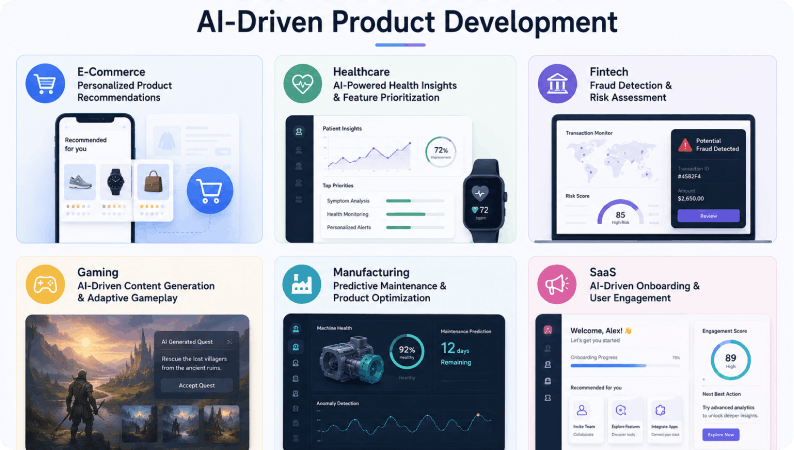
Real-World Use Cases of AI-Driven Product Development
Predictive maintenance and production planning
AI analyzes equipment sensor data in manufacturing environments to predict failures before they occur. Connected to SAP PP and SAP PM (Plant Maintenance), AI-driven predictive maintenance enables production planners to schedule interventions during planned downtime rather than responding to unplanned failures, reducing both maintenance cost and production disruption.
AI-driven quality assurance in pharmaceutical manufacturing
Computer vision models inspect physical product and packaging against specification requirements at production-line speed. In pharmaceutical environments, AI quality assurance also includes regulatory batch documentation review, compliance gap detection in design documentation, and automated flagging of specification deviations that require regulatory notification.
Generative AI for product design in food and beverage
Generative AI tools analyze consumer preference data, ingredient cost inputs, and regulatory requirements to suggest product formulation variants for new product development. Connected to SAP MM for ingredient cost data and availability, AI-assisted formulation development accelerates NPD timelines while keeping new products within cost and compliance constraints.
Customer sentiment analysis for product iteration
NLP models analyze customer feedback from reviews, support tickets, social media, and survey data to identify patterns in how customers experience products – what works well, what frustrates them, and what gaps exist. This analysis informs the priority backlog for product iteration and feature development.
AI-driven demand forecasting for new product launches
Machine learning models analyze historical sales data, market signals, promotional calendars, and external factors (weather, seasonal patterns, competitive launches) to generate demand forecasts for new product introductions. Connected to SAP IBP (Integrated Business Planning), AI demand forecasts drive production planning and inventory positioning directly.
Regulatory compliance monitoring in product development
AI systems monitor real-time updates to regulatory requirements relevant to a product’s markets and flag compliance gaps in design documentation, labeling, and manufacturing specifications. In pharmaceutical and food and beverage environments, regulatory compliance is a direct gating factor on product development timelines – AI-driven monitoring reduces the risk of late-stage compliance failures that cause significant program delays.
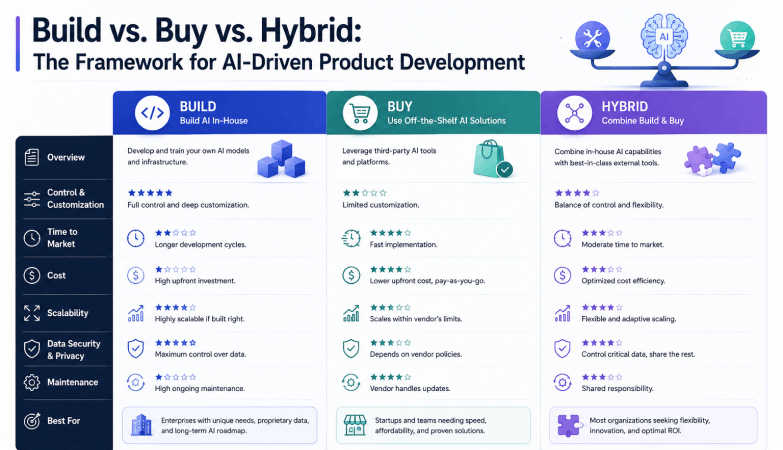
Build vs. Buy vs. Hybrid: The Framework for AI-Driven Product Development
The build vs. buy decision is one of the most strategically significant early choices in any AI-driven product development program.
Build custom AI solutions when AI capability is core to your product’s competitive differentiation, when proprietary data gives you a meaningful model quality advantage over what third-party tools can deliver, or when existing tools cannot be customized to fit regulated industry requirements.
Buy off-the-shelf AI tools when speed to value is the primary constraint, when the AI use case is a commodity function where vendor tools already perform well, and when differentiation comes from how you apply AI outputs rather than from model performance itself.
Hybrid approaches use established AI platforms as a foundation while building custom components where business-specific requirements are not met by standard tools. This is the most common model for enterprise organizations beginning AI-driven product development: adopt standard tools where they fit, and build where they do not.
The decision framework should also account for integration requirements. Off-the-shelf AI tools that cannot be integrated with your ERP, PLM, or QMS systems may be fast to deploy but slow to deliver operational value, because their outputs remain disconnected from the systems where decisions get made.
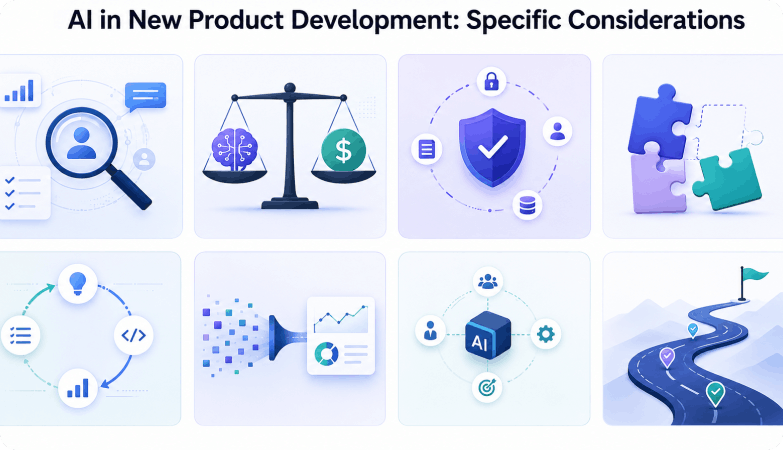
AI in New Product Development: Specific Considerations
AI in new product development introduces a distinct set of challenges that differ from AI applied to iterative improvement of existing products. In AI in new product development, the data advantage that makes AI effective IS historical performance data, established defect patterns, known customer behavior is largely absent. The product does not yet exist. There is no production baseline, no customer usage data, and no defect history to train models on.
The most effective applications of AI in new product development therefore focus on external data rather than internal performance data: market trend analysis, competitor product intelligence, customer sentiment from adjacent categories, and ingredient or materials performance data from analogous products. AI in new product development uses this external signal to reduce the uncertainty inherent in new product decisions rather than to optimize a known process.
Demand forecasting is one of the highest-value applications of AI in new product development. Machine learning models trained on launches of similar products, market conditions at the time of those launches, promotional cadences, and distribution footprint can generate more accurate first-year demand forecasts for new products than historical averaging or judgement-based approaches.
Connected to SAP IBP (Integrated Business Planning), AI in new product development demand forecasts drive production planning and inventory positioning directly, reducing the overproduction and write-off risk that consistently affects new product launches.
Formulation and design exploration is a second high-value application of AI in new product development, particularly in food and beverage and pharmaceutical contexts where the design space is large, the constraints are numerous, and the cost of physical prototyping is significant.
Generative AI in product development generates candidate formulations or designs within defined cost, regulatory, and performance constraints, and machine learning models predict likely performance outcomes before any physical prototype is produced.
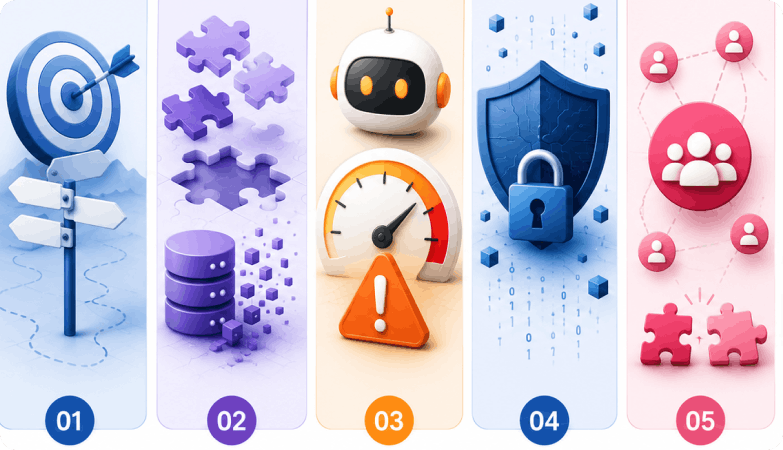
Common Challenges That Undermine Best Practices for AI-Driven Product Development
Data quality gaps that surface late
The most common cause of delayed AI in product development programs is discovering in the development or testing phase that required data is incomplete or structurally unsuitable. A data readiness assessment before committing to a build timeline prevents this class of delay.
Resistance from domain experts
Product designers, manufacturing engineers, and quality managers who have built expertise over years sometimes resist AI systems that appear to encroach on their professional judgment. Involving domain experts in defining what AI in product development should and should not do – and in validating its outputs before production deployment – is more effective than mandating adoption.
Technical debt from poorly governed AI systems
Organizations that deploy AI in product development tools without documentation standards, version control, or performance monitoring accumulate AI technical debt: systems whose outputs cannot be explained, models whose performance is degrading without monitoring, and capabilities that cannot be updated without significant rework. Governance from the start prevents this debt from accumulating.
Bias in training data that manifests at deployment
AI systems that perform well in testing can reveal bias in production when they encounter the full distribution of real-world conditions. Pre-deployment bias testing disaggregated by product category, customer segment, and production condition is the most effective preventive measure.
ERP integration gaps that disconnect AI insight from operational action
AI recommendations that cannot be connected to ERP systems for execution remain insights without outcomes. Building AI-to-ERP integration into the program scope from the beginning – rather than treating it as a post-deployment enhancement – is essential for enterprise organizations where SAP governs how product development decisions become operational actions.
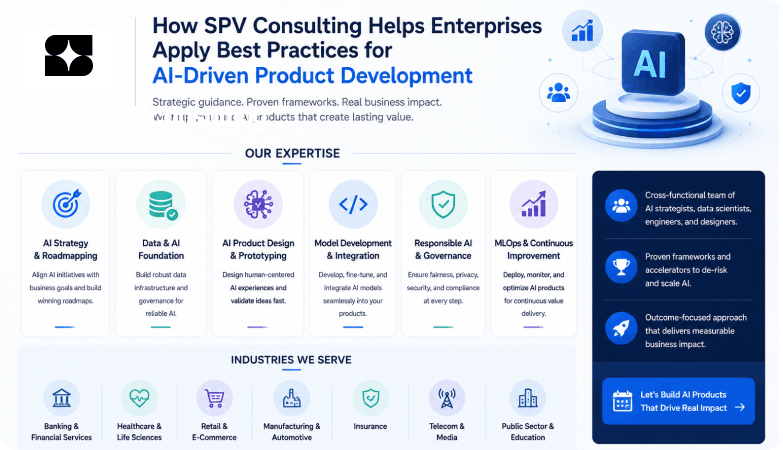
How SPV Consulting Helps Enterprises Apply Best Practices for AI-Driven Product Development
SPV Consulting brings together two capabilities that most AI implementation partners provide separately: enterprise AI in product development expertise and certified SAP knowledge.
For manufacturing, pharmaceutical, and food and beverage organizations, this combination addresses the gap that limits AI in product development ROI in most enterprise programs: the disconnect between AI insights and the SAP systems where operational decisions are made.
SPV Consulting’s approach to the best practices for AI-driven product development is grounded in four principles:
Problem definition before tool selection
Every AI in product development engagement starts with defining the specific business problem, success metrics, and data landscape before any tool or architecture is selected.
Data quality as a foundation
SPV’s SAP data governance expertise means AI in product development programs are built on clean, well-structured data from the start – not on data requiring expensive remediation after models are in training.
ERP integration as a design requirement
AI insights that do not connect to SAP production planning, procurement, quality management, or PLM systems do not become operational decisions. SPV’s SAP integration depth ensures AI recommendations close the loop to where they need to land.
Governance from day one
SPV Consulting’s delivery methodology includes AI governance framework design as a program phase – so clients deploy AI in product development systems with explainability, auditability, and accountability built in.
min read
TOPICS
- What is AI in Product Development?
- AI Product Development Vs Traditional Way
- Why Following Best Practices for AI-Driven Product Development Matters Now
- How AI in Product Development Works
- The Stages Where AI in Product Development Creates Value
- 15 Best Practices for AI-Driven Product Development
- Real-World Use Cases of AI-Driven Product Development
- Build vs. Buy vs. Hybrid: The Framework for AI-Driven Product Development
- AI in New Product Development: Specific Considerations
- Common Challenges That Undermine Best Practices for AI-Driven Product Development
- How SPV Consulting Helps Enterprises Apply Best Practices for AI-Driven Product Development
Frequently Asked Questions
What is AI in product development?
AI in product development is the application of artificial intelligence technologies – including machine learning, generative AI, natural language processing, and computer vision – to automate, accelerate, and improve decision-making across the product development lifecycle. AI in product development covers every stage from ideation and design through quality assurance, manufacturing, and post-launch iteration.
What are the best practices for AI-driven product development?
The most important best practices for AI-driven product development are: define the problem before selecting the AI tool, assess data readiness before committing to a roadmap, build cross-functional AI literacy, start with high-value pilot use cases, design for explainability from day one, implement human-in-the-loop checkpoints, establish AI governance before deployment, monitor for model drift post-launch, and connect AI insights to ERP and operational systems where decisions get executed.
What is the difference between AI in product development and generative AI in product development?
AI in product development is the broader discipline covering all AI technologies applied across the product development lifecycle – including predictive analytics, computer vision, and machine learning. Generative AI in product development is a specific subset: AI systems that create outputs (design variants, regulatory documents, test scenarios, formulation candidates) rather than only analyzing or classifying existing data. Generative AI in product development has expanded dramatically the range of tasks that can be automated or accelerated.
What are the main generative AI use cases in product development?
The main generative AI use cases in product development include design variant generation, regulatory document drafting, test scenario generation, customer insight synthesis, demand forecast narrative generation, and technical specification drafting. Generative AI use cases in product development are most mature at the ideation and design stages, but the highest-ROI generative AI use cases in product development are increasingly found in quality documentation, regulatory compliance, and post-launch analysis.
What is AI in new product development and how is it different from AI applied to existing products?
AI in new product development focuses on reducing uncertainty in product decisions where no historical performance data exists. Unlike AI applied to iterating existing products – where training data from past performance is available – AI in new product development relies on external signals: market trend data, analogous product performance, consumer preference modeling, and ingredient or materials performance prediction. AI in new product development is particularly valuable for demand forecasting, formulation exploration, and early regulatory risk assessment.
How does AI in product development connect to SAP and ERP systems?
AI in product development generates recommendations – for materials, formulations, production schedules, quality holds, and demand plans – that only create business value when they are executed through the operational systems that govern those decisions. For SAP-based enterprises, that means connecting AI in product development outputs to SAP PLM, SAP PP, SAP QM, SAP MM, and SAP IBP. Without that integration, AI in product development produces analysis that still requires manual re-entry and interpretation before it affects operational decisions.
What is human-in-the-loop AI in product development?
Human-in-the-loop (HITL) AI in product development is a design pattern where AI handles analysis, generation, or prediction tasks, and a qualified human reviews the output before any irreversible action is taken. HITL design allows organizations to deploy AI in product development with confidence in high-stakes and regulated environments while maintaining the human accountability that governance and compliance frameworks require.