
Cost of SAP Implementation: What Drives the Price and How to Plan Your Budget
The cost of SAP implementation is one of the first questions every organization asks before starting a project, and one of the hardest to answer with a single number. Search for it and you will find wildly different figures across forums, vendor pages, and consulting sites, because SAP implementation cost depends entirely on variables specific to each organization: system scope, data complexity, customization level, user count, industry regulatory requirements, and whether the work is done in-house or through a specialist partner.
Rather than quoting a number that will be outdated within a year and inaccurate for most organizations reading it, this guide breaks down the actual cost drivers behind SAP implementation, so you can build a realistic budget based on your specific environment instead of a generic industry average that may have nothing to do with your project. If you have been asking how much does SAP cost to implement without finding a reliable answer, that is because the honest answer depends on the variables covered in this guide, not a single published figure.
According to SPV Consulting’s approach to SAP implementation, drawn from SNP-certified engagements across manufacturing, pharmaceutical, and food and beverage clients, the organizations that budget most accurately are the ones that understand cost as a function of scope decisions, not a fixed price tag attached to a piece of software.
Why There Is No Single Answer to What Is the Cost of SAP Implementation
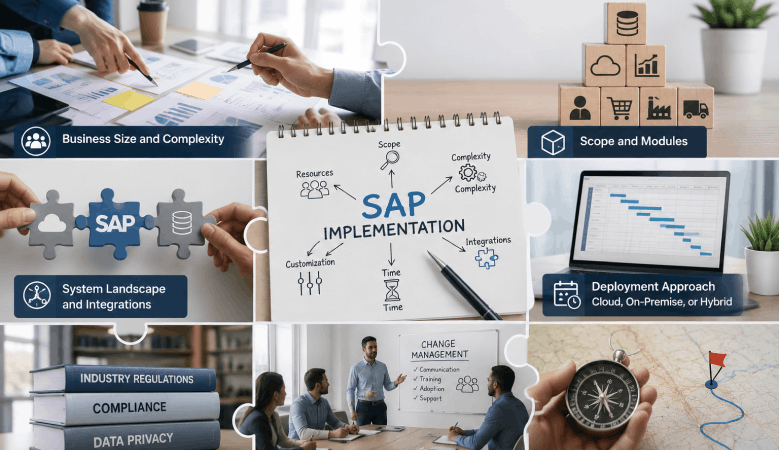
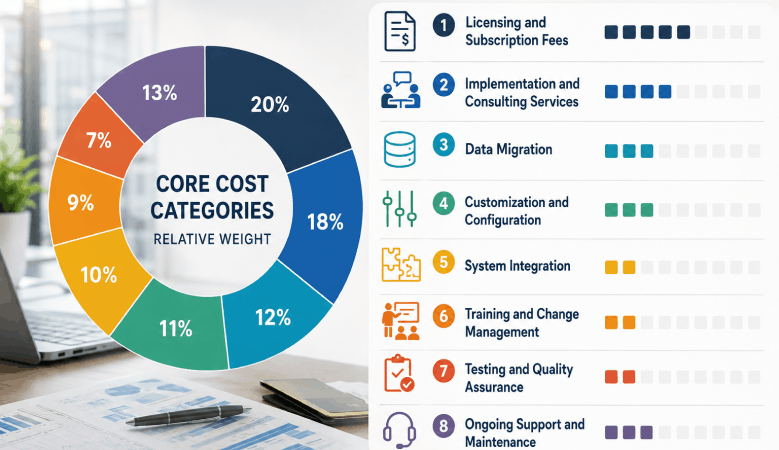
SAP implementation cost is not a single line item. It is the sum of licensing, implementation services, data migration, customization, integration, training, testing, and ongoing support — and the weight of each category shifts dramatically based on the organization’s size, industry, and existing technology landscape. Because these decisions often form part of a larger digital transformation initiative, the implementation budget needs to reflect both immediate project requirements and longer-term technology goals.
A mid-sized manufacturer running a standard implementation with minimal customization will have a fundamentally different cost profile than a pharmaceutical company requiring GxP validation, complex regulatory documentation, and extensive integration with existing quality management systems. Comparing the two on a single dollar figure is not useful – understanding the drivers behind each is.
This is also why SAP implementation cost is not published by SAP itself. Pricing is quote-based and depends on deployment model, user count, module selection, and organization-specific requirements gathered during a scoping engagement. Any number quoted publicly without knowledge of your specific environment should be treated as, at best, a rough industry reference point – not a budget you can plan against.
Why "Average Cost of SAP Implementation" Figures Are Misleading
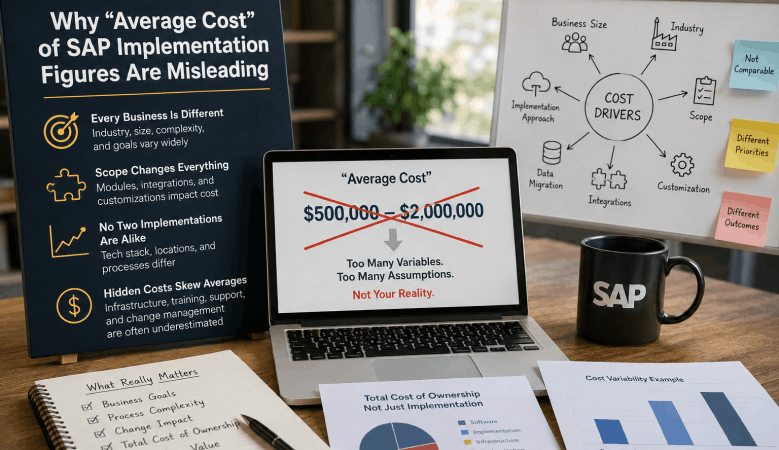
Search for the average cost of SAP implementation and you will find figures presented as industry benchmarks, often without any breakdown of what organization size, module scope, or deployment model that average is based on. An average cost of SAP implementation calculated across small businesses running SAP Business One and large enterprises running full S/4HANA rollouts produces a number that describes neither situation accurately.
A more useful approach than searching for an average cost of SAP implementation is understanding where your specific organization falls across the cost drivers covered in this guide, user count, module scope, deployment model, data complexity, and industry requirements , and building a budget from those specifics rather than anchoring to a published average that may not reflect your circumstances at all. Organizations that lack some of the required internal expertise may also evaluate SAP outsourcing options when determining how implementation resources will affect the total project budget.
The Core Cost Categories That Make Up SAP Implementation Cost
Understanding SAP implementation cost starts with understanding what you are actually paying for. These are the categories every SAP implementation budget needs to account for.
1.
Licensing and Subscription Fees
A significant share of the cost of SAP implementation is the SAP license or subscription fee itself – access to the S/4HANA platform, the modules you select, and the number of users authorized to work in the system. Licensing models vary: perpetual licenses paid upfront, subscription-based cloud licensing paid recurringly, or consumption-based models tied to usage.
License cost scales with user count, module selection, and deployment type (public cloud, private cloud, or on-premise). This is often the most visible cost in an SAP implementation, but it typically represents a smaller share of total project cost than most organizations expect – implementation, customization, and data migration usually cost more than the license itself over the life of the project.
2.
Implementation and Consulting Services
Implementation services cover the work required to configure SAP to your business processes, migrate data, integrate with existing systems, and deliver a functioning production environment. This includes business process analysis, system configuration, workflow design, testing, and go-live support.
Implementation services cover the work required to configure SAP to your business processes, migrate data, integrate with existing systems, and deliver a functioning production environment. Depending on internal capabilities, organizations may use IT outsourcing services to access specialized implementation expertise without building every capability in-house.
3.
Data Migration
Moving data from legacy systems – whether an older SAP ECC environment or a non-SAP platform – into the new S/4HANA environment is a distinct cost category, not a line item buried inside general implementation. Data migration cost is driven by data volume, data quality in the source system, the number of source systems being consolidated, and how much data cleansing and transformation is required before the data is ready to load.
Organizations that skip a proper data assessment before budgeting consistently underestimate this category. Poor data quality in the source system – duplicate vendor records, inconsistent master data, incomplete historical records – increases data migration cost significantly, because cleansing and validation work that should happen before migration ends up happening during it, at a higher cost and under time pressure.
4.
Customization and Configuration
SAP implementation cost rises substantially when standard SAP functionality does not fit existing business processes and custom development is required. Configuration – adjusting standard SAP settings to match business rules – is lower cost than customization, which involves writing custom code (typically in ABAP) to build functionality that does not exist in the standard system.
Organizations that adopt SAP best-practice processes wherever possible, rather than customizing SAP to match every existing legacy process, consistently reduce both initial implementation cost and the long-term cost of maintaining and upgrading custom code.
5.
System Integration
Most enterprise organizations run SAP alongside other systems – CRM platforms, e-commerce systems, manufacturing execution systems, warehouse management systems, and industry-specific applications.Integration cost covers the APIs, middleware, and custom interfaces required to connect SAP to other systems so that data flows accurately without manual re-entry. Organizations evaluating SAP’s integration ecosystem can also compare SAP BTP and SAP CPI when planning their architecture.
Integration complexity is one of the most underestimated cost drivers in SAP implementation. The more systems an organization needs SAP to connect to, and the more real-time that connection needs to be, the higher the integration cost climbs.
6.
Training and Change Management
SAP implementation cost includes training the workforce that will use the new system daily. This covers end-user training, train-the-trainer programs, documentation, and change management activities designed to drive adoption and reduce resistance to new workflows.
Organizations that underinvest in training consistently see lower user adoption, more support tickets in the months after go-live, and slower realization of the productivity gains the SAP implementation was meant to deliver. Training cost scales with user count and the degree of process change users are being asked to absorb.
7.
Testing and Quality Assurance
Before go-live, SAP implementations require multiple rounds of testing: unit testing of individual configurations, integration testing across connected systems, user acceptance testing with actual business users, and performance testing under expected production load. Testing cost is often compressed under project timeline pressure, which is a false economy – defects caught after go-live cost significantly more to fix than defects caught during structured testing phases.
8.
Ongoing Support and Maintenance
SAP implementation cost does not end at go-live. Ongoing support costs cover system administration, user support, patch management, periodic upgrades, and continuous improvement work as business needs evolve. Organizations should budget for post-go-live support as a recurring cost, not a one-time project expense that ends when the implementation team departs.
Cost of SAP S/4HANA Implementation vs. Cost of SAP Business One Implementation
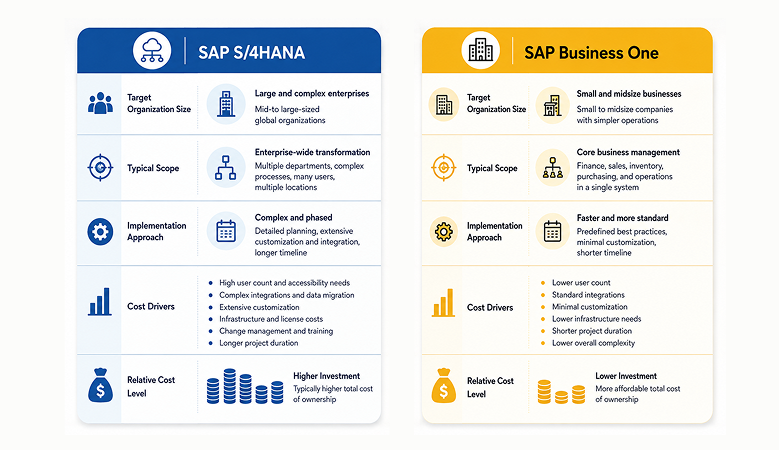
One of the most common sources of confusion when researching the cost of SAP implementation is that “SAP” is not one product. SAP offers multiple platforms targeted at different organization sizes, and conflating them produces wildly inconsistent cost expectations.
The cost of SAP S/4HANA implementation applies to large and mid-sized enterprises running complex, multi-module operations — finance, manufacturing, supply chain, and industry-specific processes at scale. S/4HANA implementations typically involve more extensive data migration, deeper integration requirements, and higher customization potential, all of which push cost of SAP S/4HANA implementation higher than smaller-scale alternatives. Organizations planning these projects can benefit from understanding the broader steps involved in an SAP implementation project before estimating the resources and timeline required.
The cost of SAP Business One implementation, by contrast, applies to small and mid-sized businesses that need core ERP functionality – finance, sales, inventory, and basic operations – without the scale or complexity that S/4HANA is built for. SAP Business One implementations are typically faster to deploy, involve fewer integration points, and require less customization, which keeps the cost of SAP Business One implementation meaningfully lower than an enterprise S/4HANA rollout in most cases.
Before researching SAP implementation cost, organizations should first confirm which SAP product actually fits their scale and requirements. A small business researching S/4HANA pricing will find figures far beyond what their operation needs, just as an enterprise researching SAP Business One pricing will find a product that cannot support their complexity. Matching the product to the organization is the first step in getting an accurate cost picture – not the last one.
Deployment Model: Cloud, On-Premise, or Hybrid
Cloud deployment (SAP S/4HANA Cloud, Public or Private Edition) typically involves lower upfront infrastructure cost since SAP manages the hosting environment, shifting cost toward a subscription model. This choice directly shapes the cost of SAP S/4HANA implementation, since cloud and on-premise deployments carry different infrastructure, security, and customization cost profiles. On-premise deployment requires the organization to own and maintain the infrastructure, which increases upfront capital cost but may offer more customization flexibility depending on organizational requirements. Hybrid approaches split systems across both models, which can optimize cost for specific use cases but adds integration complexity.
Migration Strategy: Greenfield, Brownfield, or Selective Data Transition
A greenfield implementation – a full reimplementation from scratch – typically carries higher upfront cost because it involves rebuilding configuration and processes from zero, but can reduce long-term technical debt. A brownfield conversion – upgrading an existing SAP system while retaining configuration and historical data – is typically lower cost upfront but inherits any existing data quality or process inefficiency from the legacy system. Selective Data Transition sits between the two, allowing organizations to modernize selectively while retaining critical historical data and customizations, which can moderate cost relative to a full greenfield rebuild.
Organization Size and User Count
Cost scales with the number of users who need system access, but not always in a straight line. Some SAP pricing models offer volume-based rate reductions at higher user counts, while others charge a flat per-user rate regardless of scale. User count also drives training cost, support cost, and the complexity of the authorization and security model that needs to be configured.
Industry and Regulatory Requirements
Regulated industries carry additional SAP implementation cost that unregulated industries do not. Pharmaceutical organizations require Computer System Validation (CSV) documentation, GxP compliance validation, and audit trail configuration that adds both time and specialized expertise to the implementation. Food and beverage manufacturers require lot traceability and quality hold configuration tied to regulatory reporting obligations. Manufacturing organizations may require complex production planning and shop floor integration that general-purpose implementations do not need.
Number of Modules and Scope of Functionality
Implementing SAP Finance alone is a fundamentally different scope and cost than implementing Finance, Materials Management, Production Planning, Sales and Distribution, and Warehouse Management simultaneously. Module count is one of the clearest, most direct cost drivers – more modules mean more configuration, more integration points, more testing scope, and more training requirements.
In-House Team vs. Third-Party Implementation Partner
Organizations with a mature internal SAP team and prior implementation experience may handle more of the work internally, reducing consulting services cost but requiring internal resources to be pulled from other priorities. Most mid-sized and large organizations engage a third-party implementation partner for at least part of the project, particularly for specialized work like data migration, complex integrations, and industry-specific configuration where internal expertise does not exist. The right balance depends on internal team capability, project timeline, and the criticality of getting the implementation right the first time.
Data Quality in the Source System
Organizations consistently underestimate how much source data quality affects total implementation cost. Clean, well-governed data in the legacy system reduces data migration cost significantly. Data riddled with duplicates, missing fields, and inconsistent formatting increases both the time and cost required to prepare that data for migration – work that has to happen regardless, but costs less when planned for upfront rather than discovered mid-project.
Timeline and Project Urgency
Compressed timelines increase cost. Rushing implementation phases to meet an aggressive go-live date typically requires additional resources working in parallel, overtime costs, and a higher risk of costly post-go-live remediation. Organizations planning around a fixed deadline – such as the 2027 end of mainstream maintenance for SAP ECC – should build in appropriate lead time rather than compressing the schedule and absorbing the cost premium that urgency creates.
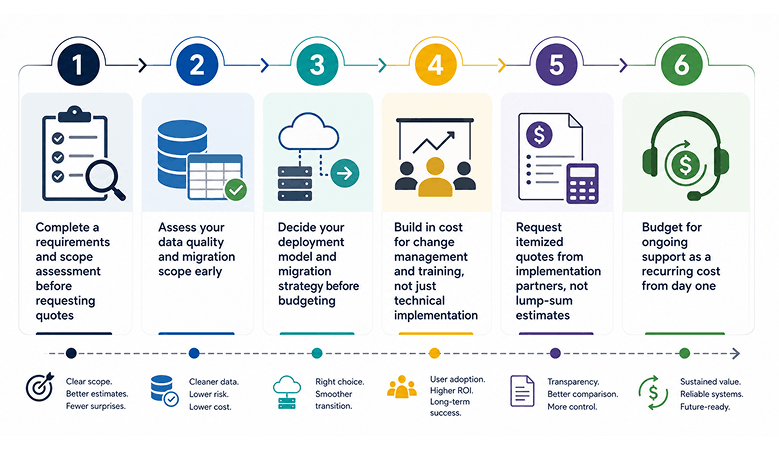
How to Build an Accurate Budget for the Cost of SAP Implementation
Step 1: Complete a requirements and scope assessment before requesting quotes
Define which modules you need, how many users will require access, what systems need to integrate with SAP, and what industry-specific compliance requirements apply. Answering how much does SAP cost to implement for your organization specifically starts here – a vendor cannot provide an accurate estimate without this information, and a vague scope produces a vague and unreliable quote.
Step 2: Assess your data quality and migration scope early
Understanding the state of your source data ,how much needs to be migrated, how much can be archived, and how much cleansing is required , prevents one of the most common sources of budget overruns in SAP implementation. A structured SAP data migration strategy should account for assessment, cleansing, transformation, validation, and reconciliation before the project timeline and budget are finalized.
Step 3: Decide your deployment model and migration strategy before budgeting
Cloud versus on-premise, and greenfield versus brownfield versus Selective Data Transition, are foundational decisions that shape every other cost category. Making these decisions late in the process, after budget has already been set, is a common cause of cost overruns.
Step 4: Build in cost for change management and training, not just technical implementation
Organizations that budget only for the technical build and treat training as an afterthought consistently underinvest in the activities that determine whether the implementation actually delivers value once live.
Step 5: Request itemized quotes from implementation partners, not lump-sum estimates
An itemized quote broken down by licensing, implementation services, data migration, integration, training, and testing lets you understand where your budget is going and identify where scope can be adjusted if needed.
Step 6: Budget for ongoing support as a recurring cost from day one
SAP implementation does not end at go-live. Building post-go-live support into the initial budget, rather than treating it as a future decision, produces a more realistic total cost of ownership picture.
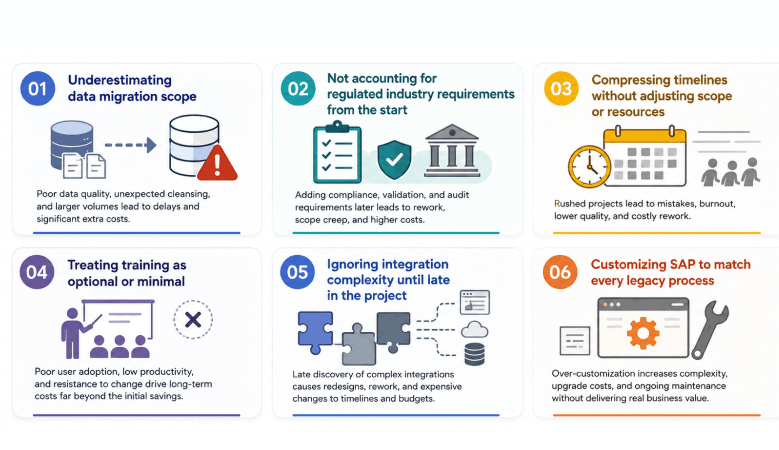
Common Mistakes That Inflate the Cost of SAP Implementation
Underestimating data migration scope
Treating data migration as a minor technical task rather than a distinct project phase with its own assessment, cleansing, and validation requirements is one of the most consistent sources of budget overruns.
Customizing SAP to match every legacy process
Every custom development request adds cost – not just to build, but to test, document, and maintain through every future upgrade. Organizations that adopt SAP best-practice processes wherever reasonably possible consistently see lower total cost of ownership than those that customize extensively to preserve legacy workflows.
Ignoring integration complexity until late in the project
Integration requirements discovered mid-implementation, rather than scoped upfront, create costly rework and timeline extensions. A full inventory of systems that need to connect to SAP should be completed before implementation begins, not during it.
Treating training as optional or minimal
Under-resourced training leads to low user adoption, which undermines the return on the entire SAP investment regardless of how well the technical implementation was executed.
Compressing timelines without adjusting scope or resources
An aggressive go-live date without corresponding additional resources or reduced scope creates cost pressure that typically surfaces as either budget overruns or post-go-live defects that cost more to fix than they would have cost to prevent.
Not accounting for regulated industry requirements from the start
Pharmaceutical and food and beverage organizations that treat compliance validation as a late-stage add-on rather than a built-in requirement from day one consistently face costly rework to meet documentation and audit trail standards that should have been designed in from the beginning.
How SPV Consulting Helps Organizations Plan and Manage SAP Implementation Cost
SPV Consulting’s approach to SAP implementation starts with a detailed scoping and assessment phase before any cost estimate is provided – because an accurate SAP implementation budget depends on understanding your specific environment, not applying an industry average that may not reflect your organization’s actual requirements.
For manufacturing, pharmaceutical, and food and beverage clients, SPV Consulting’s SNP-certified consultants bring specific expertise in the cost drivers that matter most in these industries: data migration complexity from legacy ECC environments, GxP and regulatory compliance requirements that shape implementation scope, and the integration work required to connect SAP with production, quality, and supply chain systems already in place.
SPV Consulting provides itemized project scoping so clients understand exactly what drives their implementation cost – licensing, services, data migration, customization, integration, training, and testing – rather than a single lump-sum figure that obscures where budget is actually being spent.
min read
TOPICS
- Why There Is No Single Answer to What Is the Cost of SAP Implementation
- Why "Average Cost of SAP Implementation" Figures Are Misleading
- The Core Cost Categories That Make Up SAP Implementation Cost
- Cost of SAP S/4HANA Implementation vs. Cost of SAP Business One Implementation
- How to Build an Accurate Budget for the Cost of SAP Implementation
- Common Mistakes That Inflate the Cost of SAP Implementation
- How SPV Consulting Helps Organizations Plan and Manage SAP Implementation Cost
Frequently Asked Questions
What is the cost of SAP implementation?
What is the cost of SAP implementation is one of the most common questions organizations ask before starting a project, and the honest answer is that it depends entirely on your specific scope. The cost of SAP implementation is the sum of licensing, implementation services, data migration, customization, integration, training, testing, and ongoing support – each shaped by your organization’s module selection, user count, deployment model, and industry requirements rather than a single fixed figure.
What is the average cost of SAP implementation?
There is no single average cost of SAP implementation that applies meaningfully across organizations, because published averages typically blend small business deployments with large enterprise rollouts into one misleading figure. A more accurate approach than searching for the average cost of SAP implementation is identifying where your organization falls across the core cost drivers – user count, module scope, data complexity, and deployment model – and building a budget from those specifics.
What is the cost of SAP S/4HANA implementation?
The cost of SAP S/4HANA implementation reflects the platform’s positioning for large and mid-sized enterprises running complex, multi-module operations. Because S/4HANA implementations typically involve deeper data migration, broader integration scope, and more customization potential than smaller ERP platforms, the cost of SAP S/4HANA implementation is generally higher than lighter-weight alternatives, and should be scoped against your organization’s specific module and integration requirements.
What is the cost of SAP Business One implementation?
The cost of SAP Business One implementation applies to small and mid-sized businesses needing core ERP functionality without enterprise-scale complexity. Because SAP Business One implementations typically involve fewer integration points, faster deployment timelines, and less customization than S/4HANA, the cost of SAP Business One implementation is generally lower – though it should still be scoped based on your specific user count and module requirements rather than assumed from a generic figure.
What are the main cost drivers in SAP implementation?
The primary cost drivers are the number of modules being implemented, user count, deployment model (cloud, on-premise, or hybrid), migration strategy (greenfield, brownfield, or Selective Data Transition), data quality and migration complexity, the degree of customization required, integration scope with existing systems, and industry-specific regulatory and compliance requirements.
Is SAP implementation more expensive than other ERP systems?
SAP implementation cost is comparable to other tier-one enterprise ERP platforms when evaluated on a like-for-like basis of scope and complexity. Direct cost comparisons across ERP vendors are difficult because pricing models, module structures, and licensing approaches differ significantly between vendors – the more relevant comparison is total cost of ownership relative to the specific functionality and scalability your organization requires.
How can organizations reduce SAP implementation cost?
Organizations can manage SAP implementation cost by completing a thorough requirements assessment before requesting quotes, prioritizing SAP best-practice processes over extensive customization, addressing data quality issues before migration begins, scoping integration requirements comprehensively upfront, and avoiding compressed timelines that create cost pressure and increase the risk of expensive post-go-live remediation.
Does SAP implementation cost include ongoing support?
Initial SAP implementation quotes typically cover the project delivery phase through go-live, not ongoing support. Organizations should budget for post-go-live support, system administration, periodic upgrades, and continuous improvement work as a separate, recurring cost category rather than assuming implementation cost covers the full lifecycle of the system.
How does data quality affect SAP implementation cost?
Data quality in the source system directly affects data migration cost, which is one of the largest and most frequently underestimated cost categories in SAP implementation. Clean, well-governed source data reduces migration cost significantly, while data with duplicates, missing fields, and inconsistent formatting increases both the time and cost required to prepare it for migration.
Should organizations implement SAP in-house or with a third-party partner?
The right approach depends on internal team capability, project complexity, and timeline. Organizations with mature internal SAP expertise may handle more of the implementation internally. Most mid-sized and large organizations, particularly those in regulated industries or with complex data migration and integration requirements, engage a specialized implementation partner for at least part of the project to reduce risk and access expertise that may not exist internally.