
SAP Implementation Guide: Steps, Phases and Methodology
If your organization is implementing SAP now, the methodology governing your project is almost certainly SAP Activate, not the older ASAP framework built around Project Preparation, Business Blueprint, and Realization phases. That distinction is not academic. It changes how the project is planned, what “done” looks like at each stage, and how fit-to-standard configuration is prioritized over custom development from day one.
This SAP implementation guide covers the SAP implementation steps, phases, and methodology that actually apply to a modern S/4HANA project, resolves the frequent confusion between an “SAP implementation guide” (the project methodology) and the “SAP customizing implementation guide” – the IMG, a configuration tool inside the system itself that has nothing to do with project phases – and addresses the practical pain points that derail SAP implementation projects regardless of which methodology governs them.
According to SPV Consulting’s approach, drawn from SNP-certified engagements delivering SAP implementation for manufacturing, pharmaceutical, and food and beverage clients, the organizations that succeed treat implementation of SAP as an organizational change program with a technical component, not a technical project with a training afterthought.
What Is SAP Implementation?
SAP implementation is the structured process of configuring, customizing, testing, and deploying SAP software – S/4HANA, SuccessFactors, Ariba, or other SAP products – into an organization’s live business operations, replacing or supplementing legacy systems with a unified enterprise platform covering finance, supply chain, manufacturing, human resources, and customer-facing processes.
Understanding what is SAP implementation in practice means understanding it is not primarily a software installation. The technical deployment is one component of a broader program that includes business process redesign, organizational change management, data migration, integration with existing systems, and workforce training – each of which affects project success as much as the underlying technical configuration.
SAP Implementation Methodology: ASAP vs. SAP Activate
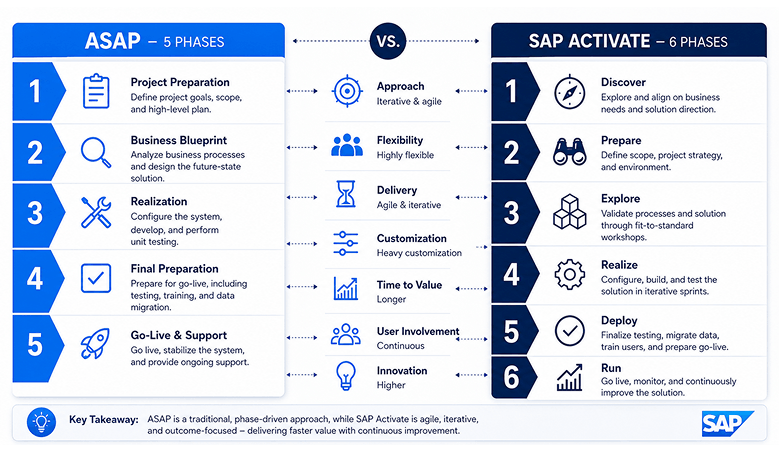
Understanding what is SAP implementation methodology in use today starts with knowing the history: ASAP (Accelerated SAP) was the methodology SAP introduced in the 1990s and used through the ECC era, structuring projects around five phases – Project Preparation, Business Blueprint, Realization, Final Preparation, and Go-Live and Support.
SAP Activate is the current SAP methodology for implementation, purpose-built for S/4HANA, cloud, and hybrid deployments. SAP Activate differs from ASAP in a foundational way: rather than starting from a blank slate and documenting every business requirement before configuration begins (as Business Blueprint did), SAP Activate starts from pre-configured best-practice business processes and works through fit-to-standard workshops to identify where the organization’s actual requirements diverge from SAP’s standard processes – configuring only those specific gaps rather than customizing extensively from scratch.
This shift matters practically. Fit-to-standard evaluation, the centerpiece of SAP Activate, pushes organizations toward adopting SAP’s best-practice processes wherever reasonable, reducing both implementation cost and the long-term burden of maintaining custom code through every future upgrade.
Organizations still planning their project around ASAP’s blueprint-first approach are working from an implementation of SAP methodology that no longer matches how SAP itself structures modern projects, particularly S/4HANA Cloud implementations where SAP Activate is effectively mandatory.
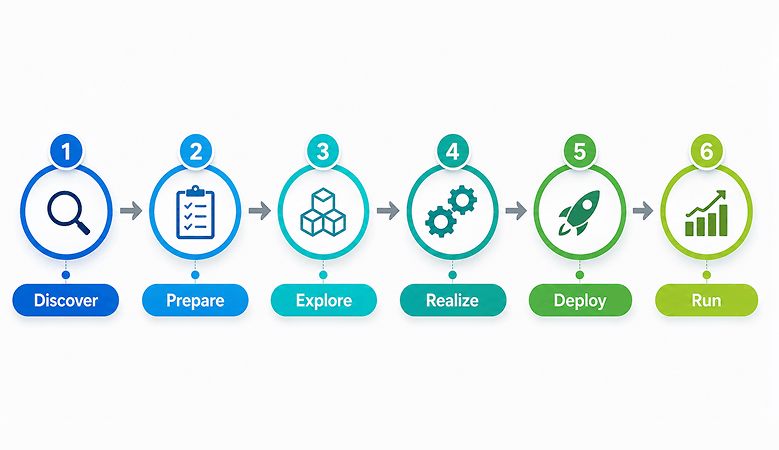
SAP Implementation Phases: The SAP Activate Framework
Phase 1: Discover
The Discover phase is where an organization builds the business case for SAP implementation, explores product capabilities, and determines whether and how to proceed. Activities include reviewing SAP’s best-practice reference processes for the relevant industry, assessing current-state pain points against what S/4HANA can address, and building the initial business case and budget approval package.
Phase 2: Prepare
Prepare is the formal project kickoff – the modern equivalent of ASAP’s Project Preparation phase, but scoped more tightly around SAP Activate’s accelerated approach. Activities include finalizing project scope and timeline, establishing the project governance structure, provisioning the initial system environment, and setting up the project team with clearly defined roles across business and technical workstreams.
Phase 3: Explore
Explore is where SAP Activate diverges most clearly from legacy ASAP methodology. Rather than documenting requirements from scratch in lengthy blueprint workshops, Explore centers on fit-to-standard workshops: business stakeholders review SAP’s pre-configured best-practice processes directly in a working system, identifying specific gaps between standard functionality and actual business requirements. This phase produces a backlog of confirmed configuration items and a much shorter list of genuine customization requirements than blueprint-driven approaches typically generate.
Phase 4: Realize
Realize is where the system is actually built – configuration, any approved custom development, data migration development, and integration build. Testing begins iteratively within this phase rather than as a separate, sequential stage: unit testing, string testing, and integration testing all occur across multiple sprints as functionality is built, allowing issues to surface and be corrected earlier than in phase-gated legacy approaches.
Phase 5: Deploy
Deploy covers final preparation and go-live: user acceptance testing, end-user training, final data migration and validation, cutover planning and execution, and the go-live event itself. Deploy also includes hypercare – a defined period of intensive post-go-live support where the project team remains closely engaged to resolve issues quickly before transitioning to standard operational support.
Phase 6: Run
Run is the ongoing operational phase following go-live, covering system administration, continuous improvement, periodic innovation cycles (adopting new S/4HANA features as SAP releases them), and the transition from project-mode support to steady-state application management. Organizations that treat Run as an afterthought – rather than a defined phase with its own resourcing plan – consistently see value erosion in the months following go-live as configuration drift and unaddressed user issues accumulate.
SAP Implementation Steps Within Each Phase
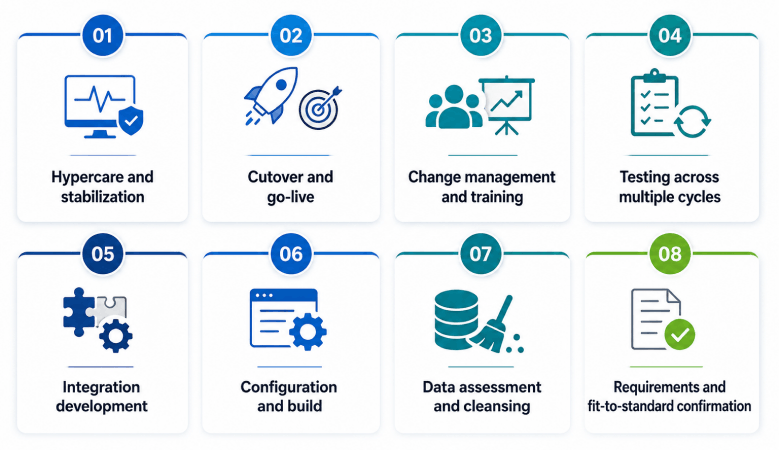
Beyond the six phases themselves, specific SAP implementation steps recur across any well-run project regardless of methodology version, and skipping or under-resourcing any of them is where projects most commonly lose time and budget.
1.
Requirements and fit-to-standard confirmation
Every genuine business requirement should be evaluated against standard SAP functionality first, with custom development approved only where a genuine gap exists and the business case for customization outweighs the long-term maintenance cost.
2.
Data assessment and cleansing
Legacy data quality directly determines migration timeline and post-go-live data trust. This step should begin early in Explore, not late in Realize, since data quality issues discovered close to go-live compress the time available to fix them properly.
3.
Configuration and build
Translating confirmed requirements into system configuration, including organizational structure, master data governance rules, and any approved custom development.
4.
Integration development
Building the connections between SAP and surrounding systems – CRM, MES, third-party logistics platforms, banking interfaces – that the business depends on for end-to-end process completion.
5.
Testing across multiple cycles
Unit testing of individual configurations, integration testing across connected processes and systems, and user acceptance testing with actual business users – each cycle catching different categories of issues.
6.
Change management and training
Structured communication, role-based training, and adoption support running in parallel with technical build, not compressed into the final weeks before go-live.
7.
Cutover and go-live
The carefully sequenced process of freezing legacy system activity, completing final data migration, and switching the business over to the new system, typically during a low-activity window.
8.
Hypercare and stabilization
Intensive post-go-live support addressing the issues that inevitably surface once real transaction volume and real users interact with the system in ways testing did not fully anticipate.
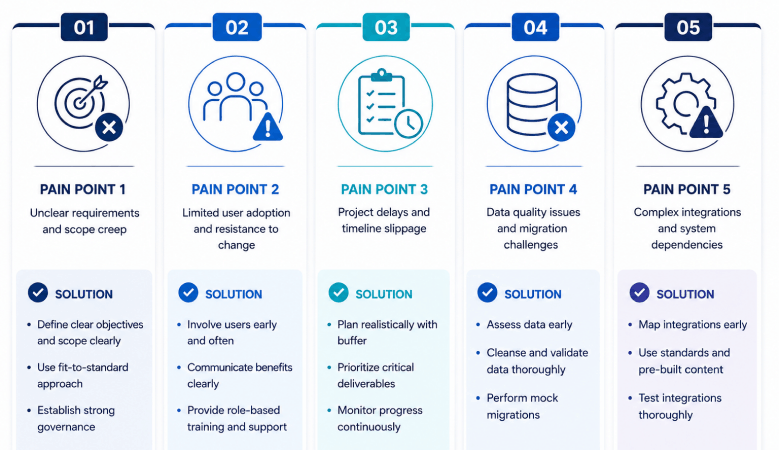
Common Pain Points in SAP Project Implementation - and How to Solve Them
Pain point 1: Scope creep from unclear fit-to-standard discipline. Without a firm commitment to fit-to-standard evaluation, Explore-phase workshops drift into extensive customization requests, each seemingly reasonable in isolation but collectively expanding scope, cost, and timeline well beyond the original business case.
Solution: Establish a formal governance process for any customization request, requiring documented business justification and total cost of ownership analysis (build plus every future upgrade) before approval, not just build cost.
Pain point 2: Data quality issues discovered too late. Legacy data problems – duplicate vendor records, inconsistent master data, missing mandatory fields – routinely surface during final data migration testing, far too late to remediate properly before go-live.
Solution: Run a formal data assessment during Explore, not Realize, profiling source data for quality issues while there is still time to build proper cleansing and validation processes rather than rushing fixes under cutover pressure.
Pain point 3: Under-resourced change management. Technical teams frequently receive full project resourcing while change management and training are treated as a smaller, later-stage activity – producing a technically sound system that users resist or misuse because they were never properly prepared for how their work changes.
Solution: Resource change management from Prepare phase onward, not as a Deploy-phase afterthought, with role-based training content developed in parallel with configuration so it reflects the actual system users will encounter.
Pain point 4: Underestimating integration complexity. Organizations frequently scope “the SAP implementation” without fully accounting for every system SAP needs to connect to – manufacturing execution systems, banking platforms, e-commerce systems, third-party logistics providers – each adding genuine technical complexity discovered mid-project rather than during initial scoping.
Solution: Complete a full integration landscape inventory during Prepare, before detailed project planning locks in timeline and budget assumptions that do not account for the true integration scope.
Pain point 5: Compressed hypercare leading to post-go-live instability. Organizations that plan minimal post-go-live support, expecting the system to run smoothly from day one, consistently underestimate the volume of issues that surface once real users and real transaction volume hit the system for the first time.
Solution: Budget a defined, adequately staffed hypercare period – typically four to eight weeks depending on project complexity – with clear escalation paths and a transition plan into steady-state support rather than an abrupt handoff.
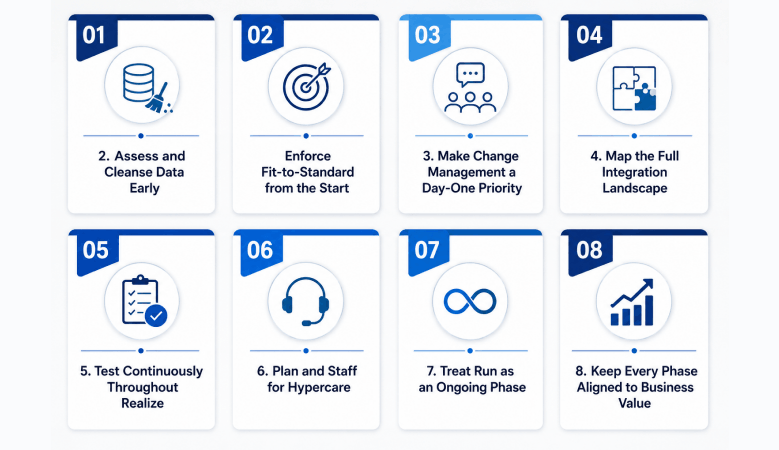
SAP Implementation Best Practices
Enforce Fit-to-Standard from the Start
Commit to fit-to-standard discipline before Explore begins. Establish upfront that customization requires documented business justification and total cost of ownership analysis, not just build cost. Projects that enter Explore without this discipline already in place consistently see scope expand well beyond the original business case.
Assess and Cleanse Data Early
Start data assessment early, not during final migration. Profiling source data quality during Explore – rather than waiting until Realize or later – gives the project enough runway to build proper cleansing and validation processes instead of rushing fixes under cutover pressure.
Make Change Management a Day-One Priority
Resource change management as a parallel workstream from day one. Training and communication should be planned and staffed from Prepare phase onward, developed alongside configuration so materials reflect the actual system users will encounter, not compressed into the final weeks before go-live.
Map the Full Integration Landscape
Complete the integration landscape inventory before locking timeline and budget. Every system SAP needs to connect to – CRM, banking platforms, e-commerce, third-party logistics, shop floor systems – should be identified during Prepare, before assumptions about scope and cost are finalized.
Test Continuously Throughout Realize
Test iteratively throughout Realize, not as a single late-stage gate. Unit, integration, and user acceptance testing should run across multiple cycles as functionality is built, surfacing and resolving issues earlier than a single end-of-phase testing gate allows.
Plan and Staff for Hypercare
Budget a properly staffed hypercare period. Four to eight weeks of intensive post-go-live support, with clear escalation paths, gives the organization room to stabilize before transitioning into steady-state operations – rather than an abrupt handoff that leaves early issues unresolved.
Treat Run as an Ongoing Phase
Treat Run as a defined phase, not an afterthought. Post-go-live governance, continuous improvement, and periodic innovation cycles need their own resourcing plan. Organizations that stop planning once go-live is complete consistently see configuration drift and unaddressed user issues accumulate in the months that follow.
Keep Every Phase Aligned to Business Value
Align every phase back to the original business case. Revisit the goals defined during Discover at each subsequent phase gate, confirming the project is still delivering against the value it was originally justified on – not just moving forward on schedule.

Industry-Specific Considerations in SAP Implementation
Generic SAP implementation guidance often assumes a relatively standard business environment. Organizations in regulated or operationally complex industries carry additional considerations that a generic project plan does not fully address.
- Pharmaceutical and life sciences implementations require Computer System Validation (CSV) documentation and GxP compliance validation woven into every phase, not added as a compliance review at the end – validation protocols need to be designed alongside configuration, not retrofitted after Realize is complete.
- Food and beverage manufacturers require lot traceability and quality hold configuration built into core process design from Explore onward, since these are regulatory requirements shaping how order-to-cash and procure-to-pay processes must function, not optional enhancements.
- Discrete and process manufacturing organizations implementing SAP alongside existing MES and shop floor systems need integration architecture scoped during Prepare, not discovered as a gap during Realize when the timeline has far less flexibility to absorb unplanned integration work.
- Financial services and insurance organizations typically carry additional regulatory reporting and data residency requirements that shape configuration decisions around financial close processes, audit trails, and cross-border data handling from the earliest planning stages.
- Retail and consumer goods implementations often center on integration complexity across e-commerce platforms, point-of-sale systems, and omnichannel inventory visibility – requirements that need to be scoped as thoroughly as core ERP functionality rather than treated as secondary integrations.
Across every industry, the common thread is the same: sector-specific requirements need to be identified and designed for early in the project, not discovered as gaps once configuration is already underway.
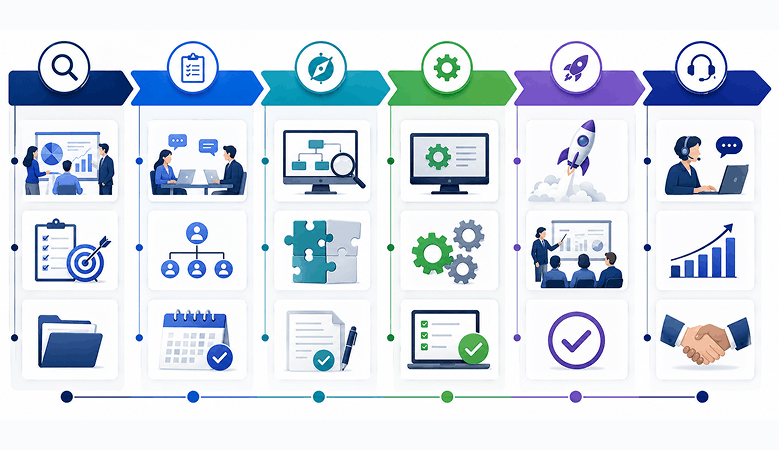
What the SAP Implementation Process Looks Like Week to Week
Understanding SAP implementation phases at a conceptual level is useful, but organizations planning their first SAP project implementation often want a more concrete sense of what the sap implementation process actually involves on a practical, week-to-week basis.
Prepare: Establishing the Project Foundation
During Prepare, the sap implementation process is largely governance and setup work: finalizing the project charter, standing up the project team, provisioning the initial system landscape, and confirming the detailed project plan against the business case built during Discover. This stage typically runs a few weeks for a focused implementation and longer for multi-country or multi-module scope.
Explore: Driving Fit-to-Standard Workshops
During Explore, the sap implementation process shifts to intensive workshop cadence – fit-to-standard sessions run process area by process area, with business stakeholders reviewing standard SAP functionality and confirming or flagging gaps daily or near-daily across several weeks. This is where the character of a modern SAP project implementation differs most visibly from legacy approaches: instead of long documentation cycles, the sap implementation process here is hands-on and iterative, with decisions captured directly against a working system rather than a requirements document reviewed weeks later.
Realize: Building and Testing in Iterations
During Realize, the sap implementation process becomes build-and-test cycles running in sprints – configuration completed, tested, and refined in short iterations rather than one long build phase followed by one long test phase. Integration development runs in parallel with configuration, and data migration development begins in earnest, informed by the data assessment work that should have started back in Explore.
Deploy and Run: From Go-Live to Operations
Deploy compresses the sap implementation process into final validation: user acceptance testing, training delivery, cutover rehearsal, and the go-live event itself, followed immediately by hypercare. Run then shifts the sap implementation process from project-mode intensity into steady operational cadence, with periodic innovation cycles replacing the constant build-and-test rhythm of Realize.
Planning Resources Around Each Implementation Phase
Organizations that understand this process at a practical, phase-by-phase level – not just as a conceptual diagram – are better equipped to staff each stage correctly, since the skills and intensity required during Explore’s workshop cadence differ meaningfully from what Deploy’s cutover execution demands.
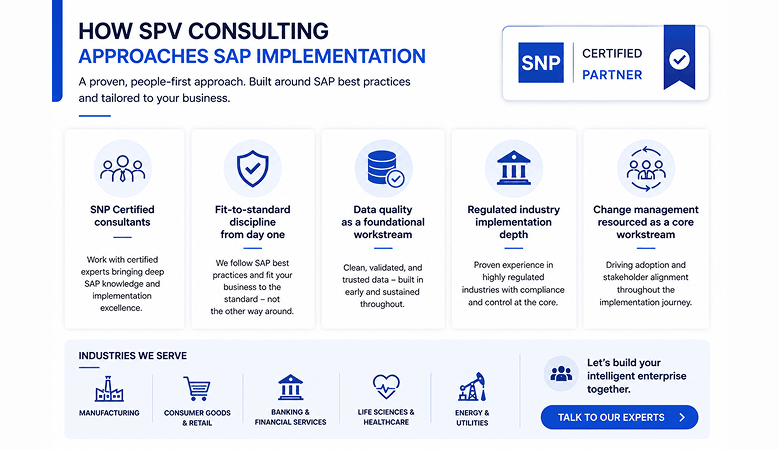
How SPV Consulting Approaches SAP Implementation
SNP Certified consultants
SPV Consulting’s SNP-certified consultants deliver SAP implementation projects using SAP Activate methodology, with specific depth in the industries where implementation carries the highest operational and regulatory stakes.
Fit-to-standard discipline from day one
SPV Consulting’s Explore-phase workshops are structured around genuine fit-to-standard evaluation, with a formal governance process for any customization request – protecting client budgets and timelines from the scope creep that undermines so many SAP implementation projects.
Data quality as a foundational workstream
Reflecting lessons from SPV Consulting’s SAP data migration practice, data assessment and cleansing begin during Explore, not as a late-stage scramble before cutover.
Regulated industry implementation depth
For pharmaceutical and food and beverage clients, SPV Consulting builds CSV documentation, GxP validation protocols, and lot traceability requirements into configuration design from the start of Realize, not as a post-implementation remediation project.
Change management resourced as a core workstream
SPV Consulting treats training and change management as a parallel workstream from Prepare phase onward, not a Deploy-phase afterthought – reflecting the reality that a technically successful implementation of SAP with poor user adoption is not actually a successful project.

Looking for SAP Implementation Experts?
At SPV Consulting, we provide end-to-end SAP implementation and consulting services tailored to your organization’s business goals. From initial planning and fit-to-standard workshops through deployment, hypercare, and ongoing support, our experienced SAP about:blank#blockedconsultants help ensure a smooth and successful transformation.
Whether you’re planning a new SAP implementation, an S/4HANA transformation, or need expert guidance to optimize your existing SAP environment, SPV Consulting is here to support your journey.
Contact SPV Consulting today to discuss your SAP implementation needs and discover how our experts can help you maximize the value of your SAP investment.
min read
TOPICS
- What Is SAP Implementation?
- SAP Implementation Methodology: ASAP vs. SAP Activate
- SAP Implementation Phases: The SAP Activate Framework
- SAP Implementation Steps Within Each Phase
- Common Pain Points in SAP Project Implementation - and How to Solve Them
- SAP Implementation Best Practices
- Industry-Specific Considerations in SAP Implementation
- What the SAP Implementation Process Looks Like Week to Week
- How SPV Consulting Approaches SAP Implementation
- Looking for SAP Implementation Experts?
Frequently Asked Questions
What is SAP implementation?
SAP implementation is the structured process of configuring, customizing, testing, and deploying SAP software into an organization’s live business operations. It includes technical configuration, data migration, system integration, testing, and organizational change management – not just the software deployment itself. This SAP implementation guide covers each of these components across the phases where they occur.
What is the difference between an SAP implementation guide and the SAP customizing implementation guide?
An SAP implementation guide refers to the project methodology used to plan and execute an SAP deployment – SAP Activate and its phases. The SAP customizing implementation guide, more commonly called the IMG, is a different thing entirely: a configuration menu built into the SAP system itself, accessed through transaction code SPRO, that consultants use during Realize to set system parameters and business rules. One is a project framework; the other is a technical configuration tool used within that framework.
What is SAP implementation methodology?
SAP implementation methodology refers to the structured framework governing how an SAP project is planned and executed. The current standard is SAP Activate, a six-phase methodology (Discover, Prepare, Explore, Realize, Deploy, Run) built around fit-to-standard evaluation. It replaced the older ASAP (Accelerated SAP) methodology, which used a five-phase, blueprint-driven approach better suited to legacy ECC-era implementations.
What are the main SAP implementation phases?
Under SAP Activate, the current SAP implementation methodology, the six phases are Discover (business case and product exploration), Prepare (project kickoff and governance), Explore (fit-to-standard workshops and requirements confirmation), Realize (configuration, build, and iterative testing), Deploy (final testing, training, cutover, and go-live), and Run (ongoing operations and continuous improvement).
What are the typical SAP implementation steps within each phase?
Common SAP implementation steps include requirements and fit-to-standard confirmation, data assessment and cleansing, configuration and build, integration development, multiple cycles of testing, change management and training, cutover and go-live, and post-go-live hypercare and stabilization.
How long does a typical SAP implementation project take?
Timeline varies significantly based on project scope, number of modules, data complexity, and organization size. A focused, single-country S/4HANA Cloud implementation using SAP Activate’s accelerated approach may run several months; complex, multi-country, multi-module enterprise implementations with extensive integration and regulated industry compliance requirements typically run over a year.
What causes most SAP project implementation failures or delays?
The most common causes are scope creep from insufficient fit-to-standard discipline, data quality issues discovered too late in the project, under-resourced change management and training, underestimated integration complexity, and compressed post-go-live hypercare support that leaves the organization unprepared for the issues that surface once real users and real transaction volume hit the new system.
Is SAP Activate required for all SAP implementations?
SAP Activate is SAP’s recommended and effectively mandatory methodology for S/4HANA Cloud implementations, and is strongly recommended for on-premise and private cloud S/4HANA projects as well. Organizations implementing SAP today should default to SAP Activate rather than legacy ASAP methodology, which remains referenced in older documentation and training content but does not reflect SAP’s current implementation approach.