
15 SAP Manufacturing Modules List: An Enterprise Guide
Ask five manufacturing IT leaders which SAP manufacturing modules matter most to their operation, and you will get five different answers, each shaped by a different production reality.
A discrete electronics manufacturer running just-in-time assembly lines cares about different configuration than a pharmaceutical company running batch production under GxP validation, which cares about different configuration than a food and beverage plant managing lot traceability across multiple facilities.Understanding this landscape means understanding which modules solve which specific operational problem, not memorizing a generic list.
This guide covers all 15 core SAP manufacturing modules used across discrete, process, and repetitive manufacturing environments, how they integrate with each other, and what enterprise organizations – not small businesses running SAP Business One actually need to configure to run production, quality, maintenance, and supply chain operations inside S/4HANA.
This guide is built for the enterprise manufacturing environment specifically: complex bills of materials, multi-plant operations, regulatory compliance, and production volumes that a Business One configuration was never designed to support.
According to SPV Consulting’s approach, drawn from SNP-certified engagements delivering SAP manufacturing modules for different clients, the organizations that get the most value from SAP treat module selection as a production strategy decision, not an IT checklist item.
What Are SAP Manufacturing Modules?
SAP manufacturing modules are the functional components within the SAP ERP and S/4HANA landscape that govern production planning, execution, quality, maintenance, and the supply chain processes that support manufacturing operations. Unlike modules built for retail, professional services, or financial services, SAP modules used in manufacturing domain environments are configured around bills of materials, work centers, routings, production orders, and the physical and regulatory realities of converting raw materials into finished goods.
A comprehensive sap manufacturing modules list spans core production functionality (Production Planning), quality (Quality Management), asset and equipment reliability (Plant Maintenance), materials and procurement (Materials Management), warehouse and logistics execution (Extended Warehouse Management), financial and cost visibility (Finance and Controlling), customer-facing order fulfillment (Sales and Distribution), safety and compliance (Environment, Health, and Safety), capital projects (Project System), engineering change control (Product Lifecycle Management), network-level planning (Integrated Business Planning), workforce management (Human Capital Management), outbound logistics (Transportation Management), configure-to-order production (Variant Configuration) and controlled documentation (Document Management System), each integrated so that a single production event updates inventory, cost, quality status, and financial records simultaneously.

SAP Solutions for the Manufacturing Industry: Why Enterprise Configuration Differs From SME Deployments
Enterprise manufacturers typically run multi-plant, multi-country operations requiring cross-plant visibility and standardized processes across facilities that may have started on different legacy systems. Bringing those operations into a unified S/4HANA environment also requires a carefully planned SAP data migration strategy to maintain data quality and continuity across plants and business units.
They carry complex, multi-level bills of materials with hundreds or thousands of components, engineering change management, and variant configuration for products built to order. They operate under regulatory frameworks – FDA 21 CFR Part 11 for pharmaceutical manufacturers, food safety and lot traceability requirements for food and beverage producers, and industry-specific quality standards for automotive and aerospace suppliers – that a small-business ERP configuration is not built to support natively.
Enterprise-scale manufacturing also requires deeper integration with shop floor systems – Manufacturing Execution Systems (MES), SCADA, and IoT sensor data – feeding real-time production data back into SAP for planning and quality decisions. This is the layer where most generic module-list content stops short, and where enterprise manufacturing organizations need genuine implementation depth rather than a feature overview.
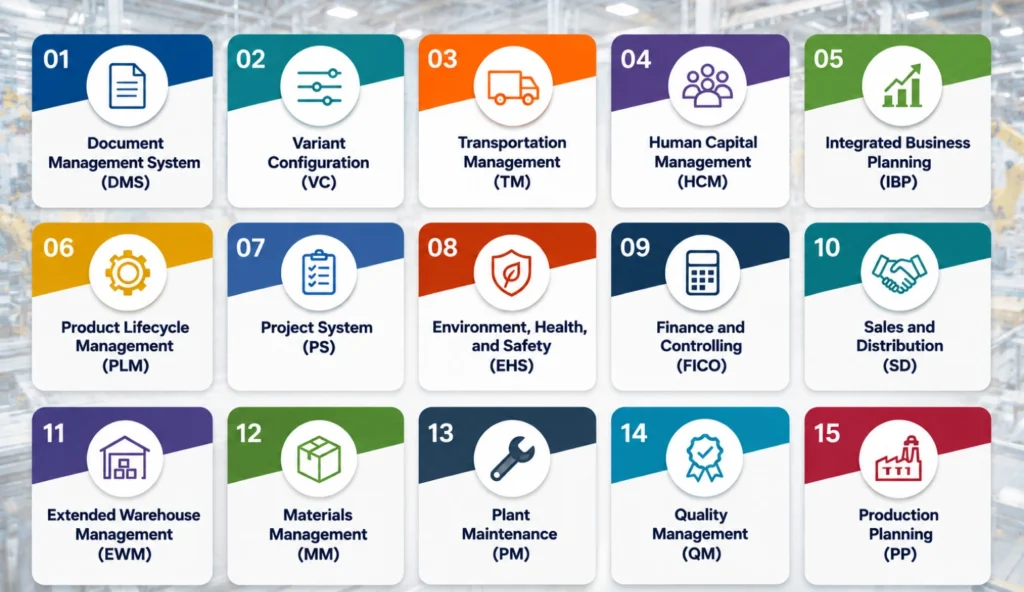
15 Core SAP Manufacturing Modules List
1. Production Planning (PP)
Production Planning is the central module in any sap manufacturing modules list, governing demand planning, master production scheduling, material requirements planning (MRP), and the creation and execution of production orders. PP manages the bill of materials (BOM) structure, work center definitions, and routings that define how a product moves through production.
For discrete manufacturers, PP configuration centers on order-based production – each production order tied to a specific quantity, routing, and bill of materials. For process manufacturers (pharmaceutical, chemical, food and beverage), PP integrates with Process Orders and recipe management, where formula-based production replaces the BOM-and-routing structure used in discrete environments. For high-volume repetitive manufacturers, PP supports Repetitive Manufacturing (REM) functionality, which streamlines order creation for production lines running the same product configuration continuously.
PP-DS (Production Planning and Detailed Scheduling), available as an advanced planning capability within S/4HANA, extends core PP with finite capacity scheduling, optimizer-driven sequencing, and more sophisticated constraint-based planning for complex production environments with capacity bottlenecks.
2. Quality Management (QM)
Quality Management governs inspection planning, quality notifications, certificate management, and the quality holds that prevent non-conforming material from moving further into production or shipping to customers. QM is one of the SAP modules used in manufacturing domain environments where regulatory compliance is non-negotiable.
For pharmaceutical and food and beverage manufacturers specifically, QM configuration extends into batch and lot traceability – tracking every batch of raw material through production into finished goods, so that a quality issue discovered downstream can be traced back to every affected batch and every customer who received product from it. This traceability is not an optional feature; it is a regulatory requirement under FDA and international food safety standards, and it is one of the clearest differentiators between a generic QM configuration and one built for regulated manufacturing.
3. Plant Maintenance (PM)
Plant Maintenance manages the equipment reliability side of manufacturing operations – preventive maintenance scheduling, breakdown maintenance, work order management, and equipment history tracking. PM integrates directly with PP, since unplanned equipment downtime directly affects production schedules, and with MM, since maintenance work orders consume spare parts inventory.
Enterprise manufacturers increasingly connect PM to IoT sensor data and predictive maintenance models, using equipment condition data to trigger maintenance work orders before failure occurs rather than relying purely on time-based preventive maintenance schedules. This is one of the areas where SAP solutions for the manufacturing industry are evolving fastest, as AI-driven predictive maintenance becomes standard rather than exceptional.
4. Materials Management (MM)
Materials Management governs procurement, inventory management, and the movement of raw materials, components, and finished goods through the supply chain. MM handles purchase requisitions and orders, goods receipt and issue, inventory valuation, and vendor management – the operational backbone that ensures production has the materials it needs when it needs them.
In manufacturing environments specifically, MM integrates tightly with PP through MRP, which calculates material requirements based on production schedules and triggers procurement or production orders automatically to meet demand without excessive inventory carrying cost.
5. Extended Warehouse Management (EWM)
Extended Warehouse Management governs the physical execution of warehouse and logistics operations – bin management, pick and pack processes, cross-docking, and the detailed warehouse operations that standard MM inventory management does not cover at the granularity enterprise manufacturers require. EWM is particularly critical for manufacturers running high SKU counts, complex packaging requirements, or multi-warehouse distribution networks. Organizations implementing or optimizing complex warehouse processes may also need access to specialized SAP EWM consultants and staffing expertise that is difficult to maintain internally.
6. Sales and Distribution (SD)
Sales and Distribution manages the customer-facing side of manufacturing operations – order entry, pricing, availability checks against production and inventory, shipping, and billing. SD integrates with PP through availability-to-promise (ATP) checks, ensuring that customer commitments are based on real production capacity and inventory position rather than optimistic assumptions.
7. Finance and Controlling (FICO)
Finance and Controlling provides the financial backbone connecting every manufacturing transaction to cost accounting, profitability analysis, and financial reporting. In manufacturing specifically, FICO integrates with PP for production order costing (planned versus actual cost variance), with MM for material valuation, and with QM for quality-related cost tracking – giving manufacturing leadership real-time visibility into production cost performance rather than a monthly close-cycle report.
8. Environment, Health, and Safety (EHS)
For manufacturers in regulated or hazardous material environments, the EHS module manages safety data sheets, hazardous material handling, incident tracking, and regulatory compliance reporting required under OSHA and equivalent international frameworks. EHS is frequently underrepresented in generic sap manufacturing modules list content but is a genuine requirement for chemical, pharmaceutical, and heavy industrial manufacturers.
9. Project System (PS)
Project System manages capital projects, plant expansions, and new production line commissioning – tracking budget, milestones, and resource allocation for initiatives too complex for standard production order structures. PS is essential when manufacturers are building or retooling capacity, not just running existing lines.
10. Product Lifecycle Management (PLM)
PLM governs engineering change management, BOM versioning, and technical document control – ensuring that when a product design changes, every downstream system reflects the update. This is critical wherever engineering and production must stay tightly synchronized.
11. Integrated Business Planning (IBP)
IBP extends beyond basic MRP into demand sensing, supply planning, and sales and operations planning (S&OP) across multiple facilities. Manufacturers coordinating production across several plants rely on IBP to balance capacity and demand at a network level, not just a single-site level.
12. Human Capital Management (HCM)
HCM covers shift scheduling, labor planning, time tracking, and workforce management for plant personnel – connecting labor availability directly to production capacity planning in PP, particularly in labor-intensive manufacturing environments.
13. Transportation Management (TM)
Transportation Management governs outbound logistics, carrier selection, freight cost management, and shipment tracking – distinct from EWM’s warehouse-level execution. TM matters most for manufacturers with complex, multi-carrier distribution networks.
14. Variant Configuration (VC)
Variant Configuration enables configure-to-order and made-to-order production, letting a single generic material master represent thousands of possible product variants defined by customer-selected options. VC is foundational for discrete manufacturers building complex, customizable products.
15. Document Management System (DMS)
DMS manages controlled documents – SOPs, engineering drawings, batch records, and quality certificates – with version control and audit trail. For pharmaceutical and food and beverage manufacturers under regulatory scrutiny, DMS is often as critical as QM itself.
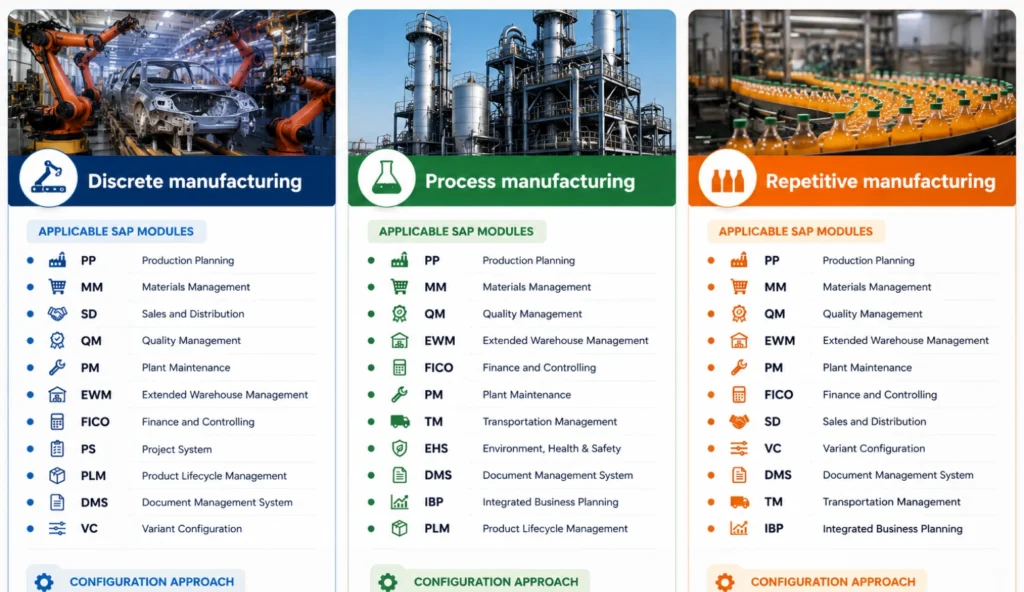
SAP Modules for Manufacturing Industry by Manufacturing Type
Understanding sap modules for manufacturing industry configuration requires understanding that “manufacturing” is not one operational model. The module configuration differs meaningfully across three primary manufacturing types.
1.
Discrete manufacturing
produces distinct, countable units – electronics, machinery, furniture, automotive components – typically using order-based production with bills of materials and routings in PP, serialized or batch tracking in QM depending on product type, and often complex variant configuration for made-to-order or configure-to-order products.
2.
Process manufacturing
produces goods through a formula or recipe-based process where the output cannot be broken back down into its original components – pharmaceuticals, chemicals, food and beverage products. Process manufacturing relies on Process Orders and recipe management within PP, with QM batch and lot traceability configured as a core requirement rather than an optional add-on, given the regulatory stakes in these industries.
3.
Repetitive manufacturing
produces the same or highly similar product continuously over an extended period – consumer electronics, packaged goods, automotive components produced at high volume. Repetitive Manufacturing (REM) functionality within PP simplifies order creation and backflushing (automatic material consumption posting) for production lines that do not require individual production orders for every run.
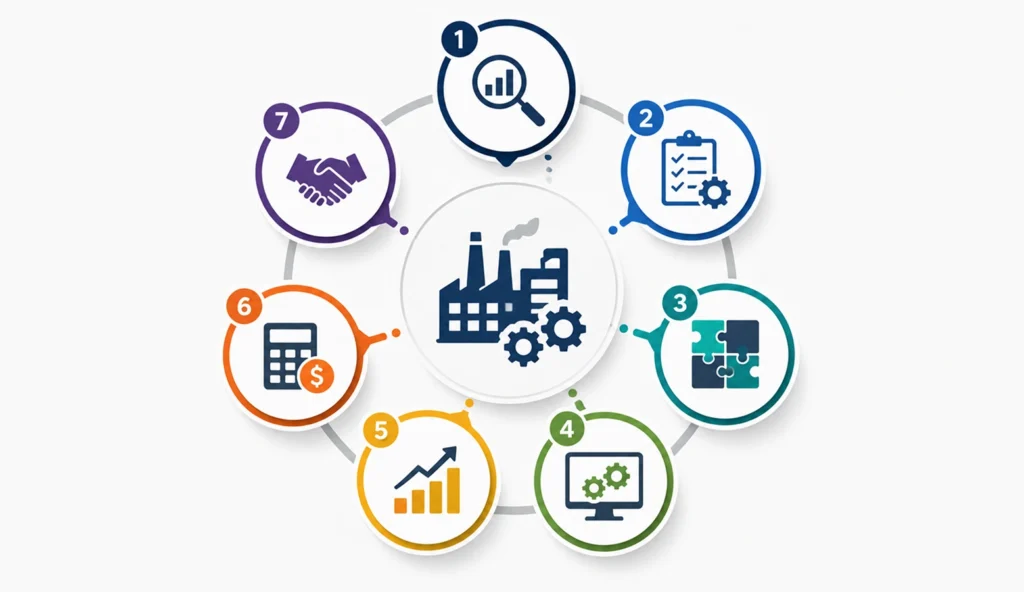
Choosing the Right SAP Modules for Your Manufacturing Operation
Selecting sap modules for manufacturing industry deployment is not a one-size-fits-all exercise, and the right combination depends on production model, industry regulation, and operational scale, not a standard template applied uniformly across every implementation.
Start by identifying your manufacturing type, since this determines the core configuration approach within PP and QM before any other module decision is made. A discrete manufacturer building configured products to order needs variant configuration and order-based production tracking. A process manufacturer producing under formula or recipe needs Process Orders and batch-centric QM configuration from day one. A repetitive manufacturer running continuous production lines needs REM functionality that most generic sap modules for manufacturing industry checklists gloss over entirely.
Next, map regulatory obligations directly to module scope. Organizations that identify FDA, food safety, or industry-specific quality standards early can build QM, EHS, and batch traceability requirements into the initial configuration rather than retrofitting compliance capability after an audit finding forces the issue. This is one of the most consistent gaps in how sap modules used in manufacturing domain projects are scoped – compliance requirements treated as a later-phase enhancement rather than a foundational design input.
Finally, evaluate integration scope beyond the ERP boundary. Enterprise manufacturers connecting SAP to MES, IoT sensor networks, or advanced planning tools need to scope that integration alongside core module selection, since retrofitting shop floor connectivity after go-live is consistently more expensive than designing for it from the start. The sap modules used in manufacturing domain organizations select should reflect not just current operational needs but the digital transformation roadmap the business is building toward over the next several years.
How SAP Manufacturing Modules Integrate With Each Other
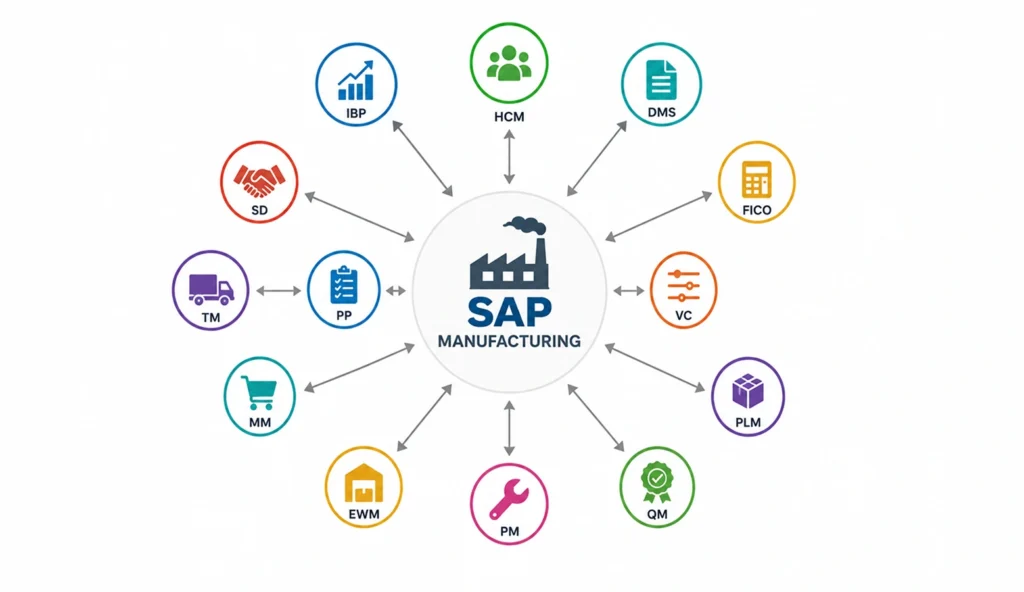
The real value of SAP manufacturing modules is not any single module in isolation – it is the integration between them, where a single production event updates multiple functional areas simultaneously without manual re-entry or reconciliation.
When a production order is created in PP, it draws on the bill of materials and routing, checks material availability against MM inventory, and reserves capacity against work centers. As production executes, goods movements post automatically to MM, updating inventory in real time. If quality inspection is required, QM triggers an inspection lot tied to the production order, and the material remains in a quality-blocked status until inspection results are recorded. Once cleared, finished goods become available for SD to fulfill customer orders, with the entire cost of the production run flowing through to FICO for variance analysis against planned cost.
This integration is where the difference between a properly configured enterprise deployment and a poorly scoped one becomes most visible. Organizations that configure modules in isolation – PP without proper QM integration, or MM without proper PP-driven MRP – end up with the manual workarounds and Excel reconciliation that SAP was implemented specifically to eliminate.
Industry 4.0 and MES Integration With SAP Manufacturing Modules
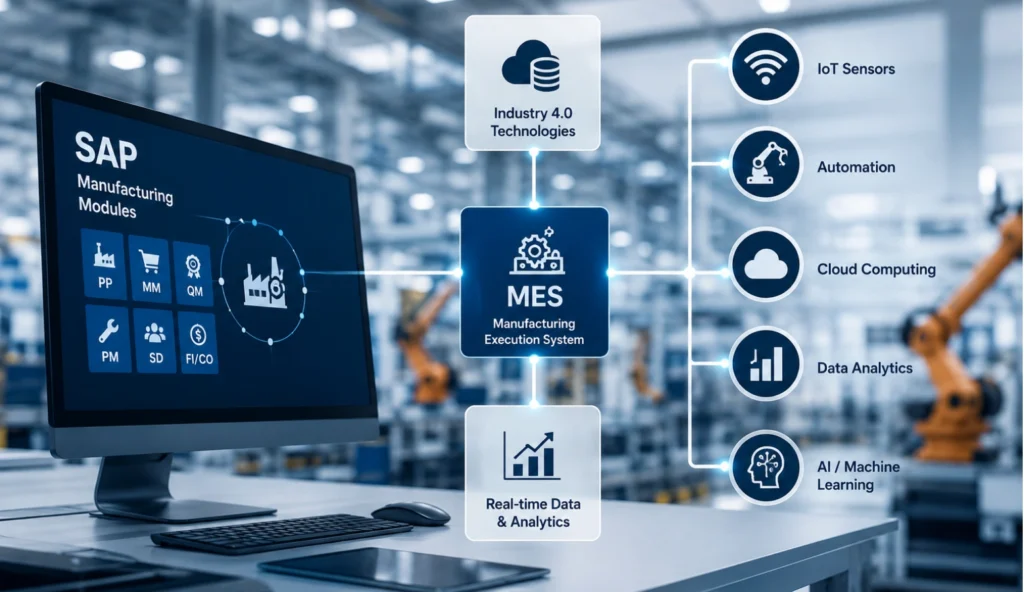
Enterprise manufacturers increasingly connect SAP manufacturing modules to shop floor systems – Manufacturing Execution Systems (MES), SCADA platforms, and IoT sensor networks – creating a bidirectional data flow between the ERP planning layer and the physical production floor. Production schedules generated in PP flow down to MES for shop floor execution, while real-time production status, machine performance data, and quality inspection results flow back into SAP for planning adjustment and cost tracking. Understanding the role of SAP BTP and SAP CPI in enterprise integration can help manufacturers evaluate the architecture needed to connect SAP with MES, cloud applications, and other operational systems.
This integration layer is where SAP Digital Manufacturing Cloud and similar SAP solutions for the manufacturing industry extend the core ERP modules with real-time shop floor visibility, machine connectivity, and manufacturing analytics that pure ERP configuration does not provide natively. Organizations planning a manufacturing digital transformation initiative should scope MES integration requirements alongside core module configuration from the start, rather than treating shop floor connectivity as a future phase.
Common Mistakes When Configuring SAP Manufacturing Modules
Treating module selection as a generic checklist rather than a production strategy decision
Organizations that implement a standard sap manufacturing modules list without mapping it against their specific manufacturing type (discrete, process, or repetitive) end up with configuration that does not match how production actually runs.
Underestimating QM configuration for regulated industries
Pharmaceutical and food and beverage manufacturers that treat batch and lot traceability as a QM configuration detail, rather than a core regulatory requirement shaping the entire implementation, consistently face costly rework when the initial configuration cannot support audit and recall requirements.
Configuring PM as an afterthought
Manufacturers that under-invest in Plant Maintenance configuration lose the connection between equipment reliability data and production planning, missing the predictive maintenance capability that reduces unplanned downtime.
Ignoring MES and shop floor integration requirements during initial scoping
Organizations that scope core ERP modules without considering shop floor connectivity requirements often face expensive integration rework once the need for real-time production visibility becomes apparent post-go-live.
How SPV Consulting Supports SAP Manufacturing Modules Implementation
SPV Consulting’s SNP-certified consultants bring direct, hands-on experience configuring SAP manufacturing modules across discrete manufacturing, pharmaceutical process manufacturing, and food and beverage production environments – industries where module configuration carries operational and regulatory stakes that generic SAP solutions for the manufacturing industry content does not address.
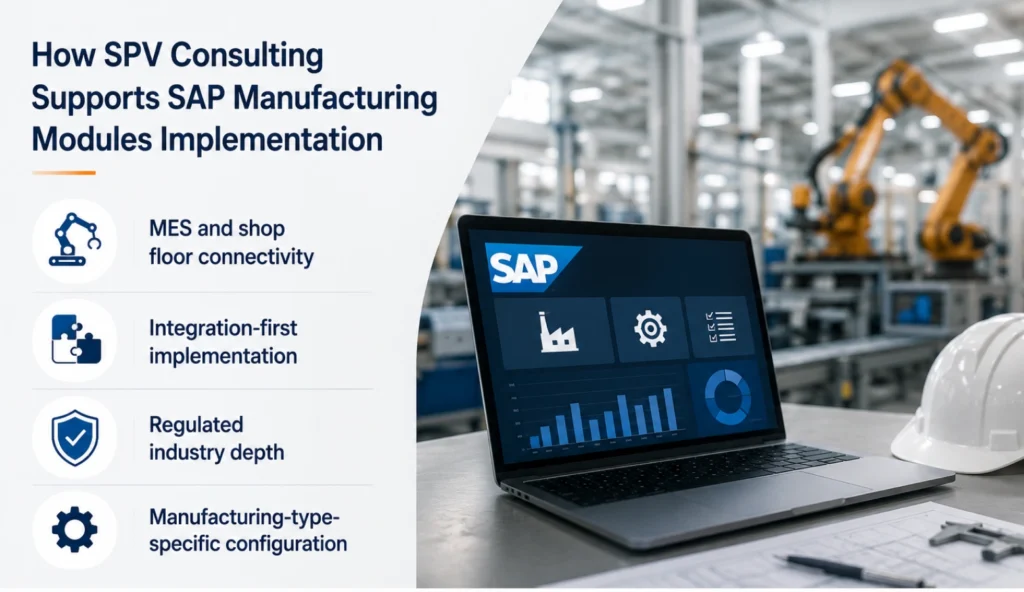
1. Manufacturing-type-specific configuration
SPV Consulting configures PP, QM, and PM based on the actual production model – discrete, process, or repetitive – rather than applying a generic sap manufacturing modules list without regard to how production actually operates on the floor.
2. Regulated industry depth
For pharmaceutical and food and beverage clients, SPV Consulting’s approach to QM configuration is built around batch and lot traceability, GxP validation requirements, and audit trail configuration from the start of the implementation, not retrofitted after go-live.
3. Integration-first implementation
SPV Consulting configures sap manufacturing modules with cross-module integration as a core design principle – ensuring PP, QM, MM, PM, SD, and FICO work together as a connected system rather than isolated functional silos requiring manual reconciliation.
4. MES and shop floor connectivity
For clients requiring real-time production visibility, SPV Consulting scopes MES and IoT integration requirements alongside core module configuration, avoiding the costly post-go-live rework that comes from treating shop floor connectivity as an afterthought.
min read
TOPICS
- What Are SAP Manufacturing Modules?
- SAP Solutions for the Manufacturing Industry:
- 15 Core SAP Manufacturing Modules List
- SAP Modules for Manufacturing Industry by Manufacturing Type
- Choosing the Right SAP Modules for Your Manufacturing Operation
- How SAP Manufacturing Modules Integrate With Each Other
- Industry 4.0 and MES Integration With SAP Manufacturing Modules
- Common Mistakes When Configuring SAP Manufacturing Modules
- How SPV Consulting Supports SAP Manufacturing Modules Implementation
Frequently Asked Questions
What are the main SAP manufacturing modules?
The core SAP manufacturing modules are Production Planning (PP), Quality Management (QM), Plant Maintenance (PM), Materials Management (MM), Extended Warehouse Management (EWM), Sales and Distribution (SD), Finance and Controlling (FICO), Environment, Health, and Safety (EHS), Project System (PS), Product Lifecycle Management (PLM), Integrated Business Planning (IBP), Human Capital Management (HCM), Transportation Management (TM), Variant Configuration (VC), and Document Management System (DMS). Together, these modules manage production planning and execution, quality inspection, equipment maintenance, procurement and inventory, warehouse operations, customer order fulfillment, financial cost tracking, safety compliance, capital projects, engineering change control, network-level planning, workforce management, logistics, product configuration, and controlled documentation.
What is the difference between SAP modules for the manufacturing industry and SAP modules for other industries?
SAP modules for manufacturing industry configuration center on production-specific functionality – bills of materials, work centers, routings, production and process orders – that industries like retail, professional services, or financial services do not require. Manufacturing configuration also carries deeper integration requirements between PP, QM, PM, and MM to support the physical production process, whereas non-manufacturing industries configure SAP primarily around transactional and service delivery processes.
What SAP modules are used in manufacturing domain environments for regulated industries?
Pharmaceutical, food and beverage, and chemical manufacturers – operating in regulated manufacturing domain environments – rely heavily on QM for batch and lot traceability, EHS for hazardous material and safety compliance, and PP configured around Process Orders and recipe management rather than discrete production orders, in addition to the core modules used across all manufacturing types.
How does SAP support different types of manufacturing?
SAP supports discrete manufacturing through order-based production with bills of materials and routings, process manufacturing through Process Orders and recipe management with strong QM batch traceability, and repetitive manufacturing through Repetitive Manufacturing (REM) functionality that streamlines order creation for continuous production lines.
What is included in a typical SAP manufacturing modules list for enterprise implementations?
A typical enterprise sap manufacturing modules list includes Production Planning (PP) and often PP-DS for advanced scheduling, Quality Management (QM), Plant Maintenance (PM), Materials Management (MM), Extended Warehouse Management (EWM), Sales and Distribution (SD), Finance and Controlling (FICO), and Environment, Health, and Safety (EHS) for regulated or hazardous material manufacturers.
How do SAP manufacturing modules integrate with MES and shop floor systems?
SAP manufacturing modules integrate with Manufacturing Execution Systems (MES) and shop floor equipment through a bidirectional data flow: production schedules and work instructions flow down from PP to the shop floor, while real-time production status, machine performance, and quality inspection data flow back up into SAP for planning adjustment, cost tracking, and quality decision-making.
What SAP solutions for the manufacturing industry exist beyond core ERP modules?
Beyond the core ERP modules, SAP solutions for the manufacturing industry include SAP Digital Manufacturing Cloud for shop floor execution and analytics, SAP Asset Performance Management for advanced predictive maintenance, SAP Integrated Business Planning for demand and supply planning, and SAP Business Technology Platform capabilities for extending manufacturing processes with AI and custom applications.
Is SAP Business One sufficient for enterprise manufacturing operations?
SAP Business One is built for small and mid-sized businesses and generally lacks the multi-plant visibility, complex bill of materials handling, advanced production scheduling, and deep regulatory compliance configuration that enterprise manufacturing organizations require. Enterprise manufacturers with complex, multi-facility, or regulated production environments typically require S/4HANA rather than SAP Business One to support their operational and compliance needs.