
SAP vs Oracle ERP: What's the Difference and Which Fits You
Choosing between SAP and Oracle is one of the highest-stakes technology decisions an organization makes, with implementation timelines running months to years and total cost of ownership extending well beyond the initial license.
Understanding the difference between SAP vs Oracle requires looking past marketing comparisons and into how each platform is actually built, who each is genuinely built for, and how each performs in the specific industry context your organization operates in.
This guide covers the real architectural and philosophical differences between SAP and Oracle, how each platform approaches deployment and cloud strategy, where each has genuine strength by functional area and industry, and a practical framework for deciding which fits your organization.
According to SPV Consulting’s approach, drawn from SNP-certified SAP delivery experience across different industry clients, the honest answer to “SAP vs Oracle” is rarely universal – it depends on your industry, your existing technology landscape, and what you’re actually trying to solve.
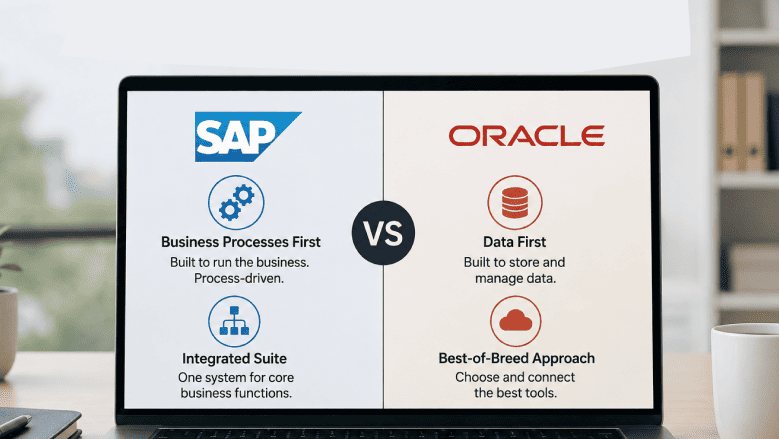
SAP vs Oracle: What’s The Real Difference
Is SAP an ERP System?
Yes, SAP is an ERP (Enterprise Resource Planning) system – specifically, SAP is the world’s largest ERP vendor by market share, offering a family of ERP products spanning S/4HANA for large enterprises, SAP Business One for small and mid-sized businesses, and SAP Business ByDesign as a cloud-based mid-market option.
SAP ERP software covers finance, supply chain, manufacturing, human resources, procurement, and sales in a unified system, with modules that integrate to give a single, connected view of business operations.
Oracle is also an ERP vendor, most commonly compared against SAP through its Oracle Cloud ERP (formerly Oracle Fusion) product for large enterprises, alongside Oracle NetSuite for small and mid-market businesses following Oracle’s 2016 acquisition of NetSuite. Both SAP and Oracle sap oracle comparisons in the market today center primarily on SAP S/4HANA versus Oracle Cloud ERP for enterprise buyers, or SAP Business One versus Oracle NetSuite for smaller organizations.
What Is the Difference Between SAP and Oracle? The Core Philosophical Divide
The most fundamental difference between SAP and Oracle – or oracle vs sap, if you’re approaching the comparison from the other direction – traces back to how each company built its product portfolio, and this difference shapes nearly everything else about how the two platforms behave in practice.
What is the difference between oracle and sap in practice comes down to two very different product development philosophies.
1.
SAP builds primarily from the ground up
SAP’s ERP suite – from its ECC predecessor through S/4HANA – has largely been developed internally as a unified platform, giving SAP products a generally consistent architecture, data model, and user experience across modules. This internal development approach tends to produce deep, tightly integrated functionality, though often at the cost of a more complex, technical implementation process.
2.
Oracle grows significantly through acquisition
Oracle’s ERP portfolio reflects a strategy of acquiring established product lines – PeopleSoft, JD Edwards, Siebel, and NetSuite among them – and integrating them into the broader Oracle ecosystem over time. This gives Oracle strength in reaching niche industry functionality quickly, but has historically meant more variation in architecture and user experience across the acquired product lines as they get folded into Oracle Cloud.
This build-versus-acquire difference between SAP and Oracle is not a simple “better or worse” distinction – it explains different strengths. SAP tends to offer deeper, more consistent core ERP functionality out of the box. Oracle tends to offer faster access to specialized capabilities absorbed from acquired companies, though sometimes with more integration complexity as a result.
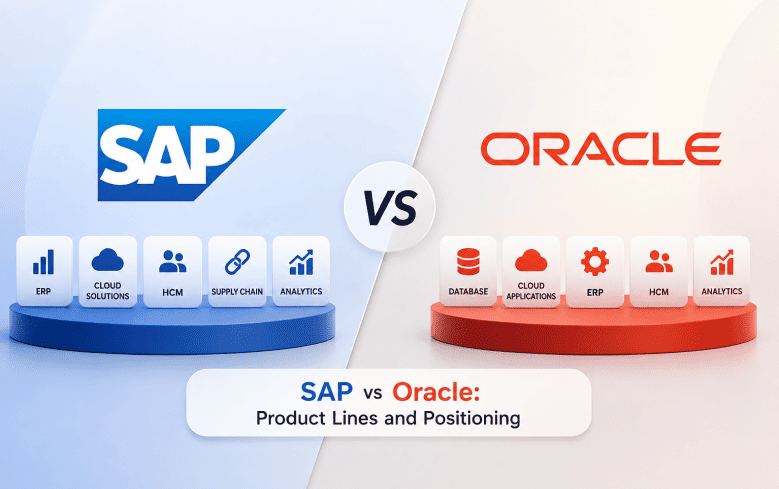
SAP vs Oracle: Product Lines and Positioning
Most sap oracle or oracle sap searches online are really trying to compare specific product lines rather than the companies as a whole, so it helps to break the comparison down by segment.
Segment
SAP
Oracle
Large Enterprise
SAP S/4HANA
Oracle Cloud ERP (Fusion)
Small / Mid-Market
SAP Business One
Oracle NetSuite
Cloud Mid-Market
SAP Business ByDesign
Oracle NetSuite
Legacy (Sunsetting)
SAP ECC (support ends 2027)
Oracle E-Business Suite, Oracle JD Edwards
HR/HCM
SAP SuccessFactors
Oracle HCM Cloud
Both SAP and Oracle are actively moving customers off older, on-premise-heavy platforms toward cloud-native architecture. SAP has set a clear timeline: mainstream maintenance for SAP ECC ends in 2027, pushing the installed base toward S/4HANA.
Oracle has similarly been shifting investment away from Oracle E-Business Suite and Oracle JD Edwards toward Oracle Cloud ERP, though without as firmly publicized an end-of-support date driving the transition.
Comparing the difference between SAP and Oracle ERP systems at this product-line level is usually far more useful than a company-wide comparison, since most buyers are only ever choosing between two specific products, not entire vendor portfolios.
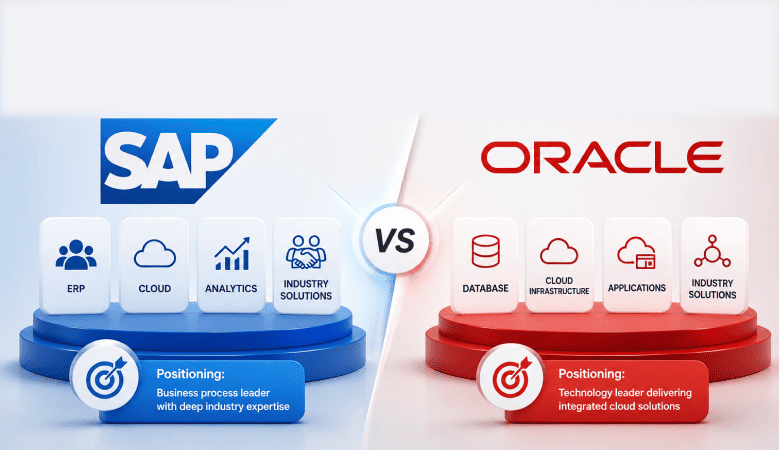
SAP vs Oracle by Functional Area
Rather than presenting fabricated precision scores neither vendor has independently verified, this section covers where each platform has genuinely recognized strength based on documented product capability and how each is typically positioned in the market.
1.
Finance and accounting
Both platforms offer deep, mature financial management functionality suitable for complex, multi-entity, multi-currency organizations. SAP’s FICO module has a long track record in complex manufacturing and industrial finance scenarios.
Oracle Cloud ERP’s financial management has been particularly strong in project-based accounting and has led analyst rankings for cloud core financial management suites in several recent years.
2.
Manufacturing and supply chain
SAP has traditionally held deeper, more mature manufacturing functionality, reflecting decades of development specifically for discrete and process manufacturing environments – production planning, quality management, and plant maintenance modules with genuine depth.
Oracle Cloud ERP has strengthened its manufacturing capabilities significantly, particularly around IoT-enabled equipment monitoring and real-time shop floor visibility, though its manufacturing sub-industry coverage has historically been less mature than SAP’s across the full range of manufacturing scenarios.
3.
Procurement
Oracle Purchasing Cloud is frequently recognized for strong automation of routine procurement transactions and tight integration with accounts payable. SAP’s Materials Management (MM) module offers deep procurement functionality especially valuable in complex, multi-plant manufacturing environments with intricate vendor and material master data requirements.
4.
Human capital management
Oracle HCM Cloud and SAP SuccessFactors are both mature, widely deployed cloud HR platforms, with the choice often driven more by which core ERP a company has selected than a standalone HR platform evaluation.
5.
Business intelligence and dashboards
SAP BusinessObjects and SAP Analytics Cloud provide strong, flexible, role-based dashboard and predictive analytics capability. Oracle’s analytics capabilities have also matured substantially within Oracle Cloud, particularly for organizations already standardized on Oracle’s broader database and analytics ecosystem.
6.
E-commerce
SAP Upscale Commerce (part of the broader SAP Commerce Cloud) supports rapid deployment of digital storefronts, particularly for manufacturers and merchants launching targeted online sales channels. Oracle Commerce Cloud continues active development for organizations building on the broader Oracle Cloud stack.
SAP vs Oracle for Manufacturing, Pharmaceutical, and Food and Beverage Companies
This is where the SAP vs Oracle decision becomes most concrete for the industries SPV Consulting works in daily, and where generic ERP comparisons tend to stay too high-level to be genuinely useful.
For discrete and process manufacturing
SAP’s production planning (PP), quality management (QM), and plant maintenance (PM) modules reflect decades of purpose-built development for manufacturing-specific processes – bills of materials, work centers, routings, and process orders for formula-based production.
Oracle Cloud ERP has made real investment in manufacturing functionality, particularly IoT-enabled equipment monitoring, but its manufacturing sub-industry depth has generally trailed SAP’s more mature, manufacturing-native module set.
For pharmaceutical manufacturers
The deciding factor is often less about general ERP functionality and more about how well each platform supports GxP validation, Computer System Validation (CSV) documentation, and the batch and lot traceability that FDA compliance requires. SAP’s Quality Management module has long-established configuration patterns for this kind of regulated batch traceability, backed by a large ecosystem of implementation partners with specific pharmaceutical validation experience.
For food and beverage manufacturers
A lot traceability, quality hold management, and recipe-based production planning are not optional features but regulatory necessities. SAP’s process manufacturing capabilities, built around Process Orders and recipe management, map directly onto these requirements.
Both platforms can be configured to meet these needs, but the depth and maturity of pre-built, industry-specific configuration tends to favor SAP for organizations with complex, multi-facility food safety compliance requirements.
None of this means Oracle cannot serve these industries – it can, and does, for many organizations. It means that when evaluating SAP vs Oracle specifically within manufacturing, pharma, or food and beverage, the depth of industry-specific, pre-built functionality and the availability of implementation partners with genuine regulated-industry experience are as important as any general platform comparison.
SAP vs Oracle: Deployment and Cloud Strategy
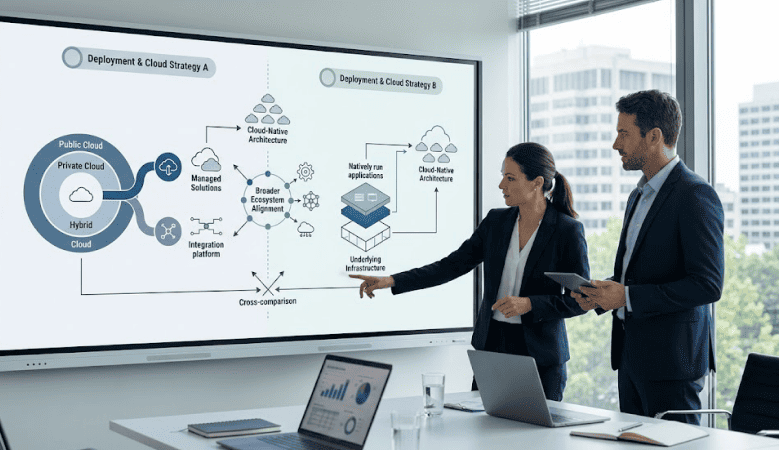
Both SAP and Oracle offer public cloud, private cloud, and hybrid deployment models, and both are actively steering customers toward cloud-native architecture as their long-term strategic direction.
SAP’s cloud strategy centers on S/4HANA Cloud (Public and Private Edition) alongside RISE with SAP and GROW with SAP as managed transformation and adoption programs. SAP has also built out SAP Business Technology Platform (BTP) as the extension and integration layer sitting alongside the core ERP.
Oracle’s cloud strategy centers on Oracle Cloud Infrastructure (OCI) as the underlying platform, with Oracle Cloud ERP and Oracle Fusion applications running natively on it, and Oracle NetSuite continuing to operate as a somewhat separate cloud-native product line for smaller organizations.
For organizations weighing SAP vs Oracle specifically on cloud maturity, both vendors have genuine, well-resourced cloud roadmaps – the more relevant question is usually which vendor’s broader cloud and infrastructure ecosystem better aligns with an organization’s existing technology investments outside of the ERP itself.

SAP vs Oracle: Vendor Viability and Product Roadmap
Neither SAP nor Oracle is at meaningful risk of business failure – both are massive, well-capitalized enterprise software companies. The more relevant viability question is which specific products within each portfolio are being actively invested in versus phased toward end of life.
On the SAP side
SAP ECC’s mainstream maintenance ends in 2027, making S/4HANA the clear, well-resourced forward path for SAP customers. SAP Business One and SAP Business ByDesign both continue active development for the SMB and midmarket segments.
On the Oracle side
Oracle E-Business Suite and Oracle JD Edwards have both seen R&D investment increasingly shift toward Oracle Cloud ERP, with fewer new implementation partners actively building expertise in the older on-premise product lines. Oracle NetSuite continues strong, active investment as Oracle’s primary cloud offering for smaller organizations.
The practical takeaway for any organization currently on a legacy platform – SAP ECC or an older Oracle product – is that the decision is less “should we migrate” and more “when, and to which modern platform.”
Which Is Better: SAP vs. Oracle?
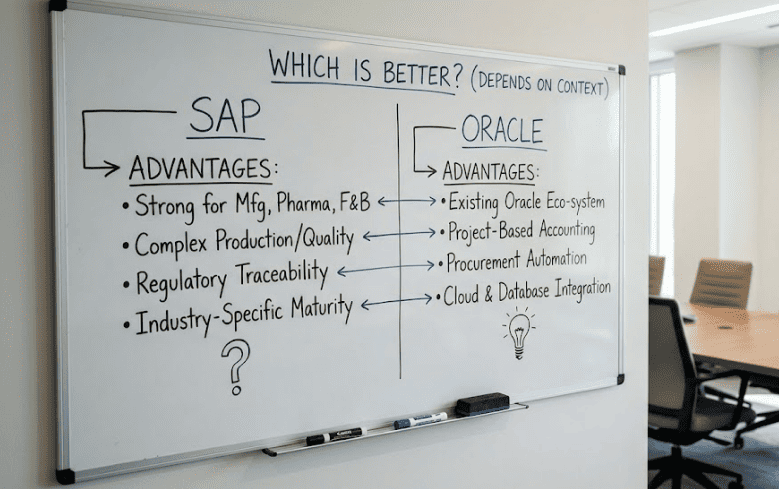
This is the question most people actually typing “SAP vs Oracle” into a search bar are really asking, and the honest answer is that which is better between SAP vs. Oracle depends entirely on what you’re optimizing for – there is no universal winner between the two platforms.
If the question of which is better, SAP vs. Oracle, is being asked by a manufacturing, pharmaceutical, or food and beverage organization with complex production, quality, and regulatory traceability needs, SAP tends to be the stronger fit based on its more mature, purpose-built industry functionality.
If the same question is being asked by an organization already deeply invested in Oracle’s broader cloud and database ecosystem, or one prioritizing project-based accounting and procurement automation, Oracle often comes out ahead.
Anyone promising a single, universal answer to which is better – SAP vs. Oracle – without first understanding your industry, your existing technology landscape, and your specific functional priorities is oversimplifying a decision that genuinely depends on context.

How to Decide: A Practical SAP vs Oracle Decision Framework
Consider SAP when
Your organization operates in manufacturing, pharmaceutical, or food and beverage industries with complex production, quality, and regulatory traceability requirements; you need deep, mature functionality across an unusually broad range of integrated business processes; or your organization is already running SAP ECC and evaluating the natural upgrade path to S/4HANA.
Consider Oracle when
your organization has significant existing investment in Oracle’s broader database and cloud infrastructure ecosystem; your primary requirements center on project-based accounting or procurement automation where Oracle has particular strength; or you’re a smaller organization where Oracle NetSuite’s cloud-native, faster-to-deploy model fits your scale better than an enterprise-grade S/4HANA implementation.
Regardless of which platform you're evaluating
the most consistent mistake organizations make is selecting a new ERP system before addressing underlying process problems. A new platform – SAP or Oracle – will not automatically fix broken business processes; it will often simply digitize the same inefficiencies in a new system. Process improvement and requirements definition should happen before, not after, vendor selection.

How SPV Consulting Helps With SAP Implementation
If your evaluation of SAP vs Oracle points toward SAP, SPV Consulting brings SNP-certified implementation expertise specifically for manufacturing, pharmaceutical, and food and beverage organizations – the exact industries where SAP’s functional depth tends to matter most.
SAP-specific depth, not generalist ERP consulting
SPV Consulting focuses exclusively on SAP – S/4HANA migration and implementation, data migration, SAP staffing, and SAP outsourcing – bringing the kind of deep, specialized expertise that a vendor-agnostic ERP consultancy covering every major platform typically cannot match on any single one.
Regulated industry implementation experience
For pharmaceutical and food and beverage clients specifically, SPV Consulting’s SAP implementations are built around GxP validation, CSV documentation, and batch and lot traceability requirements from the start – not retrofitted after go-live.
Honest scope
SPV Consulting does not offer Oracle implementation services. If your evaluation points toward Oracle, we’d rather tell you that directly than stretch our expertise somewhere we don’t have genuine depth.
If SAP is the right fit for your organization, contact SPV Consulting to discuss implementation, migration, or staffing support. If you’re still deciding, our guide on SAP implementation cost and SAP implementation methodology can help you scope what an S/4HANA project would actually involve.
min read
TOPICS
- SAP vs Oracle: What’s The Real Difference
- What Is the Difference Between SAP and Oracle? The Core Philosophical Divide
- SAP vs Oracle: Product Lines and Positioning
- SAP vs Oracle by Functional Area
- SAP vs Oracle for Manufacturing, Pharmaceutical, and Food and Beverage Companies
- SAP vs Oracle: Deployment and Cloud Strategy
- SAP vs Oracle: Vendor Viability and Product Roadmap
- Which Is Better: SAP vs. Oracle?
- How to Decide: A Practical SAP vs Oracle Decision Framework
- How SPV Consulting Helps With SAP Implementation
Frequently Asked Questions
What is the difference between SAP and Oracle?
The core difference between SAP and Oracle traces back to how each company built its product portfolio: SAP develops most of its ERP functionality internally, resulting in deep, consistently architected modules, while Oracle has grown significantly through acquiring established products (PeopleSoft, JD Edwards, NetSuite) and integrating them into its cloud ecosystem over time. This shapes differences in implementation approach, industry-specific depth, and how each platform’s functionality feels to use day to day.
What is the difference between SAP and Oracle ERP systems specifically?
As ERP systems specifically, SAP (through S/4HANA and SAP Business One) and Oracle (through Oracle Cloud ERP and Oracle NetSuite) both cover the core ERP functions of finance, supply chain, procurement, and operations. The difference between SAP and Oracle ERP systems shows up most clearly in industry-specific depth – SAP has traditionally stronger, more mature manufacturing and regulated-industry functionality, while Oracle has particular strength in project-based accounting and procurement automation.
Which is better: SAP vs. Oracle?
There is no universal answer to which is better, SAP vs. Oracle – it depends on your industry and specific priorities. For manufacturing, pharmaceutical, and food and beverage organizations with complex production and regulatory traceability needs, SAP tends to be the stronger fit. For organizations already invested in Oracle’s cloud and database ecosystem, or prioritizing project-based accounting and procurement automation, Oracle is often the better choice. The right answer depends on your specific business context, not a generic ranking.
What is the difference between Oracle and SAP for small businesses?
For small and mid-sized businesses, the comparison typically becomes SAP Business One versus Oracle NetSuite. SAP Business One offers a comprehensive, moderately priced ERP suitable for growing manufacturers and distributors. Oracle NetSuite is a cloud-native platform with a strong reputation for e-commerce and services businesses, generally faster to deploy than a full enterprise SAP implementation.
Is SAP an ERP system, and how does it compare to Oracle?
Yes, is sap an erp system is an easy question to answer directly: SAP is an ERP system, and specifically the largest ERP vendor globally by market share. Compared to Oracle, SAP’s ERP products (S/4HANA, Business One, Business ByDesign) are known for deep, internally developed functionality, particularly in manufacturing and regulated industries, while Oracle’s ERP products (Oracle Cloud ERP, Oracle NetSuite) bring strength in project accounting, procurement automation, and a cloud-native architecture for its NetSuite product line.
SAP vs Oracle: which is better for manufacturing companies?
SAP has traditionally offered deeper, more mature manufacturing-specific functionality across production planning, quality management, and plant maintenance, reflecting decades of purpose-built development for discrete and process manufacturing. Oracle Cloud ERP has invested significantly in manufacturing capability, particularly IoT-enabled equipment monitoring, but has generally trailed SAP’s manufacturing sub-industry depth. For pharmaceutical and food and beverage manufacturers specifically, SAP’s regulated-industry track record and partner ecosystem tend to be a meaningful advantage.
SAP vs Oracle: which is more expensive to implement?
Both SAP and Oracle implementations vary enormously in cost based on organization size, module scope, customization requirements, and deployment model, making a direct dollar comparison misleading without knowing the specific scope involved. Rather than comparing sticker price, organizations should evaluate total cost of ownership for their specific requirements against each platform, since implementation, integration, and long-term maintenance costs typically outweigh licensing cost differences between the two vendors.
Can a company switch from Oracle to SAP, or from SAP to Oracle?
Yes, organizations do migrate between ERP platforms, though it is a significant undertaking comparable in scope to an initial ERP implementation, requiring full data migration, business process reconfiguration, and organizational change management. This kind of platform switch is typically driven by a specific unmet need – industry-specific functionality gaps, acquisition-driven system consolidation, or end-of-life pressure on a legacy platform – rather than made lightly.
What replaced SAP ECC, and does Oracle have an equivalent transition happening?
SAP S/4HANA is the direct successor to SAP ECC, with SAP ending mainstream maintenance for ECC in 2027 to drive migration. Oracle has a broadly similar dynamic with its legacy on-premise products – Oracle E-Business Suite and Oracle JD Edwards – both of which have seen investment shift toward Oracle Cloud ERP over time, though without as explicitly publicized an end-of-support timeline as SAP’s ECC deadline.