
SAP Outsourcing: Models, Benefits and How to Choose a Partner
Every SAP leader eventually runs into the same wall. The roadmap calls for an S/4HANA migration, a new rollout, or round-the-clock support but the internal team is stretched thin, hard to hire for, and expensive to scale. That gap is exactly why SAP outsourcing has become a standard part of how enterprises run their landscapes, not as a cost-cutting afterthought, but as a deliberate way to access specialized skills without carrying the full weight of an in-house center of excellence.
Choosing the right approach to SAP outsourcing, and the right SAP outsourcing partner, is not a decision most organizations get to make often. It is high-stakes, technically complex, and mistakes are expensive to unwind. This guide covers the models available, the real benefits organizations should expect, the risks that are rarely discussed openly, and a practical framework for choosing a partner that will actually deliver.
According to SPV Consulting’s approach to SAP outsourcing, drawn from SNP-certified engagements across different client bases, the organizations that get the most value from outsourcing are the ones that match the engagement model to the actual problem they are solving, not the ones that default to the cheapest available option.

What SAP Outsourcing Actually Means
SAP outsourcing is when an organization engages a third party, an individual consultant, a staffing firm, or a full-service SAP outsourcing partner – to deliver expertise across SAP implementation, configuration, support, staffing, or ongoing system management. It covers a wide range of roles: SAP developers, functional consultants, Basis administrators, support specialists, and quality assurance professionals, each brought in to fill a specific capability gap that an internal team cannot cover alone.
This is not limited to organizations without an internal SAP team. Even businesses with an experienced in-house SAP function commonly outsource for peak project load, specialized module expertise, or after-hours support coverage that an internal team of limited size cannot sustain. The practice spans everything from a single contract developer filling a short-term gap to a full managed services agreement where an external partner owns ongoing system operations end to end.

Why Organizations Choose to Outsource SAP Work
The case for SAP outsourcing has shifted in the past several years, driven by three converging pressures that most organizations now face simultaneously.
The SAP talent shortage is real and measurable. Demand for S/4HANA-certified consultants has outpaced the supply of qualified professionals, particularly as the 2027 end of mainstream maintenance for SAP ECC drives a wave of migration projects across every industry at once. Organizations competing for the same limited talent pool face longer hiring cycles, higher compensation expectations, and greater risk of losing a critical SAP resource mid-project.
SAP system complexity keeps expanding. The move from ECC to S/4HANA, the addition of SAP BTP, the introduction of AI-driven capabilities inside SAP, and the growing footprint of RISE with SAP and GROW with SAP as delivery models all require specialized knowledge that a small internal team cannot reasonably maintain across every domain.
Digital transformation timelines are compressing. Organizations racing to migrate off ECC before the maintenance deadline, or to implement AI capabilities before competitors do, do not have the runway to build internal SAP expertise from scratch. SAP outsourcing provides immediate access to capability that would otherwise take years to develop internally.
SAP Outsourcing Models: Which Approach Fits Your Situation?
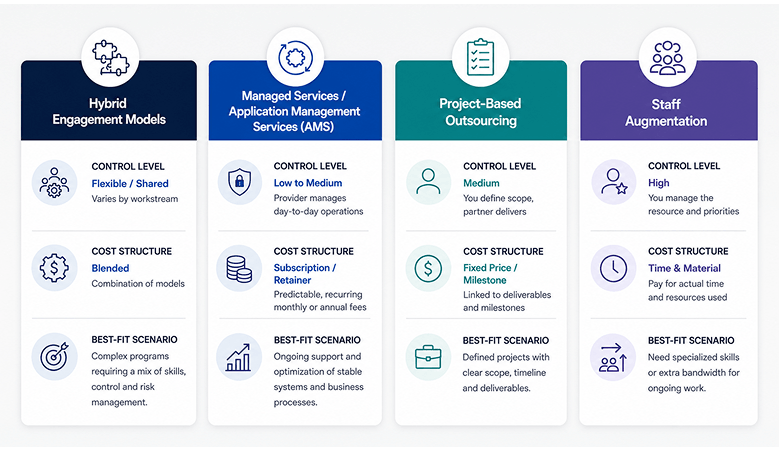
Understanding the different models of SAP outsourcing is the first step toward choosing the right SAP outsourcing partner, because the model you select shapes everything downstream: contract structure, pricing, day-to-day management responsibility, and how much control your organization retains.
Staff Augmentation
Staff augmentation means an SAP outsourcing partner places individual consultants – developers, functional experts, Basis administrators – directly into your team, working under your management and existing project structure. You direct the work; the outsourcing partner handles sourcing, vetting, and often payroll and compliance for the placed resource.
This model works best when an internal team has a functioning SAP program but needs to fill a specific skill gap or add capacity for a defined period – a peak implementation phase, a specialized module rollout, or coverage while an internal resource is on leave.
Project-Based Outsourcing
Project-based outsourcing means engaging a partner to deliver a defined scope of work – an S/4HANA migration, a module implementation, a data migration project – with the partner owning delivery, timeline, and quality against agreed milestones. Pricing is typically fixed or milestone-based, and the outsourcing partner manages the project team internally rather than integrating individual consultants into your organization’s day-to-day management structure.
This model works best for organizations with a clearly defined, bounded initiative – particularly first-time S/4HANA migrations or greenfield implementations where the scope is well understood upfront.
Managed Services / Application Management Services (AMS)
Managed services, often called Application Management Services in the SAP world, means an SAP outsourcing partner takes ongoing operational responsibility for your SAP environment, monitoring, support, incident resolution, patching, minor enhancements, and continuous improvement – under a defined service level agreement (SLA).
This model works best for organizations that have completed implementation and need reliable, ongoing system operations without maintaining a full internal support team. AMS engagements typically run on a monthly retainer tied to defined response times, resolution targets, and system availability commitments.
Hybrid Engagement Models
Many organizations combine models rather than choosing one exclusively – staff augmentation for a specific implementation phase, transitioning into managed services once the system goes live, with project-based engagements layered in for discrete enhancement initiatives. The right SAP outsourcing partner should be able to flex across these models as your organization’s needs evolve, rather than forcing every engagement into a single contract structure.
Model
Control Level
Cost Structure
Best For
Staff Augmentation
High - you manage the work
Hourly / contract rate
Filling specific skill gaps in an active team
Project-Based
Moderate - partner owns delivery
Fixed price / milestone
Defined initiatives like S/4HANA migration
Managed Services (AMS)
Lower - partner owns operations
Monthly retainer / SLA-based
Ongoing post-go-live support and operations
Hybrid
Varies by phase
Blended
Organizations spanning implementation through operations
Pricing and Engagement Structures
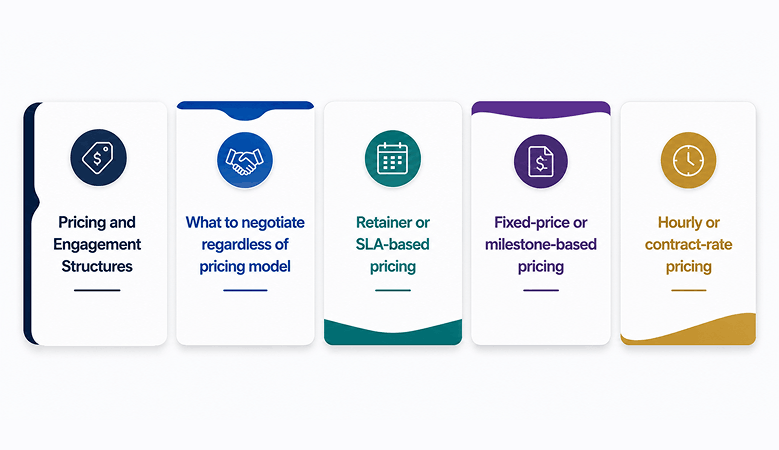
How an SAP outsourcing engagement is priced follows directly from the model selected, and understanding the structure behind each pricing approach helps organizations negotiate terms that actually match how the work will be delivered.
1.
Hourly or contract-rate pricing
It is standard for staff augmentation, where you are paying for a specific consultant’s time at an agreed rate, typically billed monthly against hours worked. Rates vary based on consultant seniority, module specialization, and onshore versus offshore delivery. This structure gives the client the most direct cost visibility but the least protection against scope creep, since hours billed are not tied to specific deliverables.
2.
Fixed-price or milestone-based pricing
It is standard for project-based engagements, where the total cost is agreed upfront against a defined scope, with payment released as specific milestones are delivered and accepted. This structure protects the client from cost overruns on well-defined scope but requires precise requirements definition before signing – a vague scope under a fixed-price contract is where change orders and disputes originate.
3.
Retainer or SLA-based pricing
It is standard for managed services engagements, where a monthly fee is tied to defined service levels – response time commitments, resolution targets, system availability guarantees – rather than hours worked or specific deliverables. This structure provides the most cost predictability for ongoing operations but requires precise SLA definition to avoid ambiguity about what is and is not covered under the retainer.
4.
What to negotiate regardless of pricing model
It provides clear definitions of what triggers a change request and how change requests are priced, IP ownership terms for any custom development delivered, defined exit and transition terms if the engagement ends, and – critically for compliance-sensitive industries – documentation and knowledge transfer requirements built into the contract rather than left as a goodwill expectation.
The Real Benefits of SAP Outsourcing
Most discussions of SAP outsourcing benefits stay vague – “fresh perspectives,” “more time for strategic work.” The measurable benefits are more specific than that.
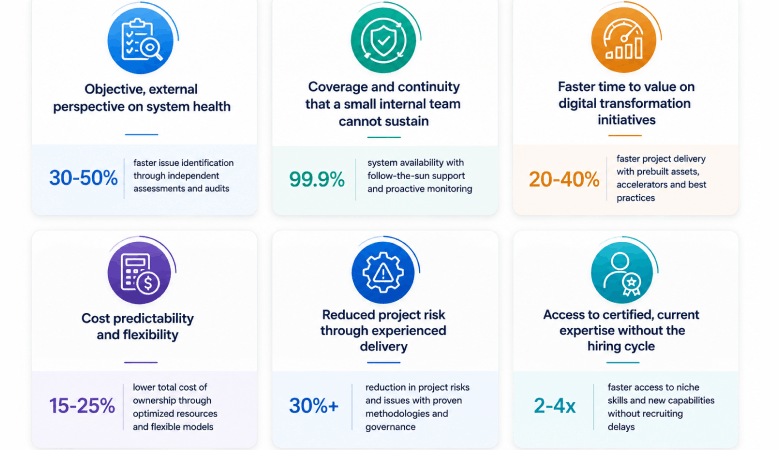
Access to certified, current expertise without the hiring cycle
SAP outsourcing provides immediate access to consultants who are already certified in current S/4HANA releases, SAP BTP, or specific modules – expertise that would take months to recruit for internally and years to develop from an existing generalist team.
Reduced project risk through experienced delivery
A qualified SAP outsourcing partner has typically delivered similar projects multiple times, which means known risks are anticipated rather than discovered mid-project. This translates directly into fewer schedule surprises and fewer costly rework cycles.
Cost predictability and flexibility
This model converts a fixed internal headcount cost into a variable cost aligned with actual project need. Organizations avoid carrying full-time SAP specialists on payroll during periods when project demand is lower, while still having access to that expertise when demand spikes.
Faster time to value on digital transformation initiatives
Outsourcing SAP project leadership and specialist roles accelerates delivery timelines on initiatives like S/4HANA migration, RISE with SAP adoption, or AI integration – programs where speed to value directly affects competitive positioning.
Coverage and continuity that a small internal team cannot sustain
A managed services engagement provides after-hours support, incident response, and continuity coverage that a lean internal team of one or two SAP resources simply cannot deliver without significant burnout risk.
Objective, external perspective on system health
An experienced SAP outsourcing partner reviewing your environment from the outside frequently identifies configuration issues, technical debt, or process inefficiencies that internal teams – close to the system every day – have stopped noticing.

The Gap Most Guides Miss: Compliance, Security, and Data Residency
Every SAP outsourcing guide covers the benefits. Fewer cover the risks honestly – and those risks are exactly where a poorly chosen SAP outsourcing partner causes lasting damage.
Knowledge walking out the door
When an outsourced consultant or team completes an engagement and moves on, the institutional knowledge they built about your specific SAP configuration, customizations, and business logic often leaves with them unless documentation and knowledge transfer are contractually required – not just assumed.
Segregation of Duties (SoD) exposure
Outsourced consultants, particularly those with elevated technical access during implementation or support engagements, can introduce SoD conflicts if their access is not scoped precisely to their assigned tasks. This is a compliance issue that internal audit and security teams need visibility into, not something to discover during the next SOX or GxP audit.
Data residency and access control gaps
For organizations in regulated industries – pharmaceutical, food and beverage, or any business handling sensitive financial or customer data – an SAP outsourcing partner’s data handling practices, offshore access patterns, and security certifications matter as much as their technical SAP skills. A partner without ISO 27001 or SOC 2 certification, or without a clear data residency policy, introduces risk that outweighs cost savings.
Vendor lock-in through undocumented customization
An SAP outsourcing partner who builds extensive custom configuration or ABAP development without producing clear documentation creates dependency – your organization cannot easily switch partners or bring work in-house later without expensive rediscovery work.
Communication and time zone friction with offshore models
Offshore SAP outsourcing offers the largest cost savings but requires disciplined communication structures to avoid the misalignment that comes from limited real-time overlap. Organizations that underestimate this friction see slower issue resolution and more rework than the headline cost savings would suggest.
Compliance blind spots in regulated environments
In pharmaceutical and food and beverage environments specifically, an SAP outsourcing partner without GxP validation experience or FDA 21 CFR Part 11 awareness can introduce compliance gaps into system changes that only surface during a regulatory audit – at which point remediation cost far exceeds what proper vetting would have cost upfront.
Onshore, Nearshore, and Offshore SAP Outsourcing
Onshore SAP outsourcing
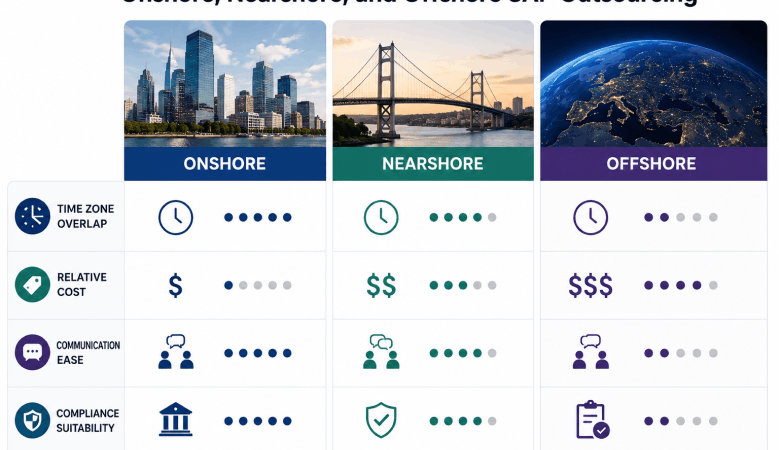
It means engaging a partner in the same country. For U.S. organizations, this means a U.S.-based SAP outsourcing partner operating under U.S. law, with no time zone friction and the strongest fit for regulated industries where data residency and compliance documentation matter most. The trade-off is cost – onshore rates are the highest of the three models.
Nearshore SAP outsourcing
It means engaging a partner in a geographically close country – for U.S. organizations, typically Canada or Latin America. Nearshore offers meaningful cost savings while maintaining workable time zone overlap for real-time collaboration.
Offshore SAP outsourcing
It means engaging a partner in a distant country – commonly India or Eastern Europe for SAP specifically, given the depth of certified SAP talent in those markets. Offshore delivers the largest cost differential but requires the most disciplined communication structure and the most careful vetting of data security and compliance practices, particularly for regulated industries.
The right choice depends on what the engagement requires. A defined, well-documented project with limited real-time collaboration needs may tolerate offshore delivery well. An ongoing managed services engagement supporting a regulated manufacturing environment, where real-time incident response and compliance documentation matter, is often better served by onshore or nearshore delivery.
Getting the Model Right Before the Vendor
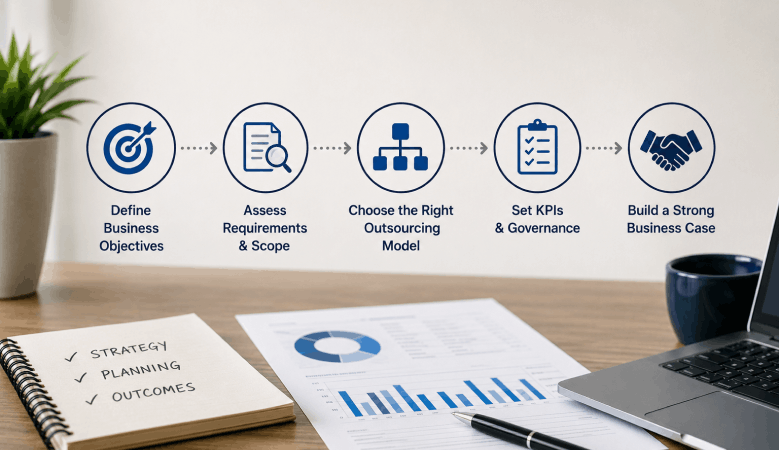
The single most common mistake organizations make when approaching SAP outsourcing is starting the search for a partner before deciding which engagement model actually fits the problem. Vendor evaluation criteria differ substantially depending on whether you need staff augmentation, project-based delivery, or managed services – and evaluating candidates against the wrong criteria wastes time on both sides and frequently produces a mismatched engagement.
Before approaching any SAP outsourcing partner, answer these questions internally first: Is this a defined, bounded piece of work with a clear end date, or an ongoing operational need? Does your organization have internal SAP management capacity to direct outsourced consultants day to day, or do you need a partner who owns delivery independently? Is the primary driver a temporary skill gap, a major digital transformation initiative, or the need for continuous production support?
The answers point directly to a model – staff augmentation, project-based, or managed services – and that model should be settled before initiating vendor conversations. A vendor search that starts with “we need SAP help” rather than “we need a fixed-price S/4HANA migration partner” or “we need an AMS provider with a four-hour response SLA” produces vague proposals that are difficult to compare on any consistent basis. Getting the model right first turns vendor selection from a series of unstructured conversations into a structured comparison against defined criteria.
How to Choose a SAP Outsourcing Partner
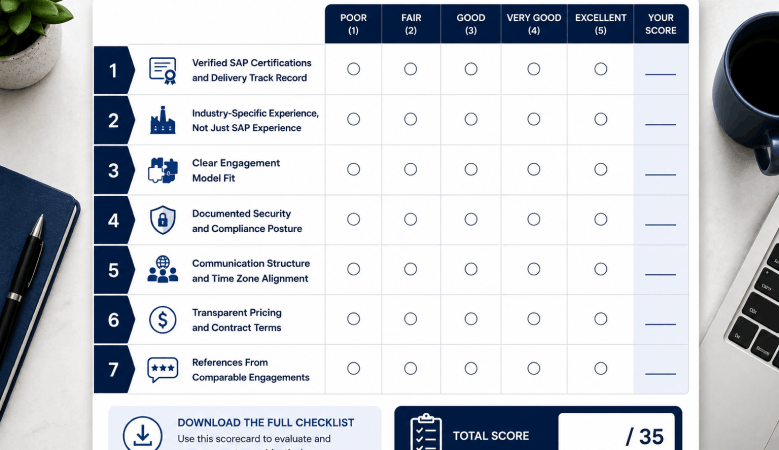
Not every firm that offers SAP services is equipped to be a genuine Outsourcing partner for your specific situation. These criteria separate specialist partners from generalist IT vendors who added SAP as a service line.
1. Verified SAP Certifications and Delivery Track Record
Ask for specific evidence: which S/4HANA modules has the partner implemented, how many similar projects have they delivered, and can they provide references from organizations of comparable size and industry. SNP certification, SAP Partner status, and named consultant certifications are verifiable credentials – not marketing claims.
2. Industry-Specific Experience, Not Just SAP Experience
An SAP outsourcing partner who has only worked in retail or professional services will not understand the production planning constraints of discrete manufacturing, the batch traceability requirements of pharmaceutical operations, or the lot management complexity of food and beverage supply chains. Industry-specific experience reduces ramp-up time and produces fewer costly misunderstandings during requirements gathering.
3. Clear Engagement Model Fit
Confirm the partner can deliver the specific model your situation requires – staff augmentation, project-based delivery, or managed services – rather than pushing every engagement into whichever model is most profitable for them. A partner offering only one model is optimizing for their business, not yours.
4. Documented Security and Compliance Posture
Request ISO 27001 or SOC 2 certification, a documented data handling policy, and specific experience with the compliance frameworks relevant to your industry – HIPAA, SOX, GxP, or FDA 21 CFR Part 11. Ask how they scope access for technical consultants to prevent Segregation of Duties conflicts, and how they handle knowledge transfer and documentation at project completion.
5. Communication Structure and Time Zone Alignment
Ask specifically how the partner structures communication for your engagement type – response time commitments, escalation paths, meeting cadence, and how much real-time overlap exists with your team. A partner who cannot answer this specifically has not thought through how the engagement will actually run day to day.
6. Transparent Pricing and Contract Terms
A credible SAP outsourcing partner provides clear, itemized pricing tied to the engagement model – hourly rates for staff augmentation, milestone-based pricing for projects, or SLA-tied retainers for managed services – along with defined terms for scope changes, IP ownership, and contract termination.
7. References From Comparable Engagements
Request references specifically from organizations with a similar engagement model, industry, and project scope to yours – not generic client testimonials curated for the partner’s own marketing. A reference from a retail company’s staff augmentation engagement tells you little about how the partner will perform on a pharmaceutical company’s managed services contract.
Questions to Ask a Potential SAP Outsourcing Partner
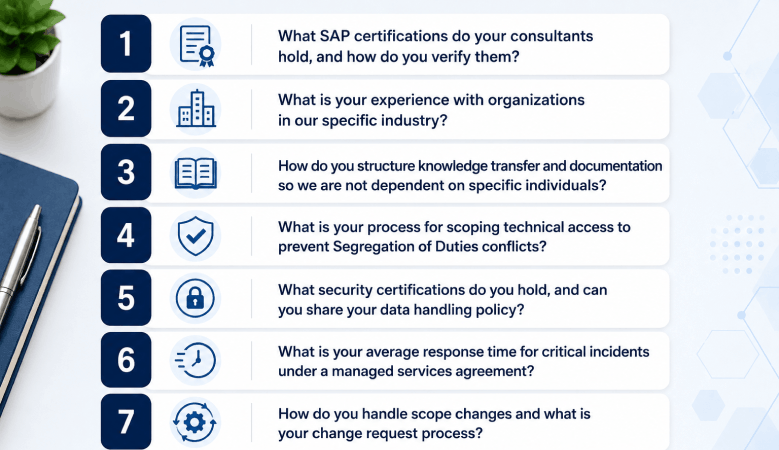
These questions reveal whether a prospective partner has genuine depth or is positioning general IT capability as SAP expertise.
- What SAP certifications do your consultants hold, and how do you verify them?
- What is your experience with organizations in our specific industry?
- How do you structure knowledge transfer and documentation so we are not dependent on specific individuals?
- What is your process for scoping technical access to prevent Segregation of Duties conflicts?
- What security certifications do you hold, and can you share your data handling policy?
- What is your average response time for critical incidents under a managed services agreement?
- How do you handle scope changes and what is your change request process?
- Can you provide references from engagements similar in scope, industry, and model to ours?
Red Flags to Watch For in an SAP Outsourcing Partner
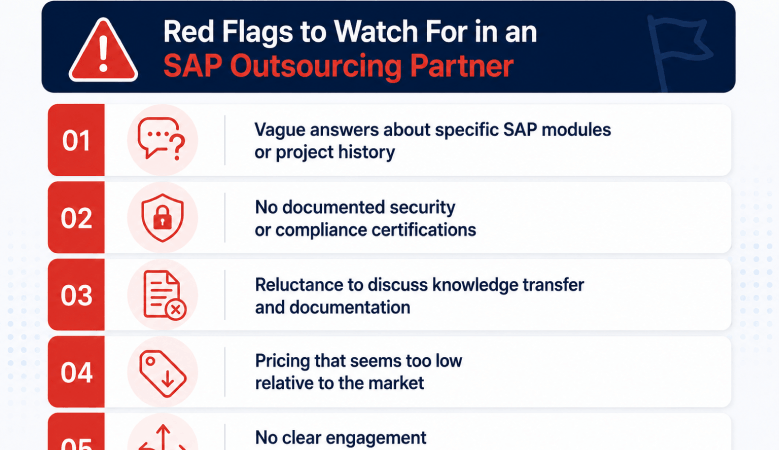
Vague answers about specific SAP modules or project history
A genuine SAP delivery partner speaks specifically about which modules, which SAP versions, and which project types they have delivered. Vague generalities about “extensive SAP experience” without specifics is a warning sign.No documented security or compliance certifications
Any partner that cannot produce ISO 27001, SOC 2, or equivalent certification – or that treats the question as unusual – should not be handling access to a production SAP environment, particularly in regulated industries.Reluctance to discuss knowledge transfer and documentation
A partner who does not have a clear answer for how documentation and knowledge transfer work at project completion is a partner who may be building dependency into the relationship rather than genuine capability transfer.Pricing that seems too low relative to the market
SAP expertise, particularly certified S/4HANA experience, commands a premium given the talent shortage. A price significantly below market for the stated scope of work is either a warning sign about consultant quality or a sign of unrealistic scope assumptions that will surface as change orders later.No clear engagement model flexibility
A partner who insists every engagement fit their single preferred model, regardless of what the client actually needs, is optimizing their own delivery convenience rather than solving the client’s problem.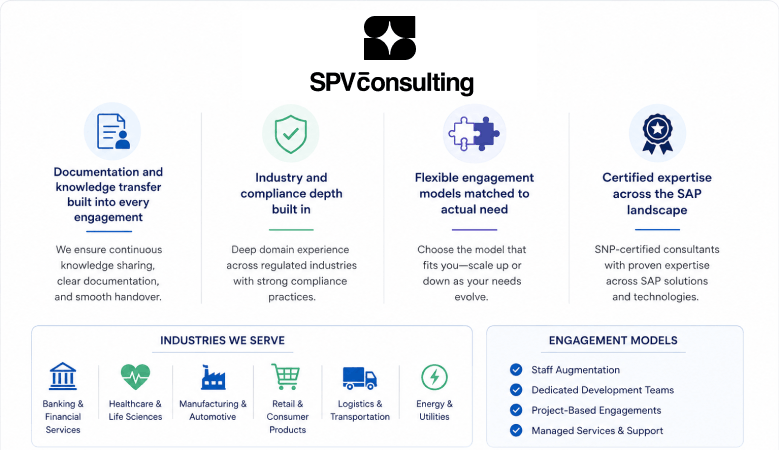
How SPV Consulting Approaches SAP Outsourcing
SPV Consulting provides SAP outsourcing built around SNP-certified consultants with direct, hands-on experience across manufacturing, pharmaceutical, and food and beverage environments – industries where SAP outsourcing carries compliance stakes that generalist IT outsourcing providers are not equipped to handle.
Certified expertise across the SAP landscape
SPV Consulting’s External SAP partner services cover S/4HANA implementation and migration, SAP FICO, MM, SD, SuccessFactors, BW/4HANA, Basis administration, and technical development – delivered by consultants with verifiable certifications and real project delivery history, not generalist IT staff positioned as SAP experts.
Flexible engagement models matched to actual need
SPV Consulting delivers SAP outsourcing across staff augmentation, project-based delivery, and ongoing managed services – selected based on what the client’s situation requires, not what is most convenient to deliver.
Industry and compliance depth built in
For pharmaceutical and food and beverage clients specifically, SPV Consulting’s consultants bring GxP validation awareness, FDA 21 CFR Part 11 experience, and Segregation of Duties discipline into every engagement – reducing the compliance risk that comes from generalist Outsourcing partners without regulated industry experience.
Documentation and knowledge transfer built into every engagement
SPV Consulting structures every SAP outsourcing engagement with defined documentation and knowledge transfer requirements, so clients retain institutional knowledge rather than losing it when a specific engagement ends.
min read
TOPICS
- What SAP Outsourcing Actually Means
- Why Organizations Choose to Outsource SAP Work
- SAP Outsourcing Models: Which Approach Fits Your Situation?
- Pricing and Engagement Structures
- The Real Benefits of SAP Outsourcing
- The Gap Most Guides Miss: Compliance, Security, and Data Residency
- Onshore, Nearshore, and Offshore SAP Outsourcing
- Getting the Model Right Before the Vendor
- How to Choose a SAP Outsourcing Partner
- Questions to Ask a Potential SAP Outsourcing Partner
- Red Flags to Watch For in an SAP Outsourcing Partner
- How SPV Consulting Approaches SAP Outsourcing
Frequently Asked Questions
What is SAP outsourcing?
SAP outsourcing is the practice of engaging an external provider – an individual consultant, a staffing firm, or a full-service partner – to deliver SAP expertise across implementation, configuration, support, staffing, or ongoing system management, rather than building and maintaining that capability entirely in-house.
What are the main models of SAP outsourcing?
The main models of SAP outsourcing are staff augmentation (individual consultants working under your management), project-based outsourcing (a partner owning delivery of a defined scope), and managed services or Application Management Services (a partner taking ongoing operational responsibility for your SAP environment under an SLA). Many organizations combine models as their needs evolve across implementation and operations phases.
What should I look for in an SAP outsourcing partner?
Look for verified SAP certifications and delivery track record, industry-specific experience relevant to your business, flexibility across engagement models, documented security and compliance certifications (ISO 27001, SOC 2), a clear communication structure with defined response times, transparent pricing, and references from engagements comparable to yours in scope and industry.
What are the risks of SAP outsourcing?
The main risks include loss of institutional knowledge when outsourced consultants leave without proper documentation, Segregation of Duties conflicts from improperly scoped technical access, data residency and compliance gaps particularly in regulated industries, vendor lock-in through undocumented customization, and communication friction with offshore delivery models.
What is the difference between SAP outsourcing and SAP staff augmentation?
SAP staff augmentation is one specific model within the broader category of SAP outsourcing. Staff augmentation means individual consultants join your team under your management. SAP outsourcing more broadly also includes project-based delivery, where a partner owns an entire scope of work, and managed services, where a partner takes ongoing operational responsibility for your SAP environment.
How much does SAP outsourcing cost?
Cost depends heavily on the engagement model, geography, and consultant seniority. Staff augmentation is typically priced hourly or by contract rate. Project-based engagements are typically fixed price or milestone-based. Managed services run on a monthly retainer tied to defined SLA terms. Onshore SAP outsourcing carries the highest rates with the strongest compliance posture; offshore delivers the largest cost savings with more communication and governance overhead required.
Is offshore SAP outsourcing safe for regulated industries?
Offshore SAP outsourcing can work for regulated industries with the right vendor vetting – specifically verified security certifications, a documented data handling policy, and demonstrated experience with the relevant compliance framework (GxP, FDA 21 CFR Part 11, HIPAA, or SOX). Organizations with strict data residency requirements or real-time incident response needs often find onshore or nearshore models better suited to regulated environments.
Why is SAP outsourcing more common now than in previous years?
SAP outsourcing has grown due to a measurable shortage of certified S/4HANA talent, the expanding complexity of the SAP ecosystem (S/4HANA, BTP, RISE with SAP, GROW with SAP, AI integration), and compressed digital transformation timelines as organizations race to migrate off ECC before the 2027 end of mainstream maintenance.