
What Is Web Development Outsourcing? A Complete Guide
Web development outsourcing is the practice of hiring an external company or team to design, build, maintain, or improve a website or web application instead of using an in-house development team. Rather than recruiting, onboarding, and managing full-time developers on your payroll, a business delegates that work to a third-party vendor who provides the technical talent, delivery process, and project infrastructure.
Outsourcing web development covers everything from a marketing website to a complex enterprise web application, an ERP-integrated supplier portal, an e-commerce platform, or a custom SaaS product. The vendor can be located anywhere – in the same city, in a nearby country, or on the other side of the world.
According to Precedence Research, the global IT services and outsourcing market reached $662 billion in 2025, and 80% of executives surveyed by Deloitte reported plans to maintain or increase their investment in third-party outsourcing in 2024. Web development outsourcing is no longer a cost-cutting tactic for budget-constrained startups. It is a mainstream delivery model used by enterprises, mid-market companies, and fast-scaling organizations across every industry and sector.

What Is the Difference Between Web Development Outsourcing, Staff Augmentation, and Managed Services?
These three terms describe different ways of working with an external web development partner. They are used interchangeably in the market but mean different things in practice.
Web development outsourcing means handing a defined project or scope of work to an external vendor who owns the delivery end-to-end. You provide the requirements and business context; the web development outsourcing company provides the team, the process, and the output.
Staff augmentation means adding outsourcing developers to your existing in-house team on a contract basis. You manage those outsourcing developers day-to-day, assign their tasks, and integrate them into your workflows. The vendor handles sourcing, vetting, payroll, and compliance – but you direct the work. This is the right model when you have a functioning internal team and need to fill specific skill gaps or add capacity quickly without a permanent hire.
Managed services means an external provider takes full, ongoing responsibility for a web property – including maintenance, updates, security, performance monitoring, and support – under a defined service level agreement.
Understanding which model fits your situation is the first decision to make before evaluating any web development outsourcing company.
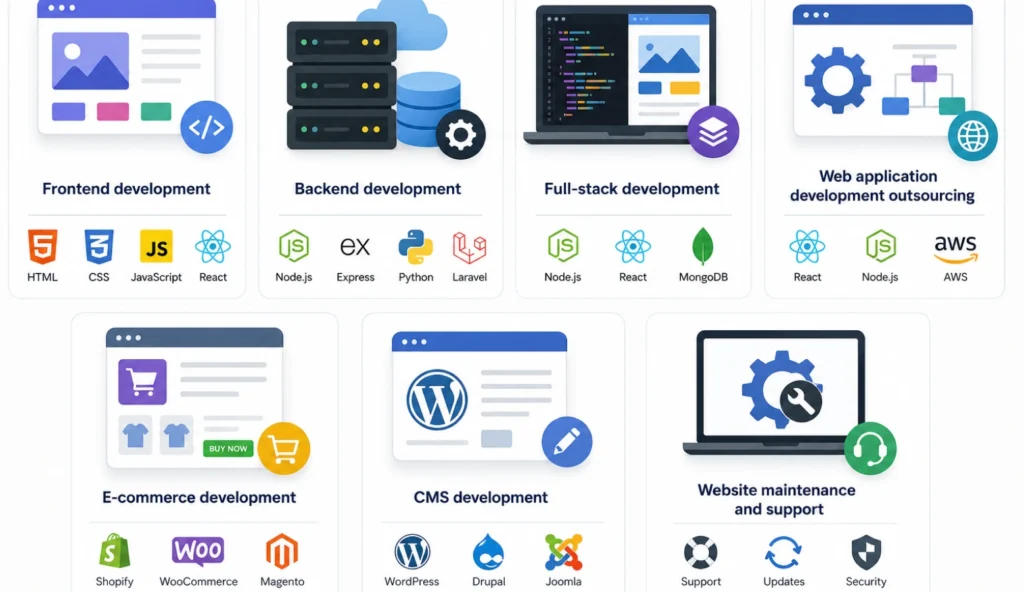
What Types of Web Development Work Are Outsourced?
Outsourcing web development covers the full spectrum of build and maintenance work:
1.
Frontend development
It covers everything a user sees and interacts with – UI design implementation, layouts, responsive behavior, and performance optimization. Common technologies include React, Vue.js, Angular, Next.js, and Tailwind CSS.
2.
Backend development
It covers server-side logic, databases, APIs, and business rules. Technologies include Node.js, Python, PHP, .NET, Ruby on Rails, and cloud-native architectures on AWS, Azure, or GCP.
3.
Full-stack development
It covers both frontend and backend end-to-end. A full-stack web development outsourcing partner owns the complete technical build from database architecture to user interface.
4.
Web application development outsourcing
It covers custom tools, portals, dashboards, SaaS platforms, and internal business applications. Web application development outsourcing is where complexity scales most significantly – particularly for enterprise organizations that need web applications integrated with ERP systems like SAP, with multi-user role management, compliance controls, and complex business logic baked into the application layer.
5.
E-commerce development
It covers online stores, payment gateway integrations, product catalog management, and order management systems built on Shopify, Magento, WooCommerce, or custom-built platforms.
6.
CMS development
It covers WordPress, Drupal, headless CMS architectures using tools like Contentful or Sanity, and proprietary content management builds.
7.
Website maintenance and support
It covers ongoing bug fixes, security patches, performance optimization, third-party integration updates, and accessibility improvements for existing properties.
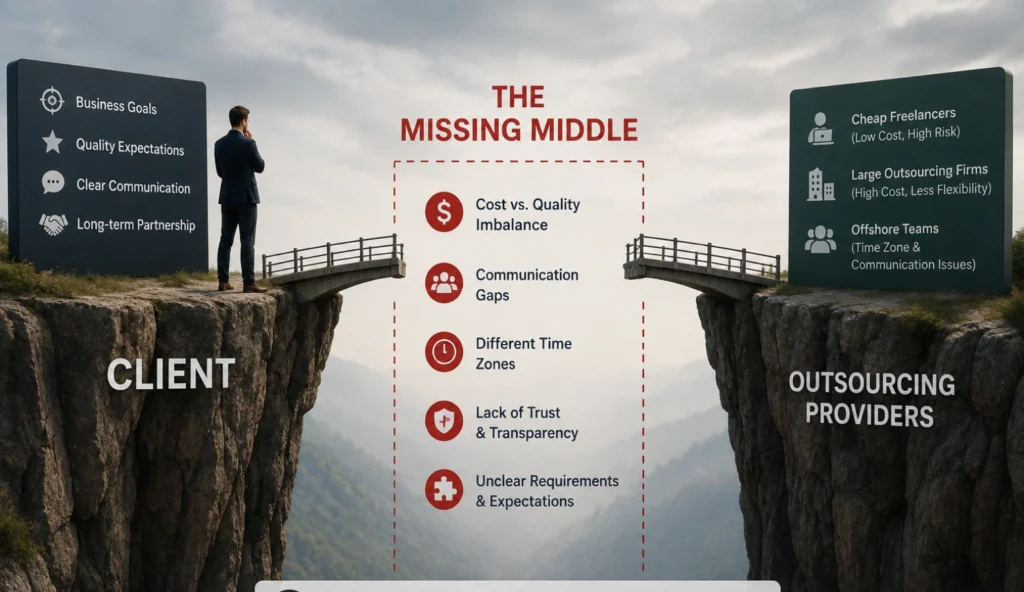
The "Missing Middle" Problem in Web Development Outsourcing
One of the least-discussed but most practically important challenges in web development outsourcing is what can be described as the “missing middle” – the gap between two extremes that leaves most businesses with a poor fit.
Open freelance marketplaces offer thousands of outsourcing developers across a wide rate spectrum. The volume creates a race-to-the-bottom dynamic where low bids win, and quality varies enormously. You might find an excellent developer. You might also spend weeks vetting candidates only to end up with missed deadlines and code that needs to be rebuilt from scratch.
Large traditional agencies sit at the other extreme. They deliver polished, professionally managed work – but their overhead pushes minimum project budgets significantly higher. For a mid-sized web application or a defined integration project, that pricing structure rarely makes sense for the scope.
The right web development outsourcing company in USA sits between these extremes: a specialist partner with verifiable credentials, a defined delivery process, and deep expertise in the specific technology stack and industry your project requires. For enterprise organizations with SAP or ERP environments, a web development outsourcing company in USA that combines web development capability with genuine enterprise integration experience is that specialist tier.
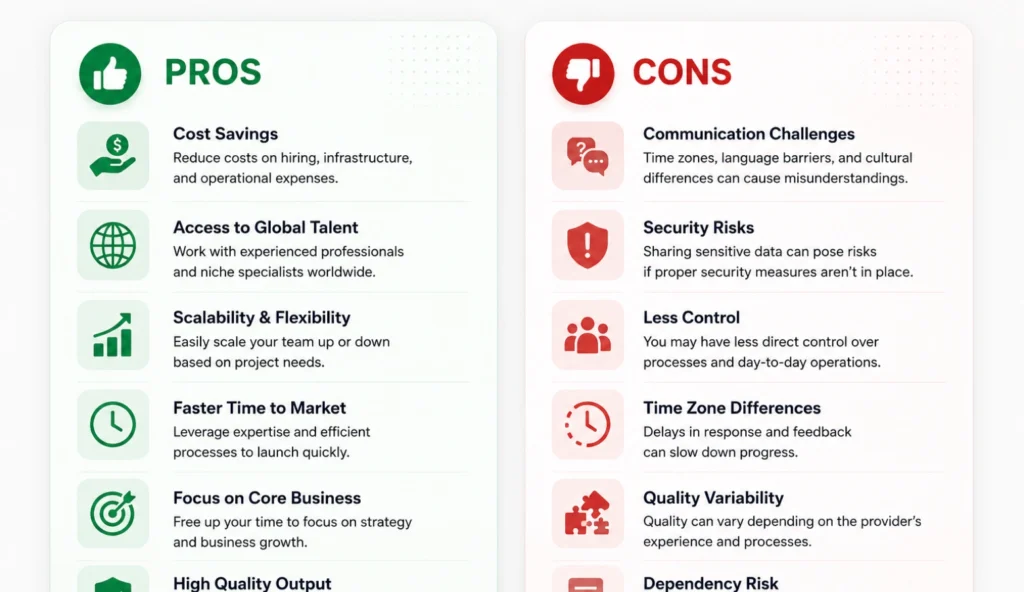
Pros and Cons of Outsourcing Web Development
Advantages of Outsourcing Web Development
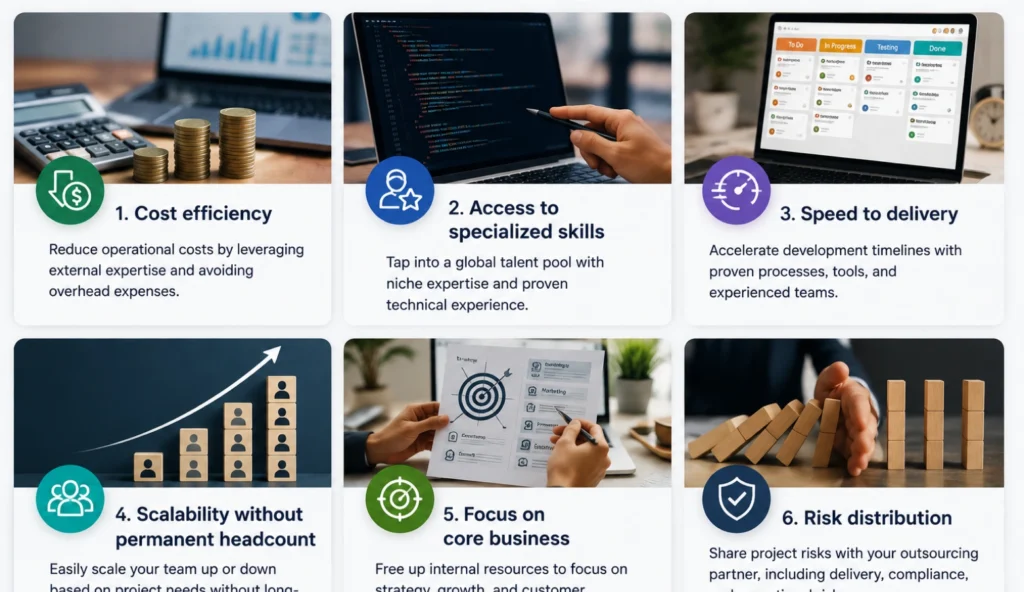
Cost efficiency
The fully loaded cost of an in-house developer – including salary, benefits, equipment, software licenses, office space, and payroll taxes – runs approximately 2.7 times base salary, according to Bureau of Labor Statistics data. When all overhead is factored in, the true cost of an in-house hire is significantly higher than the salary number on the offer letter. Web development outsourcing converts this fixed liability into a variable, project-aligned cost.
Access to specialized skills
Local hiring markets cannot supply every technical specialization a complex project requires. Outsourcing web development opens access to a global talent pool: developers with hands-on experience in specific frameworks, compliance environments, ERP integration architectures, accessibility standards, and performance engineering.
Speed to delivery
Recruiting an in-house developer takes 4 to 8 weeks on average, not counting onboarding and ramp-up. An established web development outsourcing partner has a pre-built team, defined processes, and project management infrastructure already in place. A project can start within days of signing a contract.
Scalability without permanent headcount
Outsourcing web development lets you scale the team up or down as project scope evolves adding QA engineers for a testing phase, bringing in a DevOps specialist for deployment, or reducing team size after launch – without the overhead of redundancies or new hiring cycles.
Focus on core business
Internal staff pulled into web development projects are doing so at the expense of their primary functions. Outsourcing web development frees internal teams to focus on what the business actually does while the technical build runs in parallel.
Risk distribution
Outsourcing web development distributes delivery risk. If a developer leaves the vendor’s team mid-project, the vendor provides a replacement from their bench. That is the vendor’s operational problem to resolve, not yours.
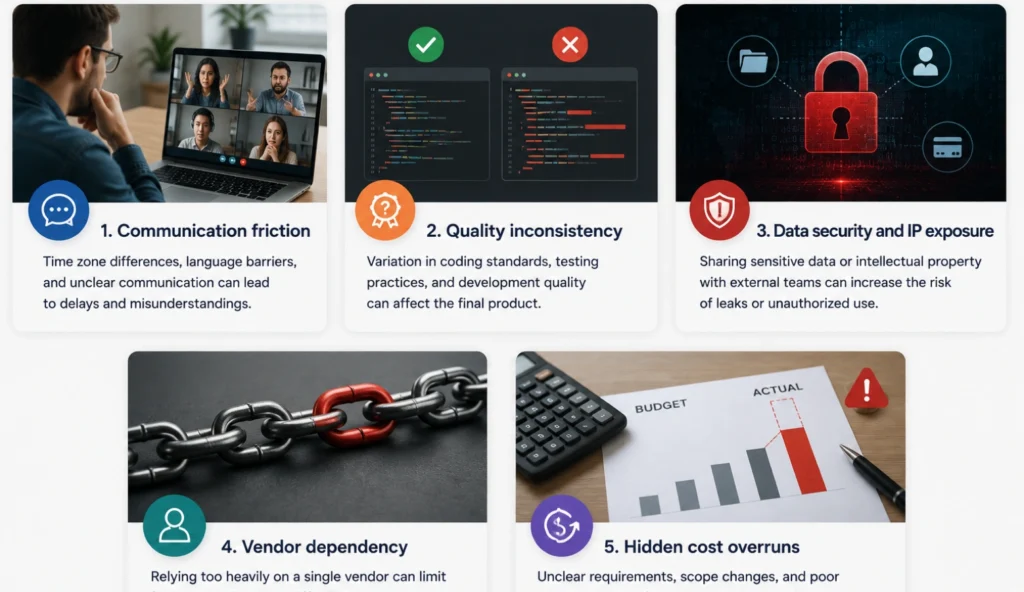
Disadvantages of Outsourcing Web Development
Communication friction
Time zone gaps, language differences, and remote-only collaboration create communication risk, particularly with offshore teams. Without a structured communication cadence and defined escalation paths, issues surface too late to fix affordably.
Quality inconsistency
The quality of outsourcing developers varies significantly across the market. Without rigorous vetting, a low-cost engagement can produce code that requires expensive remediation or a complete rebuild.
Data security and IP exposure
Outsourcing web development means external parties access your business systems, code repositories, and in some cases your production data. Without the right contract structure, security practices, and AI governance policies, that exposure creates real risk.
Vendor dependency
Sole-sourcing a critical web application to a single web development outsourcing partner creates business continuity risk. If the vendor has capacity problems, loses key personnel, or goes out of business, and you don’t own the code at every milestone, you have a serious operational problem.
Hidden cost overruns
Fixed-price projects with poorly defined scope routinely exceed budget when scope changes trigger change orders. The cost savings of outsourcing web development are only real if the project is scoped, contracted, and governed properly.

Why Do Companies Choose to Outsource Web Development? The Real Drivers
Beyond the benefit list, the decision to outsource web development is driven by a specific set of business pressures that tend to cluster together:
You are building an MVP with limited runway
Startups with 90 days of funding cannot afford two months of recruiting followed by onboarding. Outsourcing web development gets work started within days.
You need specialized skills for a defined period
WCAG 2.2 accessibility compliance, AI integration, headless CMS architecture, and SAP-connected web application development are skills that command premium permanent salaries. Outsourcing web development lets you access those skills on a project basis without a permanent hire.
Your internal team is at capacity
When existing developers are buried in maintenance work, outsourcing web development new builds keeps projects moving without burning out the people you already have.
You need to scale for a specific project without permanent headcount
A major platform launch might require five additional developers for four months. Outsourcing web development lets you add capacity, then scale back without layoffs.
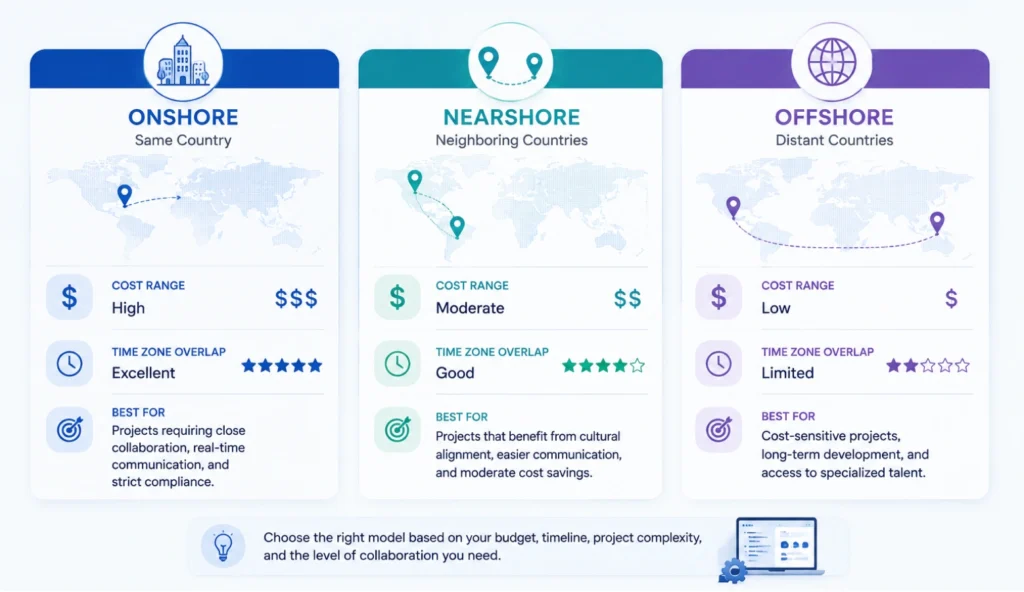
Web Development Outsourcing Models: Onshore, Nearshore, and Offshore
Onshore Web Development Outsourcing
Onshore outsourcing means working with a web development outsourcing company in the same country. For U.S. businesses, this means a U.S.-based web development outsourcing company in USA. Onshore outsourcing offers the easiest communication, no time zone friction, shared business context, and contracts governed by U.S. law and IP protections.
Onshore outsourcing web development is the right choice for projects involving sensitive business data, complex compliance obligations (HIPAA, FDA, SOX), or tightly collaborative workstreams where real-time availability is non-negotiable. The trade-off is cost – U.S. development rates are the highest globally.
Nearshore Outsourcing Web Development
Nearshore outsourcing means working with a partner in a geographically nearby country for U.S. businesses, this typically means Canada, Mexico, or Latin American countries including Colombia, Argentina, and Brazil. Nearshore teams offer meaningful cost savings compared to onshore while maintaining manageable time zone overlap (typically within 3 hours of U.S. Eastern time).
Offshore Web Development Outsourcing
Offshore outsourcing means working with outsourcing developers in a distant country – most commonly India, Poland, Ukraine, Romania, or the Philippines. Offshore offers the largest cost differential. The trade-offs are time zone gaps that require structured asynchronous communication, greater complexity in IP protection, and more intensive vendor governance.
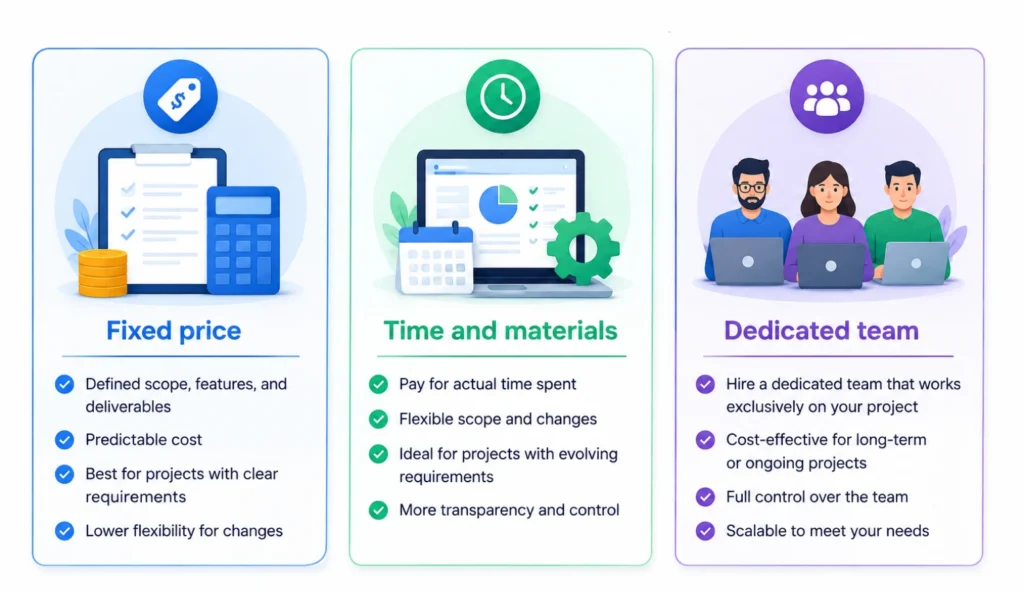
Engagement Models: Which Structure Fits Your Project?
Beyond location, the engagement model determines how you pay, how much flexibility you have, and who carries the risk when requirements change.
Fixed price:
Fixed price means the total project cost is set upfront regardless of actual hours worked. You agree on deliverables, timeline, and budget before work begins. Fixed price outsourcing web development works best when scope is completely defined and will not change.
Once the scope is set, changes require formal change requests with additional costs. If you are still discovering what you want to build, a fixed price contract will frustrate both you and your outsourcing developers.
Time and materials
Time and materials means you pay for actual hours worked and direct costs incurred, with no predetermined total. Choose this when requirements will evolve based on user feedback or technical discovery – an MVP that will pivot based on early testing, or a complex integration where unknowns will surface during development.
One development to watch: AI efficiency tools are changing how some vendors approach hourly billing. If AI tools allow a developer to complete a 10-hour task in 3 hours, some vendors now offer outcome-based milestone pricing rather than hours logged. Ask about this during vendor conversations.
Dedicated team
Dedicated team means contracted outsourcing developers work exclusively on your projects over an extended period. They learn your codebase, understand your business context, and operate as an extension of your internal team without the hiring overhead. Use this for ongoing work lasting three months or longer. The vendor handles HR, benefits, and backfill if someone leaves.
Model
Best for
Budget control
Flexibility
Risk bearer
Fixed price
Locked scope, clear deliverables
High - cost set upfront
Low - changes cost extra
Vendor
Time and materials
Evolving requirements, discovery
Variable - depends on hours
High - adjust as you learn
Client
Dedicated team
Ongoing work, 3+ months
Predictable monthly rate
High
Shared
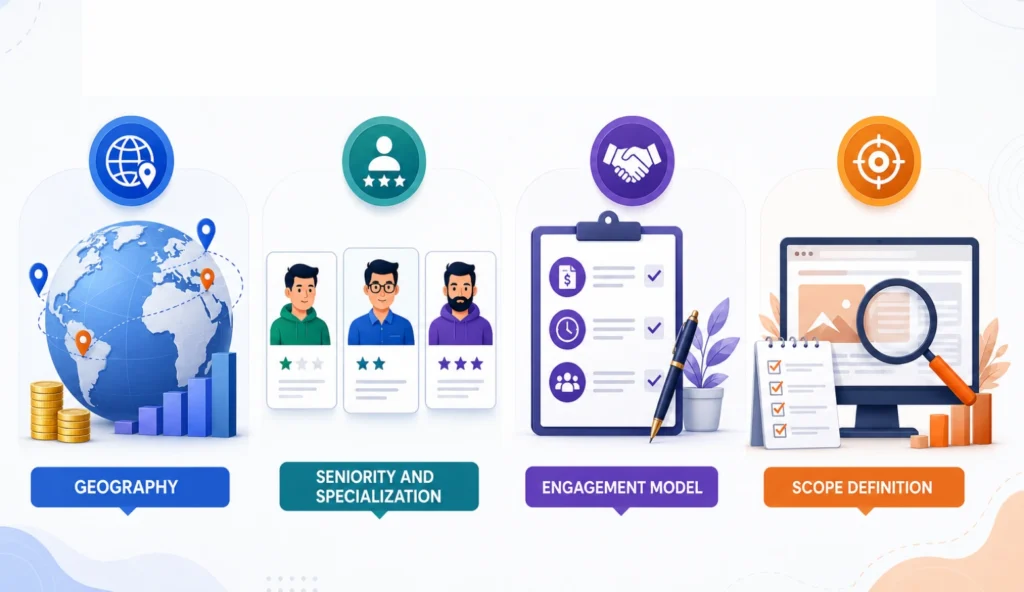
What Factors Determine the Cost of Web Development Outsourcing?
Rather than quoting specific rates – which vary widely based on your project’s scope, seniority mix, timeline, and the vendor’s location and overhead structure – the most useful framework is understanding the factors that drive cost up or down.
Geography is the largest single factor. U.S.-based web development outsourcing companies carry the highest rates due to local labor costs and overhead, but offer the strongest IP protection, easiest collaboration, and no data residency complications. Eastern European and Latin American outsourcing developers offer meaningful cost savings at moderate time zone gaps. Offshore teams in India and the Philippines offer the lowest rates with the largest time zone and communication management requirements.
Seniority and specialization drive cost significantly within any geography. A senior full-stack developer with SAP integration experience commands substantially more than a junior frontend developer in the same market. Specialized skills – enterprise ERP integration, compliance-aware architecture, AI engineering – are priced at a premium because supply is genuinely constrained.
Engagement model affects total cost structure. Fixed-price projects transfer budget risk to the vendor at the cost of less flexibility. Time-and-materials engagements give you flexibility but shift budget risk to you. Dedicated team models offer predictable monthly costs for ongoing work.
Scope definition is often the biggest hidden cost lever. Well-defined projects with complete specifications attract accurate estimates and fewer change orders. Vague briefs produce low initial estimates that expand rapidly once scope ambiguity surfaces mid-project.
The most reliable way to understand what outsourcing web development will cost for your specific project is a paid discovery engagement – a structured scoping phase that surfaces unknowns, documents requirements, and produces a defensible estimate before any significant build cost is committed.
Remember: the true cost of building an in-house alternative is approximately 2.7 times base salary when overhead is factored in, according to Bureau of Labor Statistics data. Outsourcing web development converts that fixed overhead into a variable cost tied to actual project needs.

What Questions Should You Ask When Outsourcing Web Development?
This section addresses one of the most searched practical questions in the web development outsourcing space – and the one most guides answer too briefly. These questions separate vendors who can deliver from those who can only promise.
Questions to ask about scope and delivery
Who owns the code at each milestone – you or the vendor? What is your process for handling scope changes mid-project, and what are your change request rates? What specific deliverables, pages, and integrations are included in this estimate – and what is explicitly excluded? What happens to timeline and budget if a key technical assumption proves wrong?
Questions to ask about quality
What are your Core Web Vitals targets (LCP, INP, CLS) and how do you test against them? Do you build to WCAG 2.2 Level AA accessibility standards? WCAG 2.2 AA requires 4.5:1 color contrast ratios, keyboard navigation support, and proper heading hierarchy – can you show examples of accessibility-compliant work? Do you use pull requests, peer code review, and automated linting as standard practice?
Questions to ask about security and AI governance
What is your policy on AI tool usage during development? This is critical. If outsourcing developers paste your proprietary code into a public large language model like ChatGPT to debug it, that code may enter the model’s training data – your business logic becomes exposed. Enterprise-grade vendors use private AI instances that do not retain data and maintain explicit contractual prohibitions against public LLM usage for client work. If a vendor cannot articulate their AI governance policy, they do not have one.
What security certifications do you hold – ISO 27001, SOC 2? Can you provide your documented data handling policy?
Questions to ask about communication and continuity
What is your standard response time for messages and urgent issues? Who is our primary contact throughout the project? What happens if our primary developer leaves your team mid-project? What is the escalation path if we are unhappy with quality or progress at any stage?
Questions to ask about post-launch
What is covered under your warranty, and for how long? How do you distinguish a bug from a new feature request? Is ongoing maintenance available, and at what rates and response time commitments?
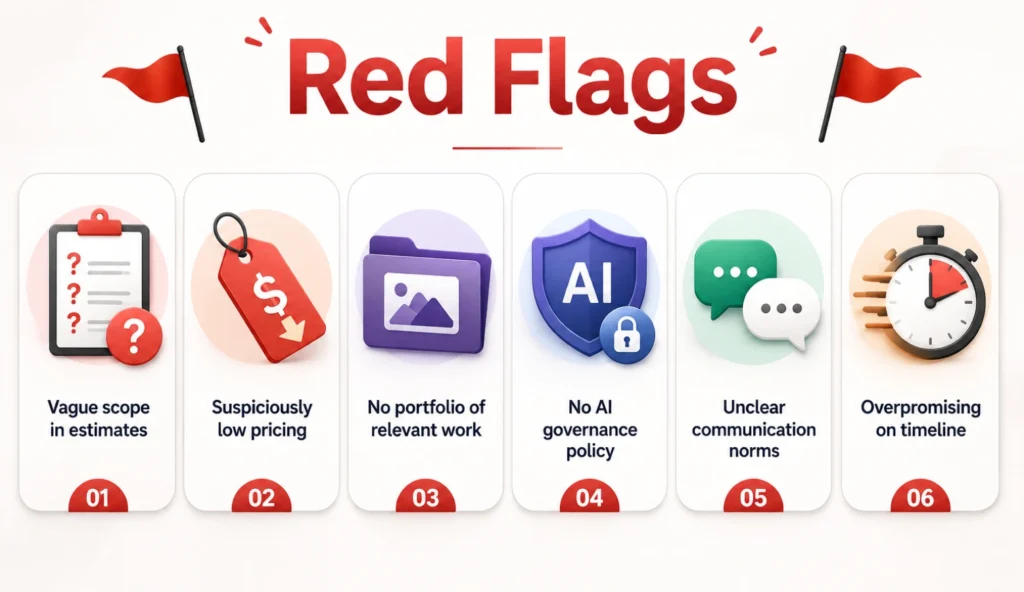
Red Flags to Watch for When Choosing a Web Development Outsourcing Company
Vague scope in estimates
A professional web development outsourcing company names specific deliverables in their estimate – exact pages, specific integrations, measurable performance targets. If a proposal reads “build website per discussions” or “development as needed,” that vagueness will become a dispute once work begins. Undefined deliverables always become budget arguments.
Suspiciously low pricing
The cheapest bid in any web development outsourcing engagement rarely delivers the best outcome. Open freelance marketplaces create a race-to-the-bottom dynamic where winning work requires undercutting on price – and that pressure manifests as corners cut, tests skipped, and documentation ignored. Premium pricing from a web development outsourcing company in USA correlates with the margin needed to actually fix problems without fighting the client on every revision.
No portfolio of relevant work
Reluctance to share past work, or an inability to provide references on projects similar in scope and industry to yours, signals risk. Every experienced web development outsourcing company has projects they are proud of and clients willing to vouch for them, much like the vendors that make lists of top IT staffing companies in the USA. If a vendor cannot or will not provide references, find out why – or find someone else.
No AI governance policy
Ask every prospective vendor: how do you govern the use of AI tools by your outsourcing developers? Vendors who cannot answer this question have not thought through the risk. Your proprietary code, business logic, and data could end up in public training datasets. This is not a theoretical risk – it is an operational one that responsible web development outsourcing companies address explicitly in their contracts and developer policies.
Unclear communication norms
If the vendor cannot tell you before signing how quickly they respond to messages, who your primary contact is, how often you will meet, and what channels will be used – assume those norms will not improve after the contract is signed. Communication breakdowns cause more web development outsourcing failures than technical shortcomings.
Overpromising on timeline
When a vendor promises an aggressive timeline without discussing scope trade-offs, plan for one of two outcomes: missed deadlines or compromised quality. Usually both. Realistic timelines from any web development outsourcing company account for discovery, revisions, testing, and the unexpected issues that surface in every project. If a timeline sounds too good to be true, ask what assumptions it is built on – and what happens when those assumptions prove wrong.
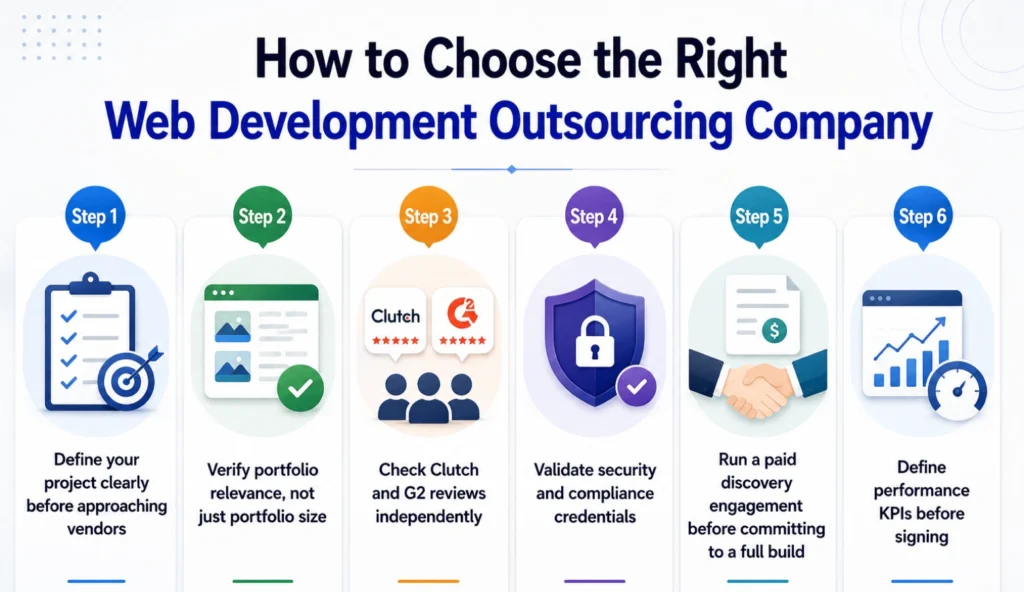
How to Choose the Right Web Development Outsourcing Company
Step 1 - Define your project clearly before approaching vendors
Know what you need to build, who will use it, what systems it integrates with, and what your timeline and budget constraints are. A web development outsourcing company cannot price or scope a project they do not understand, and a vague brief produces a vague estimate.
Step 2 - Verify portfolio relevance, not just portfolio size
A vendor with 200 delivered projects is only relevant if some of those projects resemble yours. Web application development outsourcing for manufacturing companies is fundamentally different from consumer e-commerce builds or marketing website projects.
Step 3 - Check Clutch and G2 reviews independently
Read reviews on independent platforms where clients cannot be filtered or curated by the vendor. Look specifically at reviews from clients in your industry or with similar project types.
Step 4 - Validate security and compliance credentials
For enterprise or regulated projects, ask for ISO 27001 or SOC 2 certification, a documented data handling policy, and references from clients with similar compliance requirements under HIPAA, FDA, or SOX.
Step 5 - Run a paid discovery engagement before committing to a full build
A short, paid discovery phase – requirements gathering, architecture planning, technology recommendations – reveals how a vendor thinks, communicates, and manages complexity before you commit significant budget to a full contract.
Step 6 - Define performance KPIs before signing
Agree upfront on how performance will be measured: sprint velocity, defect rate, code review turnaround, incident response time, and monthly uptime for managed services. Vendors that resist specific KPIs plan to be measured subjectively.

When Should You NOT Outsource Web Development?
Most guides focus exclusively on why you should outsource. Honest guidance includes the situations where it is the wrong decision.
Do not outsource when the project requires deep proprietary business knowledge.
If the web application requires someone to understand a decade of accumulated business logic, internal process nuance, and undocumented system behavior, an external team will struggle without a significant discovery and documentation investment upfront. Internal teams that already carry this knowledge often deliver better outcomes.
Do not outsource when real-time collaboration is non-negotiable and you cannot manage an offshore model
Offshore web development outsourcing requires disciplined async communication, detailed documentation, and structured review processes. Organizations that lack the internal project management capacity to run that kind of relationship often find that cost savings are consumed by rework and miscommunication.
Do not outsource when IP and data residency obligations require strict control
For projects involving highly sensitive personal data, regulated health records, or proprietary processes that are genuine competitive advantages, the due diligence required to outsource safely is significant. If your legal and compliance team cannot get comfortable with the vendor’s data handling practices, the risk outweighs the cost savings.
Do not outsource a project you cannot specify clearly
If you do not yet know what you want to build – the features, the users, the business rules, the integrations – a vendor cannot give you a reliable timeline or cost estimate. You will spend the first months resolving scope ambiguity that should have been resolved before contracting.
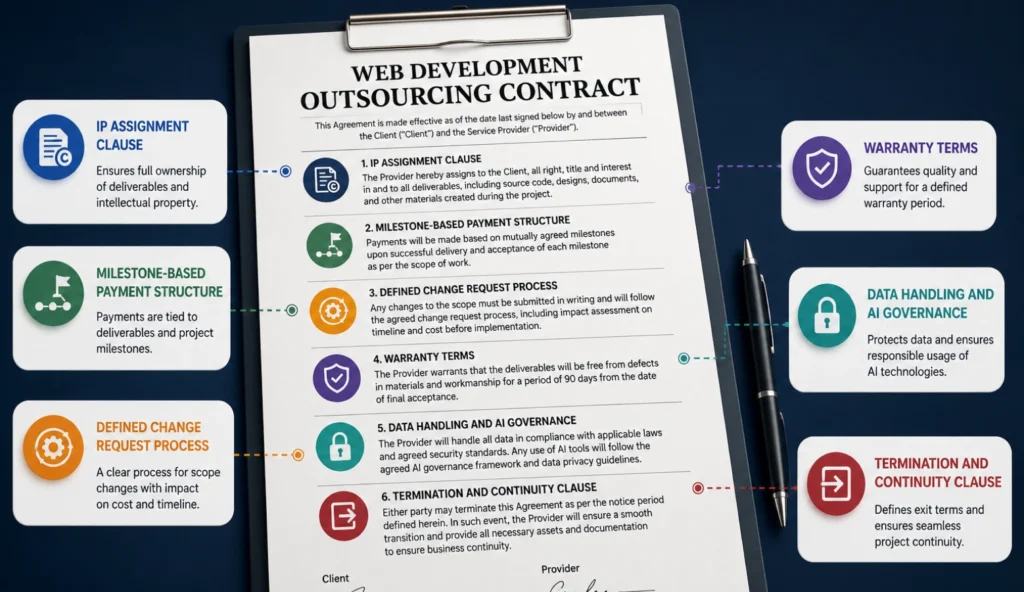
What Should a Web Development Outsourcing Contract Include?
A contract with any web development outsourcing company should include these non-negotiable elements. If any are missing or vague, treat it as a warning sign.
IP assignment clause
Who owns the code after delivery? The answer must be you, unambiguously, with no licensing restrictions. Code ownership must transfer to the client at every milestone, not only at final delivery. Always version-control on a repository you own, not the vendor’s.
Milestone-based payment structure
Payments should tie to delivered work, not calendar dates. A standard structure might be 25% upfront, 50% at development completion, and 25% after launch approval. Never pay a large upfront sum before any work is delivered.
Defined change request process
How are scope changes handled? What is the approval workflow? What are the cost implications? Get this documented before you need it. Every web development outsourcing project encounters scope questions – having a pre-agreed process determines whether they become disputes or managed decisions.
Warranty terms
What is covered after launch? For how long? What qualifies as a bug versus a new feature request? Leading web development outsourcing companies provide at minimum 30 days of post-launch bug fixing within the original scope at no additional cost.
Data handling and AI governance
Explicit prohibition on using client code or data in public AI tools. Defined data residency and access controls. Security incident notification timeframes.
Termination and continuity clause
What happens if either party needs to exit the engagement? Who owns work in progress? How is the handover managed? This clause protects both sides and signals a mature vendor relationship.

Web Application Development Outsourcing for Enterprise Environments
General web development outsourcing guides focus on marketing websites and e-commerce builds. Web application development outsourcing for enterprise organizations is a fundamentally different discipline – and one where most generalist agencies are not equipped to deliver.
Enterprise web application development outsourcing typically involves:
- Custom portals and dashboards connected to live ERP systems (SAP, Oracle, Dynamics)
- Multi-user role management and authorization hierarchies mirroring the parent enterprise system
- Compliance-aware data handling under HIPAA, FDA, SOX, or industry-specific regulatory frameworks
- Real-time data exchange with backend systems via REST APIs, OData services, or middleware platforms
- Security architecture aligned with enterprise IT policies, not general-purpose web hosting defaults
Building a React frontend connected to an SAP backend via REST APIs is not a generic outsourcing web development project. It requires developers who understand both the web technology stack and the data structures, authorization objects, and business rules of the underlying SAP system. An outsourcing developer who has never worked in an SAP environment will spend the first weeks learning what a specialist would already know – at your cost.
Web application development outsourcing for enterprises demands a vendor selection process that goes beyond reviewing website portfolios and checking Clutch scores. It requires verifying hands-on experience with enterprise integration architectures, compliance environments, and the specific business context your industry operates in.
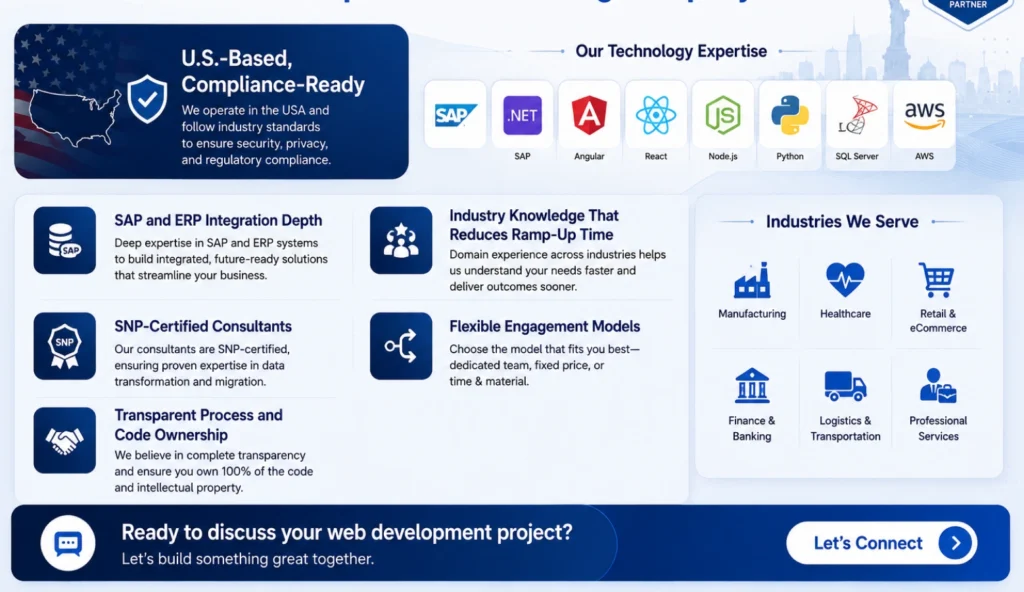
Why Choose SPV Consulting as Your Web Development Outsourcing Company in USA?
SPV Consulting is a U.S.-based web development outsourcing company in USA, headquartered in Plano, Texas, serving manufacturing, pharmaceutical, and food and beverage companies that need web development done right the first time – by outsourcing developers who understand both the technology and the business context it operates in.
U.S.-Based, Compliance-Ready
As a web development outsourcing company in USA, SPV Consulting operates under U.S. law, with no data residency ambiguity, no offshore time zone gaps, and no uncertainty about which legal framework governs your engagement. For enterprise clients with HIPAA, FDA, or SOX obligations, that matters.
SAP and ERP Integration Depth
Most web development outsourcing companies build web applications. SPV Consulting builds web applications that connect to the systems your business runs on. SPV’s outsourcing developers have hands-on experience with SAP S/4HANA and SAP ECC integration – OData service configuration, REST API layers, SAP authorization object mapping, and secure data exchange between web frontends and live SAP backends — the same integration discipline covered in our SAP data migration guide. Web application development outsourcing with SAP integration is SPV’s core capability, not a peripheral offering.
Industry Knowledge That Reduces Ramp-Up Time
Generic outsourcing web development partners spend the first weeks of a project learning your industry. SPV Consulting’s team already understands discrete manufacturing production planning, pharmaceutical batch traceability, food and beverage lot management, and the compliance frameworks that govern digital systems in regulated environments. That industry knowledge translates into faster delivery, fewer requirement misunderstandings, and web applications that reflect how your business actually operates.
SNP-Certified Consultants
SPV Consulting’s team includes SNP-certified consultants – a credential earned through demonstrated SAP delivery competency. For web application development outsourcing projects that touch SAP systems, this certification level means the people building your integration layer have verified technical depth.
Flexible Engagement Models
SPV Consulting offers web development outsourcing across three engagement models matched to what your situation actually requires: project-based delivery for defined builds, staff augmentation for clients that need to add outsourcing developers with specific skills to an existing internal team, and ongoing managed services for post-launch maintenance, security, and continuous improvement.
Transparent Process and Code Ownership
Every SPV Consulting web development outsourcing engagement starts with a structured requirements and scoping phase before any code is written. Scope, timeline, milestones, and KPIs are agreed in writing before the project begins. Code ownership transfers to the client at every milestone. Change requests follow a defined process with pre-agreed rates.
Ready to discuss your web development project? Contact SPV Consulting to start the conversation about what outsourcing web development looks like for your enterprise environment.
min read
TOPICS
- What Is the Difference Between Web Development Outsourcing, Staff Augmentation, and Managed Services?
- What Types of Web Development Work Are Outsourced?
- The "Missing Middle" Problem
- Pros and Cons of Outsourcing Web Development
- Why Do Companies Choose to Outsource Web Development? The Real Drivers
- Web Development Outsourcing Models:
- Engagement Models
- What Factors Determine the Cost of Web Development Outsourcing?
- What Questions Should You Ask When Outsourcing Web Development?
- Red Flags to Watch for When Choosing a Web Development Outsourcing Company
- How to Choose the Right Web Development Outsourcing Company
- When Should You NOT Outsource Web Development?
- What Should a Web Development Outsourcing Contract Include?
- Web Application Development Outsourcing for Enterprise Environments
- Why Choose SPV Consulting as Your Web Development Outsourcing Company in USA?
Frequently Asked Questions
What is web development outsourcing?
Web development outsourcing is the practice of hiring an external company or team to design, build, maintain, or improve a website or web application rather than using in-house developers. The web development outsourcing company provides the technical talent, delivery process, and project infrastructure.
What is the difference between outsourcing web development and staff augmentation?
Outsourcing web development means handing a defined project to a vendor who owns delivery end-to-end. Staff augmentation means adding outsourcing developers to your existing team, which you continue to manage directly. The key difference is who manages the outsourcing developers day-to-day.
How much does it cost to outsource web development?
Cost depends on geography, seniority, engagement model, and how clearly the scope is defined. U.S.-based web development outsourcing companies carry the highest rates but offer the strongest compliance posture and easiest collaboration. Offshore outsourcing developers in markets like India offer the lowest rates at the cost of larger time zone gaps and more intensive communication management. The most reliable way to get an accurate cost for your specific project is to start with a paid discovery and scoping engagement before committing to a full build contract.
What are the most important questions to ask when outsourcing web development?
The most important questions to ask when outsourcing web development cover five areas: who owns the code at each milestone, how scope changes are handled and priced, what the vendor’s AI governance policy is for outsourcing developers, what security certifications the web development outsourcing company holds, and what is covered under the post-launch warranty.
What is web application development outsourcing?
Web application development outsourcing refers specifically to outsourcing the design and build of custom web applications – dashboards, portals, SaaS tools, or business-specific platforms – rather than general marketing websites. Web application development outsourcing is more complex than website builds because it involves custom business logic, backend integration, multi-user authorization, and compliance requirements that simple websites do not.
Is it safe to outsource web development for enterprise projects involving ERP data?
Yes, with the right vendor and contract. Look for a web development outsourcing company in USA with verifiable enterprise integration experience, ISO 27001 or SOC 2 certification, a documented AI governance policy covering how outsourcing developers use AI tools, and explicit IP assignment in the contract.
What is the difference between onshore, nearshore, and offshore outsourcing web development?
Onshore means working with a web development outsourcing company in the same country (highest cost, easiest collaboration). Nearshore means working with outsourcing developers in a geographically close country (moderate cost, manageable time zone overlap). Offshore means working with outsourcing developers in a distant country (lowest cost, largest time zone and communication management requirements).
When should a company not outsource web development?
Outsourcing web development is not the right choice when the project requires deep proprietary business knowledge an external team cannot quickly acquire, when real-time collaboration is essential but an offshore model cannot be managed effectively, when IP and data residency obligations make external access too risky, or when the project scope is not yet clearly enough defined to write a contract against.