
Top Healthcare IT Recruitment: What to Look For and How to Choose
Healthcare IT recruitment is one of the most specialized and high-stakes talent functions in the modern workforce. Finding the top healthcare IT recruiter determines whether a hospital system goes live on a new EHR platform on schedule, whether a health insurer builds the analytics infrastructure it needs to manage outcomes, or whether a pharmaceutical organization maintains the IT compliance posture its regulatory environment requires.
The challenge is that the top healthcare IT recruiter sits at the intersection of two demanding disciplines: deep healthcare industry knowledge and deep technology expertise. Most IT staffing firms understand one without the other. The growing demand for clinical data engineers, health informatics professionals, and healthcare data analysts reflects the increasing importance of data analytics services in helping healthcare organizations manage outcomes, population health, operational performance, and data-driven decision-making.

What Is Healthcare IT Recruitment?
Healthcare IT recruitment is the specialized process of sourcing, vetting and placing technology professionals in healthcare organizations – including hospitals, health systems, health insurers, pharmaceutical companies, medical device manufacturers, and healthcare software vendors.
Healthcare IT recruitment covers the full range of technology roles that modern healthcare organizations require: EHR implementation specialists, cybersecurity engineers, clinical data analysts, health informatics professionals, cloud infrastructure engineers, and professionals supporting AI and ML initiatives, along with interoperability specialists and IT compliance and privacy officers.
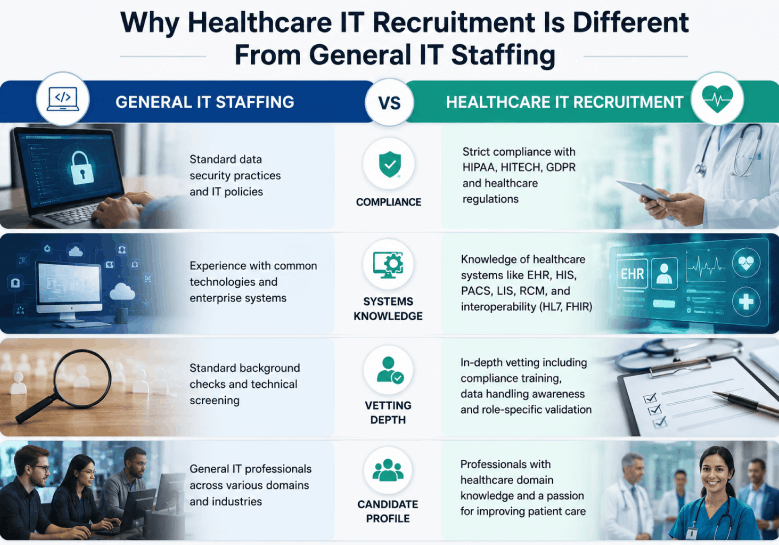
Why Healthcare IT Recruitment Is Different From General IT Staffing
Understanding what makes healthcare recruitment strategies distinct from broader IT staffing services is the first step in knowing what to demand from a recruitment partner.
Regulatory and compliance depth
Healthcare IT professionals work within a compliance environment that general IT candidates may not know exists. HIPAA (Health Insurance Portability and Accountability Act) governs the handling of protected health information.
The Joint Commission sets standards for healthcare technology environments. FDA 21 CFR Part 11 applies to electronic records in pharmaceutical organizations. HL7 and FHIR standards govern health data interoperability. A top healthcare IT recruiter must screen candidates for awareness of and experience within these frameworks – not just for technical certifications.
Clinical workflow understanding
The best healthcare IT hires understand how clinicians work, how compliance influences decisions, and how technology must support patient care without disrupting clinical processes.
An EHR implementation specialist who has never worked in a clinical setting will struggle to build user adoption in the way that someone who understands nursing workflows, physician documentation habits, and patient safety protocols will succeed.
System-specific expertise
Healthcare IT recruitment requires familiarity with the core systems that power modern healthcare organizations. Epic, Cerner, Meditech, and Allscripts dominate the EHR market. Workday and Oracle are common for HR and financial systems in large health systems.
SAP is used extensively by pharmaceutical manufacturers, health insurers, and integrated delivery networks for finance, supply chain, and operations. A healthcare IT recruiter who cannot screen meaningfully for these platforms is not equipped for the role.
Security clearance and background verification standards
Healthcare IT recruitment involves vetting candidates against a higher standard than general IT hiring. Criminal background checks, OIG exclusion list checks, drug screening, and employment verification are baseline requirements.
For roles with access to protected health information, additional screening and access certification processes apply.
Speed combined with precision
Healthcare organizations cannot wait. A gap in EHR support staff affects clinical operations directly. This recruitment specialty must combine the vetting discipline of specialized technical screening with the delivery speed that keeps critical systems running.

The State of Healthcare IT Talent: Why Recruitment Has Become Critical
The healthcare IT talent market is structurally undersupplied against growing demand. Several converging forces make specialized healthcare IT talent acquisition more critical now than at any previous point.
According to the Bureau of Labor Statistics, employment of health information technologists is projected to grow 15% from 2024 to 2034 – a rate classified as “much faster than the average for all occupations.” The pipeline of qualified candidates is not growing at the same pace.
According to IBM’s Cost of a Data Breach Report, the healthcare industry has experienced the highest average cost of a data breach for more than a decade.The organizational response to this sustained breach risk is sustained investment in cybersecurity talent – one of the most competitive and hardest-to-source categories within healthcare IT staffing.
At the same time, the shift to value-based care, AI-driven diagnostics, remote patient monitoring, and population health management is expanding the technical scope of what healthcare organizations need.
IT recruitment in healthcare is no longer primarily about maintaining EHR infrastructure. It is about building intelligent, interoperable, secure systems that improve outcomes while protecting sensitive patient data.
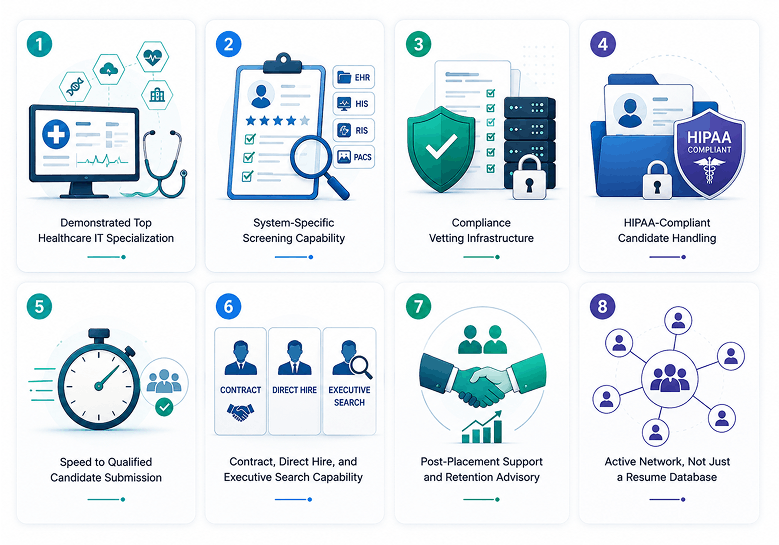
What to Look For in a Top Healthcare IT Recruiter
Not every firm that calls itself a top healthcare IT recruiter delivers the same quality of outcome. These eight criteria separate specialist this discipline partners from generalist staffing firms rebranding their technology practice.
1.
Demonstrated Top Healthcare IT Specialization
Ask for evidence of healthcare IT placements, not healthcare placements generally and not IT placements generally. A firm that places nurses and a firm that places network engineers are not healthcare IT recruiters.
Organizations hiring across multiple technical disciplines may also benefit from working with a partner that provides broader IT recruitment services, while still maintaining the specialized healthcare IT screening expertise these roles require.
Ask for case studies or anonymized examples of placements in healthcare IT specifically. If a firm cannot produce them, their healthcare IT talent sourcing practice is in name only.
2.
System-Specific Screening Capability
The recruiter you choose should be able to screen candidates meaningfully for the specific systems your organization runs. If you are on Epic, your healthcare IT recruiter should know what Epic certification levels exist, what the difference between a build analyst and a go-live support specialist is, and how to evaluate a candidate’s Epic project history.
If your organization runs SAP for finance, supply chain, or HR alongside your clinical systems, your recruiter should be equally capable of screening for SAP-specific experience. Organizations that run both clinical and enterprise ERP systems need a IT staffing in healthcare partner with depth in both landscapes.
3.
Compliance Vetting Infrastructure
Healthcare IT hiring requires a structured compliance vetting process, not just a standard background check. Your recruitment partner should conduct: criminal background checks, OIG (Office of Inspector General) exclusion list screening, drug testing where applicable, employment and credential verification, and reference checks from healthcare-specific prior employers.
For roles with access to protected health information, ask specifically what steps the recruiter takes to verify that candidates understand and have practiced HIPAA obligations. A candidate who has technically worked in healthcare but never been trained on PHI handling is a compliance risk the recruitment process should surface.
4.
HIPAA-Compliant Candidate Handling
The healthcare IT recruitment process itself involves handling candidate data. Your healthcare technology staffing partner should operate under a HIPAA-compliant data management framework when handling any information that could be connected to patient or clinical contexts. Ask for their data handling policy and how they manage candidate information securely.
5.
Speed to Qualified Candidate Submission
Healthcare organizations cannot absorb long vacancies in IT roles that support clinical operations. Ask every prospective healthcare IT recruiter for their median time from requisition intake to first qualified candidate submission, measured from the previous quarter. Leading this recruitment specialty firms typically deliver first submissions within 7 to 14 days for contract roles. If a firm cannot give you a specific number based on actual performance data, they are measuring themselves subjectively.
6.
Contract, Direct Hire, and Executive Search Capability
Healthcare IT talent acquisition needs vary by role seniority, urgency, and budget. The right partner offers flexible engagement models: contract staffing for project-based or interim coverage needs, direct hire for permanent headcount, and executive search for CISO, CIO, VP of IT, and Director-level healthcare technology leadership.
A single-model firm – one that only does direct hire, or only places contractors – will push your requirements into a model that fits their practice, not your need.
7.
Post-Placement Support and Retention Advisory
Hiring great healthcare IT talent is only half the battle. Retaining them is the other. With demand for skilled professionals outpacing supply, IT talent has options.
A healthcare IT recruiter that disappears after placement is not a recruitment partner. The best healthcare IT staffing firms provide post-placement support: checking in with both client and candidate in the first 30, 60, and 90 days, flagging early signs of fit issues, and advising on the retention factors that matter most to healthcare IT professionals – professional development, mission alignment, work-life balance, and visible career growth.
8.
Active Network, Not Just a Resume Database
IT recruitment in healthcare at the highest level requires access to passive candidates – the experienced EHR architects, cybersecurity engineers, and health informatics specialists who are not actively job searching but who would move for the right opportunity.
An healthcare IT recruiter with only a resume database is fishing in the same pond as your internal HR team. A recruiter with an active, maintained network in healthcare IT can reach the candidates who never post to job boards.
Top Healthcare IT Roles Being Recruited Right Now
Understanding which roles are most in demand sharpens what you should expect from your healthcare technology recruitment partner in terms of candidate sourcing depth and specialization.
EHR Implementation and Optimization Specialists
Epic, Cerner, and Meditech certified specialists remain among the most consistently demanded healthcare IT roles .Organizations moving from legacy systems, implementing new modules, or optimizing existing EHR performance need certified professionals who understand both the technical configuration and the clinical workflow implications.
Healthcare Cybersecurity Engineers and Analysts
With healthcare maintaining the highest average data breach cost across all industries, cybersecurity is the fastest-growing category within this discipline. Roles include security operations center analysts, penetration testers, cloud security architects, and HIPAA security officers.
Clinical Data Analysts and Health Informatics Specialists
Clinical analysts transform patient data into meaningful insights that allow for data-driven decision-making. Backed by evidence, this role identifies trends in patient outcomes and optimizes treatment plans that enhance healthcare operations.
Healthcare IT talent sourcing for these roles requires screening for both technical data skills and clinical context understanding.
Healthcare Data Engineers
Data engineers manage and analyze data closely,focusing primarily on developing and implementing health information systems that ensure the quality of the data is accurate and is being secured properly to improve the patient experience.
Healthcare data engineering roles sit at the intersection of cloud infrastructure, data pipeline management, and healthcare data standards including HL7 and FHIR.
Interoperability and Integration Specialists
As healthcare organizations build connected ecosystems of clinical, operational, and financial systems, the demand for professionals who can design and implement HL7 FHIR-based integrations, API connections, and middleware solutions between disparate platforms has grown significantly.
AI and Machine Learning Engineers in Healthcare
Emerging roles in AI-driven product development, such as AI and Automation Specialists and Data Analysts, are reshaping healthcare staffing dynamics. IT staffing in healthcare for AI roles requires screening for both the technical ML engineering skillset and an understanding of the FDA regulatory requirements that apply to AI-based clinical decision support tools.
Healthcare IT Systems Analysts
A systems analyst develops, implements, and maintains healthcare IT systems that improve the efficiency of healthcare operations, working closely with machine learning models and AI to provide the latest technology that improves patient care outcomes and administrative operations.
IT Compliance and Privacy Officers
HIPAA privacy officers, information security compliance managers, and healthcare regulatory affairs technology specialists are consistently in demand as healthcare organizations face growing regulatory scrutiny of their technology environments.
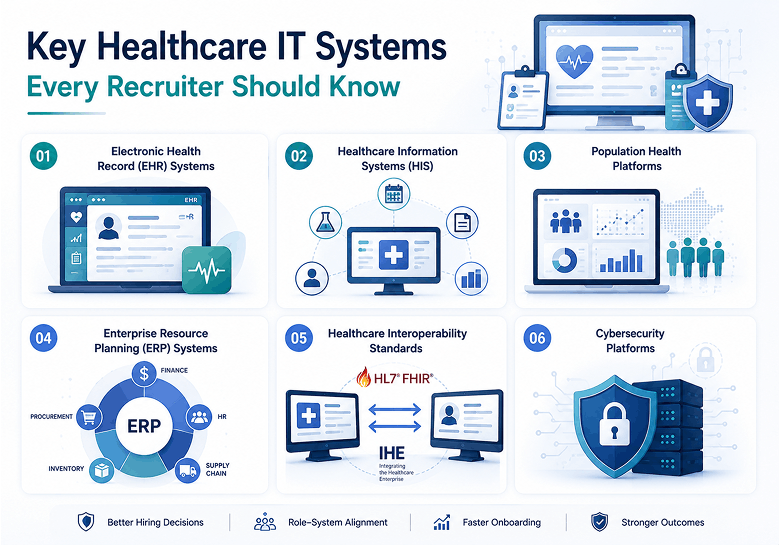
Key Healthcare IT Systems Every Recruiter Should Know
A healthcare IT recruitment partner that cannot speak knowledgeably about the following systems is not equipped to screen candidates who will be working with them.
Electronic Health Record (EHR) Systems
Epic, Cerner (Oracle Health), Meditech, Allscripts, eClinicalWorks. Each platform has its own certification structure, configuration specializations, and go-live methodology. EHR expertise is not transferable across platforms without meaningful retraining.
Healthcare Information Systems (HIS)
Hospital information systems covering admissions, discharge, and transfer; patient billing; laboratory information management; and pharmacy management systems.
Population Health Platforms
Tools for managing patient panels, identifying high-risk patients, and measuring quality metrics against value-based care contracts.
Enterprise Resource Planning (ERP) Systems
Large health systems and pharmaceutical organizations run SAP, Oracle, or Workday for finance, supply chain, HR, and operational management alongside their clinical systems. Healthcare technology staffing for organizations that run SAP requires a recruitment partner with ERP depth as well as clinical system knowledge.
Healthcare Interoperability Standards
HL7 v2, HL7 FHIR (Fast Healthcare Interoperability Resources), DICOM for medical imaging, and CCD/CCDA for clinical document exchange. These are technical requirements that this recruitment specialty screening must verify.
Cybersecurity Platforms
SIEM (Security Information and Event Management) systems, endpoint detection and response tools, identity and access management platforms, and encryption and data loss prevention solutions configured for HIPAA-compliant healthcare environments.
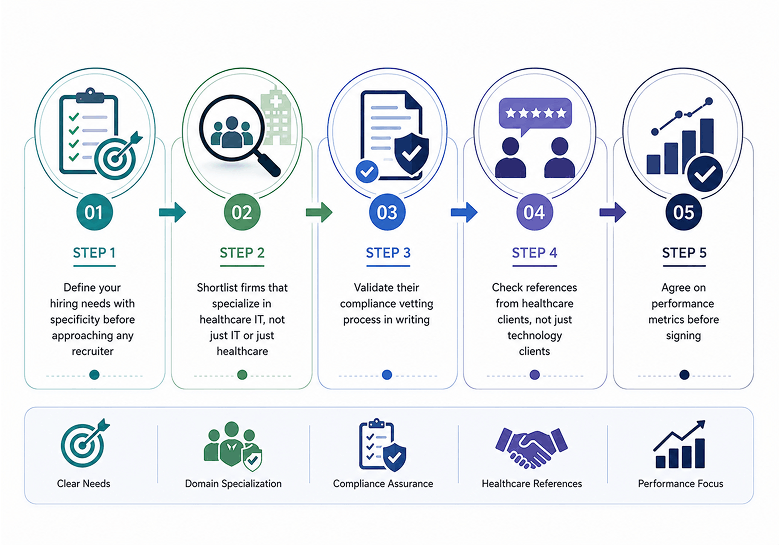
How to Choose the Right Healthcare IT talent acquisition Partner: A Decision Framework
Step 1: Define your hiring needs with specificity before approaching any recruiter
Know the specific systems your candidates need experience with, the seniority levels you are hiring at, whether you need contractors or permanent staff, your timeline, and the compliance and access requirements for each role. Vague briefs produce vague candidates.
Step 2: Shortlist firms that specialize in healthcare IT, not just IT or just healthcare
Run three separate checks: ask for healthcare IT placements specifically, ask for the number of active healthcare IT candidates in their network, and ask what healthcare systems their recruiters are personally experienced in screening for.
Step 3: Validate their compliance vetting process in writing
Ask for their standard background check and compliance verification documentation. Ask specifically how they handle OIG exclusion screening and HIPAA training verification. The answer tells you whether their compliance process is real or marketing language.
Step 4: Check references from healthcare clients, not just technology clients
A firm that has placed successfully in manufacturing IT or financial services IT is not the same as a firm that has placed in health systems, health insurers, or pharmaceutical IT environments.
Step 5: Agree on performance metrics before signing
Time to first qualified candidate submission, interview-to-offer ratio, 90-day retention rate, and replacement policy for failed placements should all be defined in writing before engagement begins.
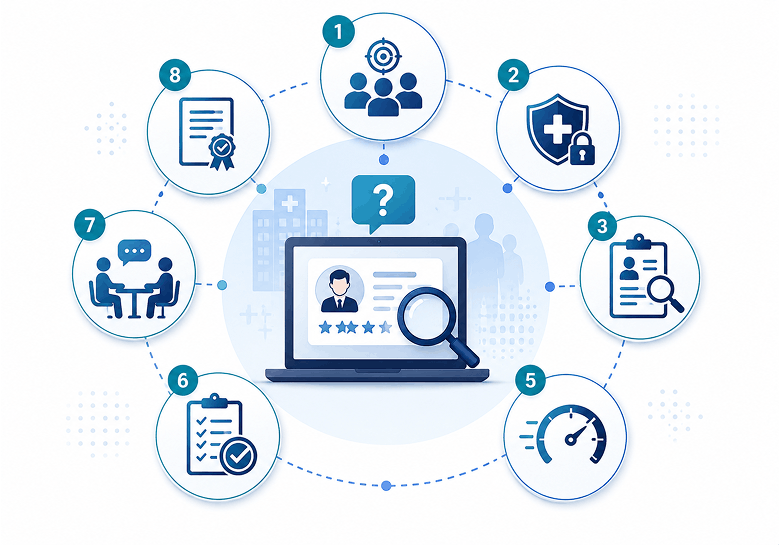
Questions to Ask a Healthcare IT Recruiter Before You Hire Them
These questions will quickly reveal whether a IT recruitment in healthcare partner has genuine depth or is positioning a general IT staffing practice with healthcare branding.
- How many healthcare IT placements have you made in the last 12 months?
- Which healthcare IT roles and systems do you recruit for most frequently?
- How do you verify a candidate’s HIPAA training and compliance history?
- How do you screen and validate Epic or Cerner certifications?
- What specific questions do you ask to assess EHR implementation and support experience?
- What is your process for OIG exclusion list screening?
- At what stage of the recruitment process do you perform OIG checks?
- Do you recruit for both EHR-focused healthcare IT roles and healthcare ERP positions?
- Which healthcare ERP platforms (e.g., Workday, Oracle, SAP) do you support?
- What is your 90-day placement retention rate for healthcare IT hires?
- Do you offer a replacement guarantee if a candidate leaves within the first 90 days?
- What is included in your replacement or refund policy?
- How do you source passive healthcare IT candidates who are not actively job hunting?
- What channels and networks do you use to find specialized healthcare IT talent?
- How do you assess both technical expertise and healthcare domain knowledge?
- How quickly can you present qualified healthcare IT candidates for critical roles?
- What is your average time-to-fill for healthcare IT positions?
- Can you provide examples or case studies of successful healthcare IT placements?
- How do you stay current with evolving healthcare regulations, EHR technologies, and industry trends?
- What makes your healthcare IT recruitment process different from a general IT staffing agency?
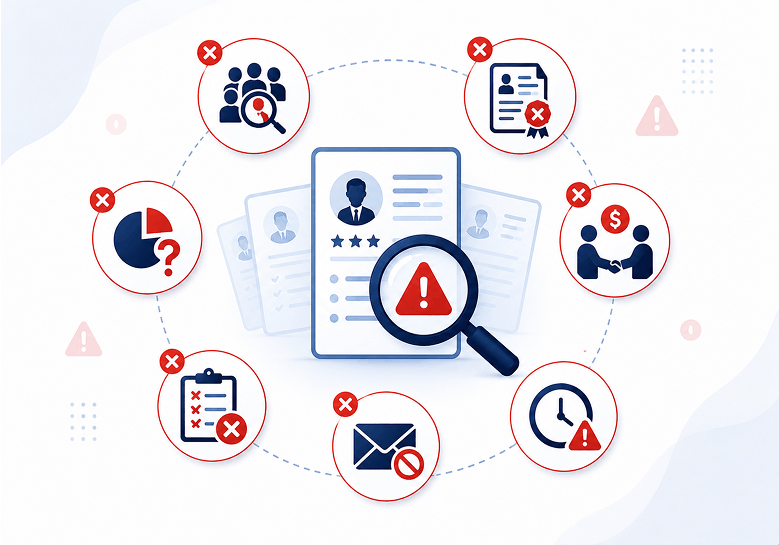
Red Flags in Healthcare technology recruitment
Cannot differentiate between healthcare IT and clinical recruitment
A firm that describes its healthcare practice in terms of nurses, physicians, and allied health without mentioning IT systems, cybersecurity, or data roles is not a healthcare IT recruiter.
No healthcare system-specific screening process
A recruiter who screens for “healthcare experience” without distinguishing between Epic-certified analysts, Cerner build specialists, and HL7 integration developers does not have the technical depth the role requires.
No documented OIG exclusion screening
Any this discipline partner that cannot explain their OIG exclusion list screening process should not be placing candidates in healthcare environments. This is a baseline compliance requirement that reflects how seriously the firm takes the regulatory environment.
Weak passive candidate network
If a healthcare IT recruiter’s sourcing strategy begins and ends with posting to job boards,.they are accessing the same pool of candidates your internal recruitment team can reach. The value of a specialist recruiter is access to the professionals who are not actively looking.
Promising unrealistic timelines without qualification
Healthcare IT talent sourcing for specialist roles takes time when done properly. A recruiter who promises to fill a certified Epic build analyst position in 48 hours without understanding your requirements is either working with unvetted candidates or overstating their pipeline.
No post-placement process
A IT staffing in healthcare firm that does not have a structured post-placement follow-up process has optimized for placement fees, not for long-term client outcomes.Healthcare IT retention is as important as placement – and the right partner is invested in both.
How SPV Consulting Approaches Healthcare IT Recruitment for Pharma and Enterprise Health Organizations
SPV Consulting brings enterprise technology staffing expertise to healthcare IT recruitment with a specific focus that most generalist staffing firms cannot match: the intersection of clinical system knowledge, pharmaceutical regulatory compliance, and enterprise ERP experience that large healthcare and pharma organizations require.
For pharmaceutical manufacturers, health insurers, and integrated delivery networks that run SAP alongside their clinical and operational systems, SPV Consulting’s SNP-certified SAP expertise means candidates are screened for both the regulated IT environment and the enterprise operational systems that govern finance, supply chain, HR, and compliance reporting.
IT Recruitment for Pharmaceutical Companies
Pharmaceutical companies represent one of SPV Consulting’s core verticals for IT staffing and healthcare IT recruitment. Pharma IT recruitment is one of the most demanding technology hiring environments in any industry. Every system that touches a regulated manufacturing process, a batch record, a clinical trial dataset, or a product submission must be validated under FDA 21 CFR Part 11, GAMP 5, and GxP principles.
IT professionals who have never worked in a validated pharmaceutical environment require significant onboarding before they can function independently. SPV Consulting’s pharmaceutical IT recruitment practice focuses specifically on candidates who already carry that regulated environment experience.
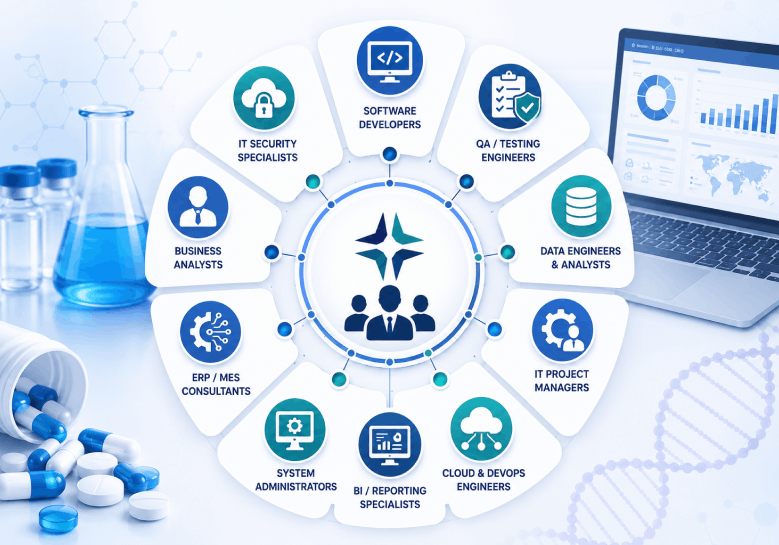
Roles SPV Consulting places in pharmaceutical organizations
SAP consultants and system administrators for pharma
Large pharmaceutical manufacturers run SAP for ERP operations covering production planning, materials management, quality management, regulatory affairs tracking, and financial reporting.
SAP S/4HANA implementations in pharma require consultants who understand both the technical configuration and the GxP compliance obligations that govern system changes in regulated environments.
Computer System Validation (CSV) specialists
Pharma IT recruitment for CSV specialists is one of the most consistently undersupplied categories in the talent market. CSV professionals design and execute validation protocols for IT systems that touch regulated pharmaceutical processes – from LIMS to MES to ERP platforms. SPV Consulting maintains active networks of experienced CSV specialists for both contract and permanent placements.
Regulatory affairs technology professionals
Pharmaceutical organizations submitting to FDA, EMA, and other regulatory bodies require IT professionals who understand electronic submission standards, eCTD systems, regulatory information management platforms, and the intersection of IT compliance and regulatory strategy.
Quality management system (QMS) administrators
IT professionals who implement, configure, and maintain QMS platforms in pharmaceutical environments need a specific combination of technical system knowledge and GxP awareness that general IT candidates do not carry.
Manufacturing execution system (MES) and LIMS specialists
Pharmaceutical manufacturing operations depend on MES and LIMS platforms that capture batch records, manage laboratory workflows, and provide the audit trails that regulatory inspections require. Healthcare IT recruitment for these roles requires screening for both system-specific experience and pharmaceutical manufacturing process understanding.
Cybersecurity and data integrity professionals in pharma
Data integrity is a regulatory requirement in pharmaceutical IT, not just a security best practice. IT professionals responsible for cybersecurity and data integrity in pharmaceutical environments must understand both the technical controls required and the regulatory documentation obligations that FDA inspections examine.
IT project managers for pharma implementations
Pharmaceutical IT projects – SAP implementations, ERP upgrades, MES deployments, CSV programs – require project managers who can manage both the technical delivery and the validation lifecycle simultaneously. General IT project managers without pharmaceutical experience consistently underestimate the compliance workload of regulated IT projects.

Healthcare Technology Staffing for Organizations Undergoing Digital Transformation
Health systems and pharmaceutical companies deploying new ERP systems, cloud infrastructure, data platforms, or AI capabilities need IT professionals who can navigate both the technical requirements and the compliance environment simultaneously.
SPV Consulting’s combined SAP and healthcare IT depth means clients do not need separate staffing partners for their clinical and enterprise IT needs.
Flexible Engagement Models for Healthcare and Pharma IT
SPV Consulting offers top healthcare IT recruitment across three engagement models matched to what the client situation requires: contract staffing for project-based or interim coverage, direct hire for permanent headcount, and project-based consulting for defined implementation or transformation programs.
min read
TOPICS
- What Is Healthcare IT Recruitment?
- Why Healthcare IT Recruitment Is Different From General IT Staffing
- The State of Healthcare IT Talent: Why Recruitment Has Become Critical
- What to Look For in a Top Healthcare IT Recruiter
- Top Healthcare IT Roles Being Recruited Right Now
- Key Healthcare IT Systems Every Recruiter Should Know
- How to Choose the Right Healthcare IT talent acquisition Partner: A Decision Framework
- Questions to Ask a Healthcare IT Recruiter Before You Hire Them
- Red Flags in Healthcare technology recruitment
- How SPV Consulting Approaches Healthcare IT Recruitment for Pharma and Enterprise Health Organizations
- Roles SPV Consulting places in pharmaceutical organizations
- Healthcare Technology Staffing for Organizations Undergoing Digital Transformation
Frequently Asked Questions
What is this discipline?
Healthcare IT talent sourcing is the specialized process of sourcing, vetting, and placing technology professionals in healthcare organizations – including hospitals, health systems, pharmaceutical companies, health insurers, and healthcare software vendors. IT staffing in healthcare covers roles ranging from EHR implementation specialists and cybersecurity engineers to clinical data analysts, health informatics professionals, and healthcare IT compliance officers.
What makes healthcare IT hiring different from general IT staffing?
Healthcare technology staffing requires screening candidates for compliance awareness (HIPAA, FDA, Joint Commission standards), system-specific expertise (Epic, Cerner, Meditech, SAP), clinical workflow understanding, and a background verification standard that includes OIG exclusion list screening. General IT staffing firms typically do not screen for these healthcare-specific requirements.
What should I look for in a top healthcare IT recruiter?
The top healthcare IT recruiters demonstrate verifiable healthcare IT placements in specific systems and roles, documented compliance vetting processes including OIG screening, system-specific candidate screening capability, access to passive candidate networks, flexible engagement models, and a post-placement retention advisory process.
How long does this recruitment specialty take?
Healthcare IT talent acquisition timelines vary by role complexity and specialization. Contract placements for defined roles typically see first qualified candidate submissions within 7 to 14 days from a specialist healthcare IT recruiter. Direct hire searches for specialist or senior roles typically run 4 to 8 weeks. Executive search for CISO, CIO, or VP of Healthcare IT roles typically runs 8 to 16 weeks.
What are the most in-demand healthcare IT roles right now?
The most in-demand roles in healthcare IT staffing currently include Epic and Cerner certified implementation and optimization specialists, healthcare cybersecurity engineers and analysts, clinical data analysts and health informatics specialists, HL7 FHIR interoperability engineers, healthcare data engineers, and AI and machine learning engineers with healthcare application experience.
What compliance requirements should a healthcare IT recruiter screen for?
At a minimum, IT recruitment in healthcare compliance screening should include HIPAA training and awareness verification, OIG exclusion list screening, criminal background checks, drug testing where applicable, employment and credential verification, and for roles involving access to protected health information, additional access and privacy training certification.
Do healthcare organizations need a recruiter that understands both clinical IT systems and ERP systems?
Yes, for many healthcare organizations. Large health systems, health insurers, and pharmaceutical companies operate both clinical IT systems (EHR, clinical data, population health platforms) and enterprise ERP systems (SAP, Oracle, Workday) simultaneously. A healthcare technology recruitment partner that only understands one side of this landscape cannot effectively recruit for the full range of IT roles these organizations require.
What is the cost of a poor healthcare IT hire?
Beyond the direct recruitment and replacement cost, a poor healthcare IT hire creates clinical risk (through EHR system errors or gaps in technical support), compliance risk (through improper handling of protected health information or missed regulatory requirements), and operational disruption that affects care delivery. The indirect cost of a failed healthcare IT placement consistently exceeds the direct fee cost by a significant multiple.